 Rafael Santos
Terlingua is the practical west side base for Big Bend because it puts a traveller minutes from the park’s Maverick Junction entrance with fuel, food and supplies concentrated in Study Butte at the Highway 118 and FM 170 junction, while the ghost town itself, its Chisos Mining Company ruins, the cemetery in use since the early 1900s and the Trading Company porch, supplies the evenings. Enter the park early through the west gate for Santa Elena Canyon and the Ross Maxwell Scenic Drive, return before dark, and let the ghost town’s dinner and porch hours do the work that a remote park lodge cannot.
Quick Facts
- Where: Terlingua, in southwestern Brewster County, Texas, between Study Butte to the east and Lajitas to the west, along FM 170 west of its junction with Highway 118.
- Park gate: The ghost town sits about eight miles from Big Bend National Park’s western entrance at Maverick Junction, with Study Butte at the junction itself.
- Park fee: Big Bend charges 30 dollars per private vehicle, 25 dollars per motorcycle and 15 dollars per person on foot or by bicycle, each valid for seven days, card only with no cash accepted, per the National Park Service.
- Park size: Big Bend protects 801,163 acres, per the National Park Service fact sheet, with Santa Elena Canyon and the Ross Maxwell Scenic Drive reached from the west side.
- Ghost town: The Chisos Mining Company quicksilver town, built on cinnabar mining from the mid 1880s, when the district’s population reached about 2,000; the cemetery, still in use, dates to 1903 in most local accounts and holds miners and victims of the 1918 to 1919 influenza epidemic.
- Supplies: Study Butte, at the 118 and 170 junction, is the fuel and general store stop; the next full services north are at Alpine, roughly 80 miles away.
Why does the west gate change a Big Bend trip?
Big Bend has two paved entrances, and they serve different parks in practice. The west entrance at Maverick Junction, reached from Study Butte, is the fast route to the Rio Grande corridor: Santa Elena Canyon, where the river exits between limestone walls up to 1,500 feet high, the Castolon Historic District and the Ross Maxwell Scenic Drive that connects them along the park’s western flank. Basing in Terlingua or Study Butte removes the long cross-park drive from Panther Junction that an east side or Basin base requires for those sights, and it makes a dawn start at Santa Elena, before heat and tour groups build, a realistic plan rather than a 5 a.m. alarm.
The fee and logistics are simple but strict. The National Park Service charges 30 dollars per private vehicle for seven days, payable by card only, and the park’s size means fuel planning matters more than ticket planning: fill up in Study Butte before entering, every day, because there is no margin for a low tank between the west gate, the canyon and the drive back. Travellers pairing the west side with the park’s other desert icons can plan the same early start discipline used for Saguaro National Park’s two districts near Tucson, where gate choice likewise decides the day.
What is the Trading Company porch, exactly?
The Terlingua Trading Company, the ghost town’s general store in the old company store building, fronts a long wooden porch that functions as the settlement’s town square. The routine is unwritten and easy to join: buy a drink inside, take a seat on the porch in the late afternoon, and watch the Chisos Mountains change colour while residents, river guides, park staff and travellers trade the day’s information, road conditions, river levels, which trailhead was empty, where music is happening that night. It is not a scheduled attraction and it does not perform; its value to a visitor is practical as much as social, because the porch is where a west side trip gets corrected in real time.
Next door, the Starlight Theatre, a 1930s movie theatre for the mining town, now operates as the area’s best known restaurant and saloon, opening in the evening on a first come basis in season, which is why the porch doubles as its waiting room. Dinner timing is the one reservation style decision in Terlingua: arrive near opening or expect to wait on the porch, which most visitors count as part of the evening rather than a cost.
How should the ghost town cemetery be visited?
The Terlingua Cemetery, downhill from the Trading Company, has been in use since the early years of the 1900s and is listed on the National Register of Historic Places. Its graves are mounded with stone and marked with wooden crosses and handmade memorials rather than polished headstones, and many of the earliest burials are miners and residents who died in the 1918 to 1919 influenza epidemic, which hit the isolated mining camp hard. It remains an active community cemetery, and on Dia de los Muertos, 2 November, families decorate graves with candles and offerings.
Visit late in the day, when the light is low over the desert and the heat has eased, walk the paths rather than between graves, photograph respectfully and leave every object where it lies. Combined with the ruins around it, the roofless stone and adobe walls of the Chisos Mining Company town, the Perry school and mansion ruins and St. Agnes Church, built in 1914 for mining families, the cemetery is what separates Terlingua from a themed stop: this was a company town of about 2,000 people at its peak, built to extract quicksilver, mercury, from cinnabar, and its remains are a working community’s inheritance, not a set.
What does Study Butte actually provide?
Study Butte, pronounced Stoodie, is the service junction a few miles east where Highway 118 meets FM 170 and the park road to Maverick Junction. This is where the west side’s fuel pumps, general store supplies, outfitters and much of its lodging sit, and the honest description is functional rather than picturesque: a traveller who stocks water, fuel, ice and food here can ignore logistics for days, while one who assumes Terlingua’s ghost town will supply everything will be driving back. The Cottonwood General Store on FM 170 towards Lajitas is the other recognised supply stop.
The distances enforce the discipline. Alpine, the nearest town with full services, supermarkets and a hospital, is roughly 80 miles north on Highway 118, and the park interior adds its own miles on top. Mobile signal is patchy to absent across the area, so downloads, maps, park alerts and reservations belong to the evening before, on lodging wifi, not the morning of a canyon day. The desert rules rhyme with those for White Sands, where heat and distance punish improvisation: in Big Bend country, the gateway town is not a photo stop before the real trip, it is the supply system that makes the real trip possible.
What about the River Road west and the second park?
Terlingua also faces west. FM 170, the River Road, runs from Study Butte through the ghost town and on to Lajitas and Presidio, following the Rio Grande along the edge of Big Bend Ranch State Park, the national park’s wilder state run neighbour. That gives a Terlingua base a second, different desert day without entering the national park at all: the River Road’s viewpoints, the Lajitas river access and the state park’s canyon trails sit within an easy drive, and the road itself, climbing and dropping along the river bluffs, is regularly counted among the great Texas drives. It is also the direction of the ghost town’s own calendar anchor, the annual chili cookoffs held behind the Trading Company in late autumn, which fill every lodging bed on the west side and should be checked before any fall booking. A base that works in both directions, national park east and River Road west, is why Terlingua holds travellers for three and four nights rather than the single overnight its size suggests.
Frequently Asked Questions
How far is Terlingua from Big Bend National Park?
About eight miles. The ghost town lies west of Study Butte on FM 170, and Study Butte sits at the junction with the park road to the Maverick Junction west entrance, so the drive from a Terlingua lodging to the gate takes roughly 15 to 20 minutes.
How much does Big Bend cost to enter?
The National Park Service charges 30 dollars per private vehicle, 25 dollars per motorcycle and 15 dollars per person on foot or by bicycle, each valid for seven days. Payment is by credit or debit card only; no cash is accepted.
Is the Terlingua Cemetery open to visitors?
Yes, it is an open, active community cemetery with no gate fee, in use since the early 1900s and listed on the National Register of Historic Places. Visit respectfully, stay on the paths, and leave offerings and grave objects untouched.
Where do visitors buy fuel and supplies on the west side?
In Study Butte, at the Highway 118 and FM 170 junction a few miles east of the ghost town, with the Cottonwood General Store further west on FM 170. Fill up before entering the park each day; the nearest full service town, Alpine, is roughly 80 miles north.
When is the best time of day for the ghost town?
Late afternoon into evening. The ruins and cemetery are best in low light after the desert heat eases, the Trading Company porch gathers before dinner, and the Starlight Theatre opens in the evening, so one unhurried visit covers all three.
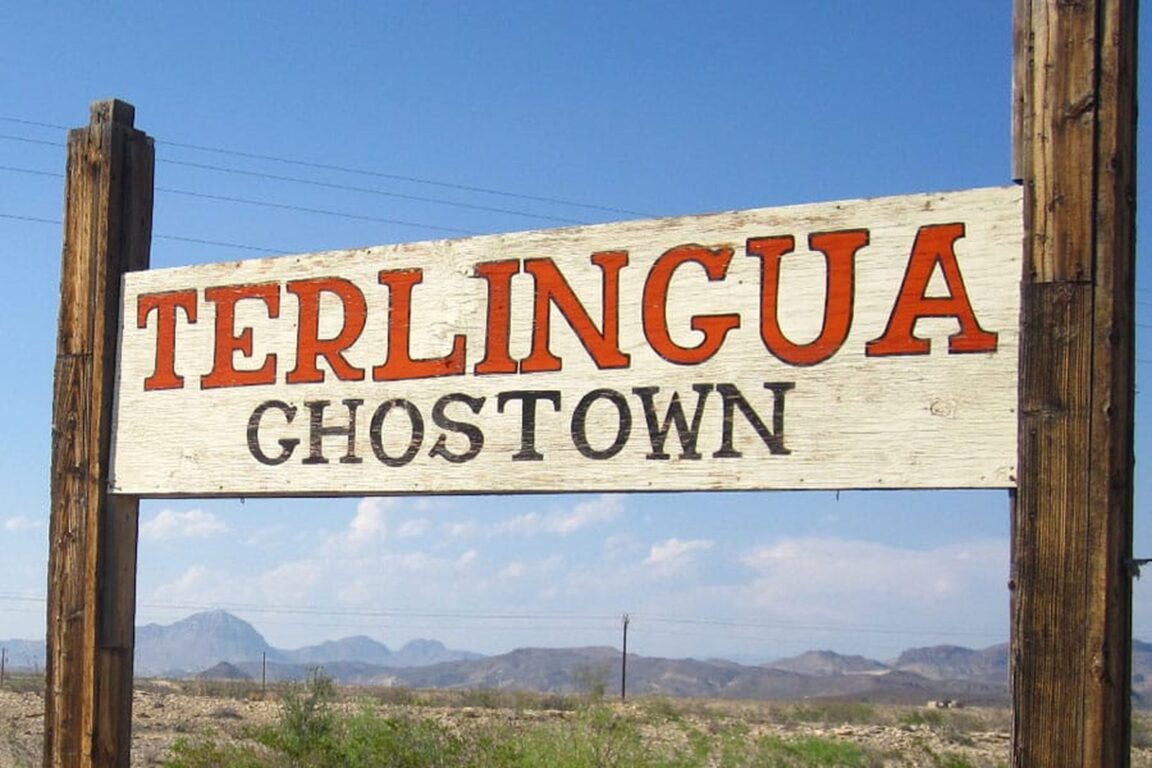
Photo: The Terlingua Ghostown entrance sign against the Chihuahuan Desert and the hills west of Big Bend. Credit: Visit Big Bend, via visitbigbend.com, the Big Bend region’s official visitor guide.