 River Callahan
Most White Sands mistakes happen before noon and look harmless: arriving at midday when the gypsum is at its most punishing, buying a sled that will not slide, and assuming the ranger Sunset Stroll can be booked like a tour. White Sands National Park in New Mexico protects 275 square miles of gypsum dunes, the largest gypsum dunefield on Earth, and it is a kind, forgiving landscape only if you respect three facts: there is no shade and no water beyond the visitor center, the white surface reflects heat and light back at you from below, and the park sits inside an active missile range that can close its only road. Avoid the errors below and a half day here becomes the easiest great desert day in the national park system. Make them, and the same dunes turn into a headache, sometimes literally.
Quick Facts
- Where: White Sands National Park, New Mexico, on US-70, 15 miles southwest of Alamogordo and about 50 minutes from Las Cruces
- Entrance fee: 25 dollars per private vehicle for seven days; interagency passes accepted; no entry reservation required
- The road in: Dunes Drive runs 8 miles into the dunefield, five paved and three over packed gypsum; allow about 45 minutes round trip before stops
- Park hours: Gates open at 7 a.m. and the park closes 30 minutes after sunset; the visitor center generally runs 9 a.m. to 5 p.m.; the park is closed on Thanksgiving and Christmas Day
- Sledding rule: Waxed plastic saucers work; wax the base and reapply often, ride seated or lying feet first, and never sled near the Interdune Boardwalk or across roads
- Sunset Stroll: Free ranger led walk on Friday, Saturday and Sunday, about half a mile over 45 minutes to one hour, no reservations required or permitted; cancelled during heat advisories
- Water rule: Carry at least one litre per person for the Sunset Stroll and far more for longer hikes; there is no water anywhere on Dunes Drive
- Facts checked: 22 November 2026, against nps.gov White Sands pages
Mistake one: treating midday like beach time
Gypsum looks like snow and behaves like a reflector oven. The dunes bounce sunlight upward, so you burn from angles a hat brim does not cover, and in summer the surface and air temperatures make long hikes genuinely dangerous; the park advises against starting hikes in serious heat and cancels its Sunset Stroll when a heat advisory is in force. The fix is scheduling, not toughness. Hike the longer trails, above all the 5 mile round trip Alkali Flat Trail, early in the morning. Keep the middle of the day for the short loops, the 1 mile Dune Life Nature Trail and the half mile Playa Trail, for the visitor center exhibits, and for a slow Dunes Drive with stops. Then return to the sand for the last two hours, when the light drops, the ridges throw shadows and the field turns pink and gold. In late November the equation softens, with daytime highs far below summer extremes, but the short day creates the opposite trap: sunset comes early, the park closes 30 minutes after it, and a late start leaves no margin.
Mistake two: bringing the wrong sled, or the right sled unwaxed
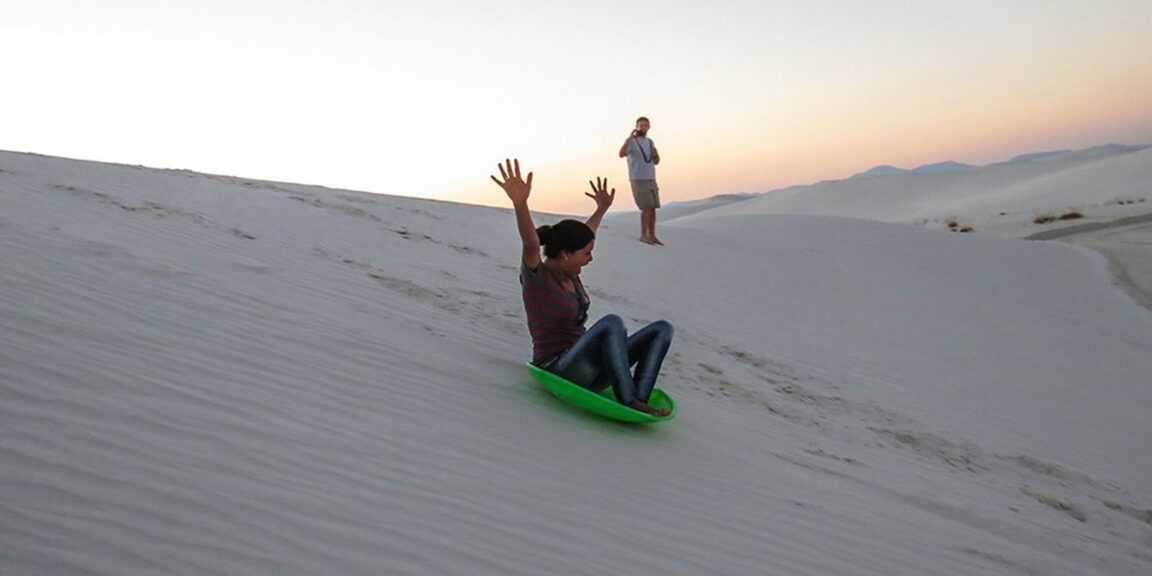
Sand is not slippery, and the National Park Service is blunt about it: sledding down a dune face takes the correct equipment and technique. The sled that works is a waxed plastic snow saucer. Cardboard, flat toboggans and inflatables mostly sit still or dig in. Wax is not optional garnish; it is the mechanism. Rub the wax over the saucer base before the first run and reapply it often, because gypsum strips wax far faster than snow does. Saucers and wax are sold and rented at the park gift shop by the visitor center, and buying there also buys local advice about which slopes are running well. Technique matters as much as kit: sit or lie on the sled with your feet pointing downhill, never stand, and never go head first, which the park specifically warns increases injury risk.
Choosing the slope is the third part of the sledding mistake. Pick a gently sloping face with a level run out at the bottom so you stop on flat ground, and look hard at where the soft dune sand meets the desert floor, because that base can be very hard and the park notes that unintentional injuries are surprisingly common. Your run must not cross the roadway or parking areas and must be clear of vegetation, hard clumps and other obstructions. Sledding is off limits around the Interdune Boardwalk trail. Children aged 5 to 9 are the most injury prone group, so adults should supervise closely and never let young children sled alone. Do all of that and the signature White Sands experience works exactly as advertised: a fast, soft, slightly ridiculous slide down a wave of white sand.
Mistake three: misunderstanding the Sunset Stroll booking window
Here is the misunderstanding to unlearn: there is no booking window for the Sunset Stroll, because there are no bookings. The National Park Service states that reservations are not required and not permitted. The stroll runs on Friday, Saturday and Sunday, as staffing and weather allow, timed to end at sunset, and you join it by being at the meeting point on time. That point is the Sunset Stroll parking area near the end of Dunes Drive, an 8 mile drive from the fee station, staying left at the intersection and stopping at the signed parking area on the left just past the Backcountry Camping Loop trailhead parking. The walk itself is a leisurely half mile over 45 minutes to one hour, crossing and climbing moderate dunes, and it is not wheelchair or stroller accessible. There are no toilets at the meeting area and no seating along the way.
So the real Sunset Stroll mistakes are timing and preparation. Arriving at the visitor center at stroll time leaves an 8 mile drive you have not budgeted. Wearing dark, heavy clothing works against the park advice to wear loose, light coloured clothing, and turning up without the litre of water per person the park specifies is the classic White Sands error in miniature. Check the park calendar or call the park on the day, because heat advisories cancel the program outright and schedules shift with the sunset through the year. For a sense of how ranger led timing shapes other park days, see our guide to the Smokies synchronous fireflies lottery and viewing rules, and for another desert park where the plan is built around one trailhead, our Kenai Fjords Exit Glacier costs and budget guide shows the same plan around the fixed point discipline applied to ice rather than sand.
Mistake four: ignoring the missile range and the closure list
White Sands is entirely surrounded by the White Sands Missile Range, and during tests Dunes Drive can close for up to three hours, with US-70 toward Las Cruces sometimes closing too. Notice can be as short as 24 hours. The visitor center and gift shop stay open during a test, which softens the blow, but a closure across your only morning or your drive to the airport is a trip level event. Check the park closure page the day before and again on the morning, and never build an unmissable commitment tight against a White Sands visit. Build the day with a flex block, a picnic, the gift shop, the visitor center film, that can absorb a closure without eating the dunes themselves.
Mistake five: walking out of sight of the trail markers
White Sands trails are not paths, they are routes marked by posts across open sand, and wind erases footprints with unsettling speed. The park rule is simple enough to memorise: if you cannot see the next marker, stop and turn back. The Alkali Flat Trail is the serious offender, 5 miles round trip with no shade, no water and no margin for a navigation error in heat, and it should be started early, with a full water carry, a hat, sunscreen applied to the undersides people forget, and a hard turnaround time. Sunglasses are not a style choice here; the glare off gypsum is closer to snow blindness than to a beach day. Tell the visitor center desk your plan if you are taking the long trail, and treat any dizziness or stopped sweating as an immediate retreat signal, not a challenge.
Frequently Asked Questions
Do I need to book the Sunset Stroll at White Sands?
No. Reservations are not required and not permitted. The free ranger led stroll runs on Friday, Saturday and Sunday, weather and staffing allowing, and you join by arriving at the Sunset Stroll parking area, 8 miles along Dunes Drive, before the published start time.
What kind of sled works at White Sands?
A plastic snow saucer with a waxed base. Wax it before the first run and reapply often. Saucers and wax are sold and rented at the park gift shop. Cardboard and flat sleds barely move on gypsum.
How much does White Sands cost to enter?
25 dollars per private vehicle for a seven day pass. Interagency passes such as America the Beautiful are accepted, and no separate entry reservation is required.
When does White Sands close each day?
The park opens at 7 a.m. and closes 30 minutes after sunset, so closing time moves with the season. The park is closed on Thanksgiving and Christmas Day, and Dunes Drive can close for up to three hours during missile tests.
Can I sled anywhere in the park?
Almost, with exceptions: not around the Interdune Boardwalk, never across roads or parking areas, and only on slopes with a clear, level run out. Ride seated or lying feet first, and never stand or go head first.
How much water should I carry?
At least one litre per person for the short Sunset Stroll, and substantially more for longer hikes such as Alkali Flat. There is no water available anywhere along Dunes Drive.