 Jonas Lindqvist
The Westfjords does hot pots the way it does everything, locally and without ceremony: three tubs on the shoreline at Drangsnes that the village uses all year, a farm pool under glass at Heydalur, and Hellulaug, a stone pool hidden below the road at the head of a fjord, where the rule is quiet and the entry fee is a coin in a canister. Driven in that order, south to north and back down the southern shore, they make the best possible thread through a region where the distances are long and the water is always the reward.
Quick Facts
- Drangsnes: Natural hot pots right on the shoreline in the middle of the village, used throughout the year by locals and visitors; admission is by free donation, per Visit Westfjords.
- Heydalur: A working farm stay in the Heydalur valley whose hot pot sits inside a greenhouse, the region’s sheltered soak when the weather closes in.
- Hellulaug: A stone and concrete pool on the beach at Vatnsfjordur near Flokalundur, about 38 degrees Celsius and about 60 centimetres deep, hidden from the road; no entry fee, with a donation canister at the parking area.
- Etiquette: Wash before you soak, keep voices down at unstaffed pools, take everything away with you, and never leave glass near the water.
- The order: Drangsnes on the northern shore of Steingrimsfjordur, Heydalur inland from Isafjordur’s fjords, Hellulaug on the southern shore road, Route 60, as the loop returns south.
- Season: The pots are a year round culture in the Westfjords; winter soaks in the dark are the local norm, not a stunt.
What makes the Drangsnes pots the village living room?
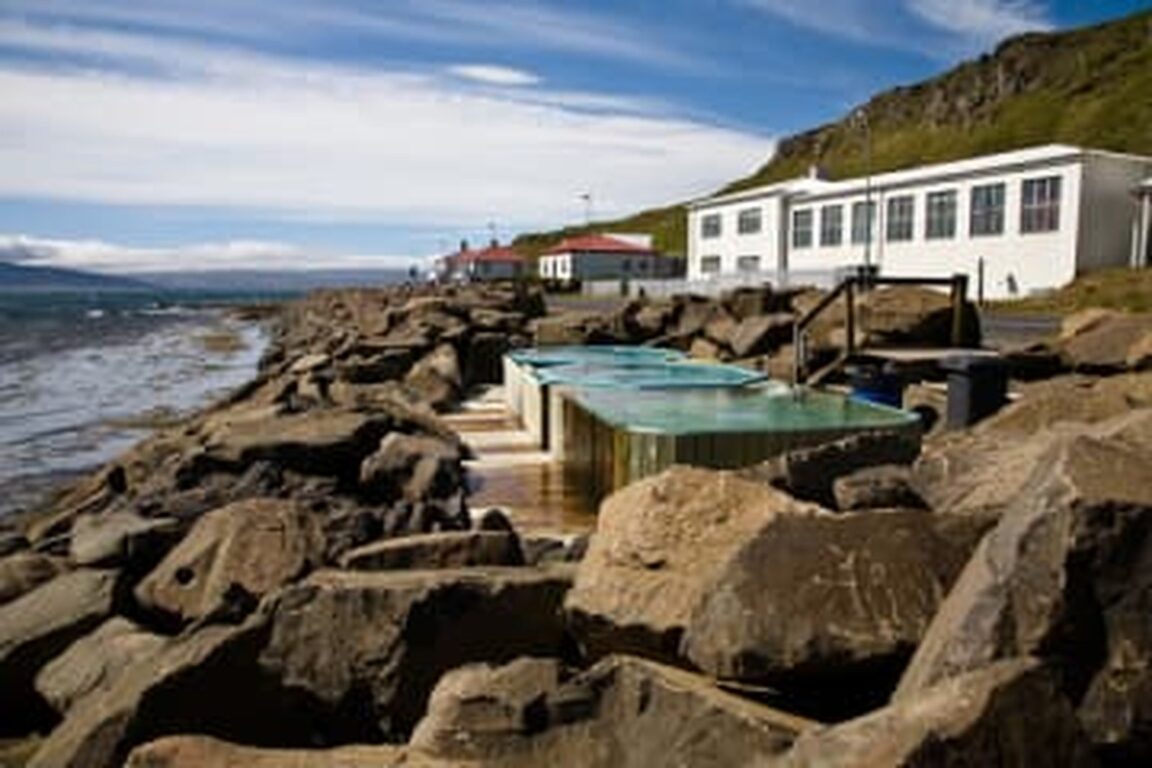
Position, first of all. Visit Westfjords, the region’s official authority, places the hot natural pools right along the shoreline in the middle of Drangsnes, easily spotted from the road, and notes that they are used throughout the year by locals and visitors alike. Even after the village built a modern swimming pool, the pots kept their hold, because their function was never only swimming. They are where the village talks. The view runs across Steingrimsfjordur to the island of Grimsey, the water is hot, the rocks are black, and admission works on free donations.
For the visitor, Drangsnes is the gentlest possible introduction to Icelandic hot pot culture: no hike, no hidden turn off, facilities in the village around you, and locals in the water beside you setting the volume and the tone. Follow their lead. Travellers building a full Iceland winter around geothermal water will find the capital’s version of the same ritual in Reykjavik’s winter light culture, from pool evenings to the Imagine Peace Tower, where the evening soak structures the darkest weeks of the year.
Why does Heydalur put its pool in a greenhouse?
Because the Westfjords weather demands a roof somewhere in the system. Heydalur is a farm in its own valley, and its hot pot sits inside a greenhouse, where the geothermal water, the shelter and the green growth around the pool make a soak that works in wind and rain that would empty an open hillside tub. It is the middle term between Drangsnes’ public shoreline and Hellulaug’s wild beach: a farm welcome, a roof overhead, and hot water that belongs to a working property rather than a village or a roadside.
Heydalur also solves the loop’s logistics. The Westfjords’ fjord roads make every day a chain of headlands, and a farm base with its own hot water at the end of the chain is worth more than a slightly shorter drive. Stay the night if the itinerary allows; the greenhouse pool at the end of a fjord day, with dinner from the farm, is the region’s comfort argument in its purest form.
What is the Hellulaug rule of quiet?
Hellulaug is the pool the road hides. It sits on the beach at Vatnsfjordur, near Flokalundur on Route 60, tucked behind a rise so it cannot be seen from the road at all; a small parking area above and a short path down are all the infrastructure there is. The pool itself is modest: stone and concrete, roughly four metres across and about 60 centimetres deep, holding water at about 38 degrees Celsius, with the fjord and the beach spread out in front of it. There is no entry fee and no attendant; a canister at the parking area collects the donations that pay for its upkeep, and there are no changing facilities, so swimmers change at the car or arrive with a suit under their clothes.
The rule of quiet is the local contract that keeps such a place intact. An unstaffed pool survives on the behaviour of the last visitor: voices low, no glass anywhere near the water, nothing left behind, the donation made without being asked, and the pool left cleaner than the state it was found in. Hellulaug rewards that restraint with the Westfjords’ essential experience, a hot, silent soak at the edge of a cold sea, often with the pool entirely to yourself precisely because it cannot be seen from the road. Travellers who love the contrast of mineral heat and northern landscape can compare it with a very different desert version in Ojo Caliente’s four mineral waters north of Taos, where the soaking is a resort and the quiet is enforced by design rather than by custom.
How does the washing rule work in Iceland?
It is the one piece of etiquette that is not optional. Iceland’s pool culture runs on hygiene before entry: swimmers wash thoroughly, with soap, before putting on a swimsuit and entering the water, a rule posted and enforced at staffed pools across the country. At unstaffed country pots there is no attendant to enforce it, which makes observing it a matter of respect rather than compliance: arrive clean, rinse off the day’s road dust where facilities allow, and keep lotions, drinks and food away from small pools whose water changes slowly. The pots stay clean because generations of users have treated the rule as belonging to them.
How should the three pots be driven in order?
Let the loop decide. A Westfjords circuit that comes up the southern shore meets Hellulaug first, on Route 60 near Flokalundur, and should stop then and there, because backtracking fjord roads is the region’s one unforgivable waste. Drangsnes anchors the eastern side of the loop, on the shore at Steingrimsfjordur, and pairs with a village night. Heydalur sits in the northern fjords’ hinterland and works best as the base night in that sector. Whichever order the roads impose, keep one principle: soak at the end of the driving day, never as a detour in the middle of it, because hot water and long fjord roads are a combination that belongs to the evening.
Frequently Asked Questions
Are the Drangsnes hot pots free?
Admission is by free donation, per Visit Westfjords. The pots sit on the shoreline in the middle of the village, are easily spotted from the road, and are used all year by locals and visitors.
How hot is Hellulaug?
About 38 degrees Celsius. The pool is roughly 60 centimetres deep and about four metres across, on the beach at Vatnsfjordur, with no entry fee and a donation canister at the parking area.
Can you see Hellulaug from the road?
No. The pool hides behind a rise below the road near Flokalundur; a small parking area and a short path down are the only signs. There are no changing facilities, so change at the car.
What is the most important hot pot etiquette in Iceland?
Wash thoroughly before entering the water, keep quiet at unstaffed pools, leave a donation where a canister is provided, and take everything away with you. Unstaffed pots survive on visitor behaviour.
Which pot is best in bad weather?
Heydalur. Its hot pot sits inside a greenhouse on the farm, so the soak works in wind and rain that would make the open shoreline and beach pools a battle.
Photo: The Drangsnes hot pots, three turquoise tubs set into the shoreline rocks of the Westfjords village, with the fjord beyond. Credit: Visit Westfjords, via westfjords.is, the region’s official website.