 Omar Haddad
With two spare days in Marrakech, the honest split is one mountain day and one spectacle day: Imlil for High Atlas walking at 1,740 metres, about 64 kilometres and ninety minutes south of the city, and Ouzoud for the 110 metre waterfall that justifies its three hour drive north east. The Agafay is the third option, not a rival to either: a stone desert only 30 to 40 kilometres away that earns an evening, a sunset dinner and a night under stars, but never a full day taken from the other two.
Quick Facts
- Imlil: High Atlas village at about 1,740 metres, roughly 64 kilometres and 1.5 hours by road from Marrakech via Asni; trailhead for Jbel Toubkal.
- Jbel Toubkal: 4,167 metres, the highest peak in North Africa; the standard ascent takes two days via a refuge at about 3,207 metres, so it is not a day trip.
- Ouzoud Falls: 110 metres in three tiers into the El Abid gorge in Azilal Province, about 150 to 160 kilometres and roughly three hours each way; entry is free.
- Agafay: A rocky stone desert, a reg rather than a sand erg, 30 to 40 kilometres south west of Marrakech, about 45 minutes to an hour by road; it has no dunes.
- The real Sahara: The dunes at Merzouga sit about 560 kilometres away, a nine to ten hour drive, which is a three day trip, not a day trip.
- Best pairing: Imlil on the walking day, Ouzoud on the early start day, Agafay slotted into a free evening.
How do the three trips compare on drive time alone?
Drive time is the decision, because all three trips are sold as day trips and only two of them behave like one. Imlil is the closest real change of scene: the road climbs south through Asni into the Ait Mizane valley and reaches the village in about an hour and a half, which leaves most of the day for walking. Ouzoud is the long haul, roughly three hours each way on the road to Azilal, so the falls have to be worth six hours in a vehicle, and for most travellers they are, provided the day starts early and nothing else is stacked on top of it.
The Agafay breaks the pattern entirely. At 30 to 40 kilometres and under an hour, it is close enough to visit after a morning in the medina, which is exactly how it should be used. Travellers planning the wider Morocco loop can pair these excursions with Chefchaouen and the Akchour waterfalls in the Rif later in the trip, where the waterfall day works on a completely different, slower rhythm.
What does a day in Imlil actually involve?
Imlil is the end of the road and the start of the paths. The village sits at the head of its valley under the Toubkal massif, ringed by walnut groves, terraced fields and stone houses, and its working economy is guiding, muleteering and guesthouses. A day trip here is not about a single sight. It is a walk: up to the village of Aroumd at about 1,900 metres, along mule tracks between hamlets, lunch on a terrace, and the walk back down before the drive to Marrakech.
What Imlil is not, on a day trip, is Toubkal itself. The summit at 4,167 metres is a two day undertaking, up to the refuge at about 3,207 metres on the first day and a pre dawn start for the top on the second. Anyone sold a one day Toubkal summit from Marrakech is being sold something that does not exist. Treat Imlil as a mountain day in its own right, or stay overnight and climb properly. In winter the upper paths can hold snow and ice, and even the village walks need proper footwear rather than trainers.
Is Ouzoud worth six hours in a car?
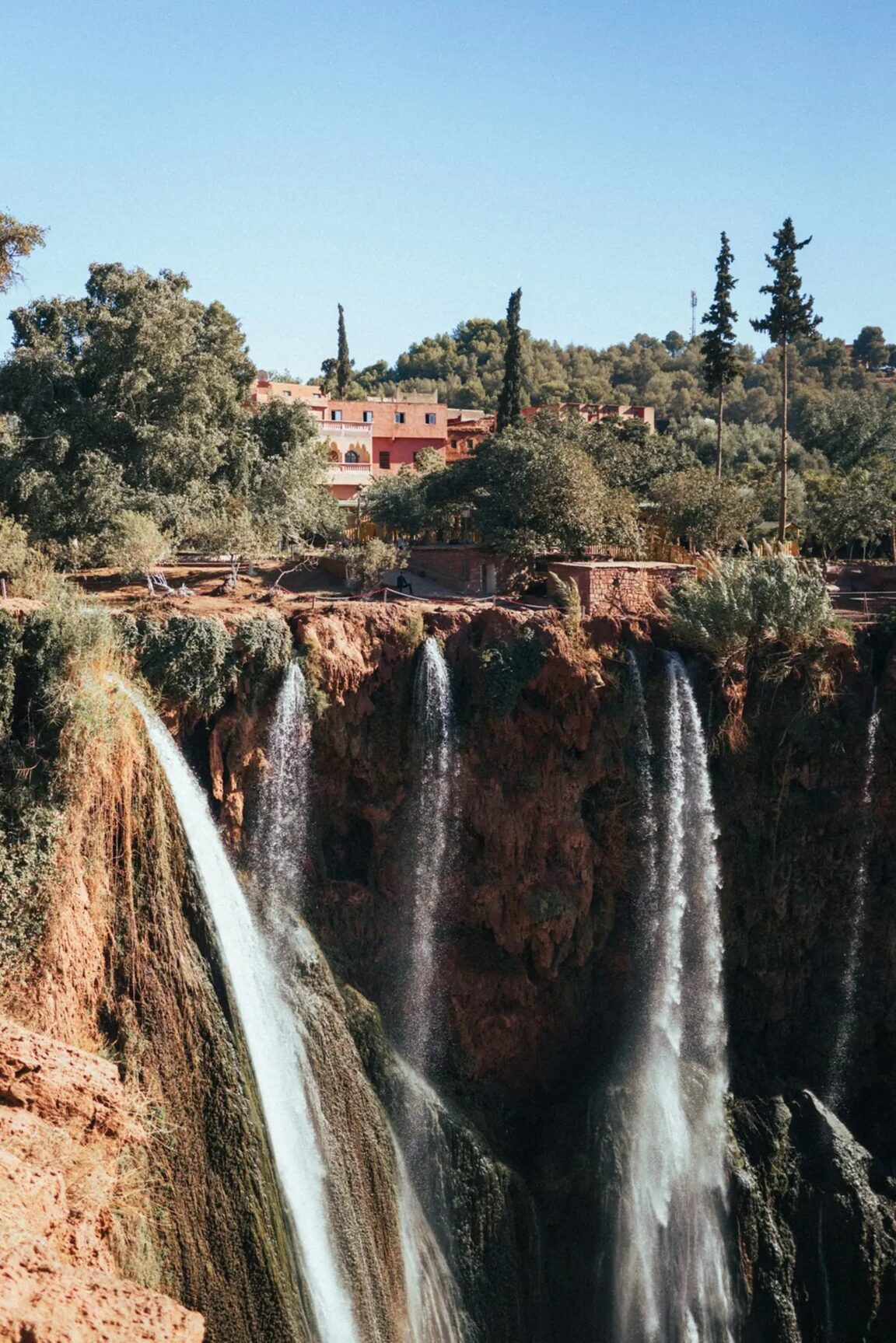
For the waterfall itself, yes. Ouzoud drops 110 metres in three tiers over red cliffs into the gorge of the Oued El Abid, and it is a geosite of the M’Goun UNESCO Global Geopark. The site is arranged as a circuit rather than a single viewpoint: a stepped path descends from the rim through olive groves and past old grain mills to the foot of the falls, small boats work the pool at the base, and terrace cafes line the descent. Plan three to four hours on site, which is why the drive has to start early.
Two honest caveats shape the day. First, flow is seasonal: spring, after winter rain and snowmelt, usually brings the falls at their strongest, while late summer is the lowest water and the busiest rim. Second, the resident troop of Barbary macaques is wild and endangered, and the rule is simple: watch them, photograph them, and do not feed them. Entry to the falls is free; the costs on the day are transport, parking, an optional local guide and lunch. Travellers building a first Marrakech base around these trips will find the medina sequencing in a two day Marrakech itinerary for the medina, souks and Jardin Majorelle a useful frame for the days in between.
What is the Agafay, honestly?
The Agafay is a stone desert, and the sooner that is said plainly the better the evening goes. Geographers call this kind of ground a reg: a plateau of pale marl hills and dry riverbeds at the foot of the High Atlas, with the lake of Lalla Takerkoust at its southern edge. There are no sand dunes, and there is no point pretending otherwise. What there is, within an hour of the city, is open horizon, silence, and low sun warming the stone hills while the Atlas closes the view to the south.
That makes the Agafay an evening product: ride out in the late afternoon, take a camel walk or a quad run over ground that suits wheels better than sand does, eat dinner at a camp, and sleep either in a tent there or back in Marrakech. Judged as a Sahara substitute it disappoints. Judged as the only desert landscape reachable after lunch, it has no competition at all.
Which trip suits which season?
Spring is the strongest all round answer: Ouzoud runs full, Imlil’s valleys are green and walkable without extreme heat, and Agafay evenings are warm without being fierce. Summer pushes the choice toward altitude and evening: Imlil at 1,740 metres is the coolest of the three days, the Agafay should be done strictly at sunset, and Ouzoud’s gorge gives shade and spray but the rim is hot and crowded. Autumn settles back to spring logic with thinner crowds. Winter is Imlil’s most dramatic season, with snow on the massif above the village, but it is also when paths above the village may need winter equipment, and when an Agafay night turns genuinely cold after dark.
How should two spare days be split?
Give day one to Imlil if walking matters most, because legs are freshest and the drive is short enough to allow a slow medina evening afterwards. Give day two to Ouzoud, starting early, and keep the evening free rather than booking the Agafay dinner on the same night: six hours of driving plus a desert dinner is a worse version of both. If only one full day exists, choose Imlil for mountains, Ouzoud for a single natural spectacle, and the Agafay only when the day cannot be spared at all and an evening is all there is.
What should you book, and what can stay loose?
Transport is the one element worth fixing in advance for Ouzoud and Imlil, because both days depend on an early, unhurried start and a driver who waits rather than a timetable that does not. The Agafay needs even less structure: most camps bundle the transfer, the sunset activity and dinner into a single evening booking, and the only real choice is whether to sleep out or return to the city. Walking routes in Imlil, the circuit at Ouzoud and the evening in the Agafay all run perfectly well without pre booked extras, and money kept back for a good lunch, a local guide where one genuinely helps, and tips will do more for any of the three days than an upgraded vehicle.
Frequently Asked Questions
Can you climb Toubkal as a day trip from Marrakech?
No. Jbel Toubkal is 4,167 metres and the standard ascent takes two days, sleeping at a refuge at about 3,207 metres. Imlil works as a day trip for valley walking; the summit needs an overnight.
How long is the drive to Ouzoud Falls?
About 150 to 160 kilometres and roughly three hours each way. The falls drop 110 metres in three tiers, entry is free, and three to four hours on site makes the drive worthwhile.
Does the Agafay have sand dunes?
No. The Agafay is a rocky stone desert, a reg of pale hills and dry riverbeds about 30 to 40 kilometres from Marrakech. The nearest great dunes are at Merzouga, about 560 kilometres away.
Which day trip is best in summer?
Imlil, for altitude: at about 1,740 metres it is the coolest option. The Agafay works only as an evening trip in summer, and Ouzoud is best started early before the rim heats up and crowds build.
Do you need a guide at Ouzoud?
No. The stepped circuit from the rim to the foot of the falls is straightforward and entry is free. A local guide is an optional extra, not a requirement.
Photo: The Ouzoud Falls dropping over red cliffs below the village rim, Morocco. Credit: Tobias Pfeifer, via Unsplash (Unsplash License), hosted copy via Book Morocco Tour.