 Jonas Lindqvist
Via ferrata in the Dolomites is a walker’s route onto ground that looks like climbing: a fixed steel cable, iron rungs and the occasional ladder carry you across exposed rock while you stay clipped in with two lanyards at all times. For a first route, Cortina d’Ampezzo is the most forgiving base in the range. Its official route list grades the Via Ferrata Ra Gusela and the Via Ferrata Ra Bujela as Easy, both start from high passes you can reach by road, and both end at staffed mountain huts. Start on one of those, learn the clipping rhythm on easy ground, and leave the expert lines on the Tofane and Cristallo for a later trip.
Quick Facts
- Best first route: Via Ferrata Ra Gusela, graded Easy by Cortina’s official tourism site: 3 hours, 420 metres of ascent, topping out at the Rifugio Nuvolau at 2,575 metres.
- Shortest taster: Via Ferrata Ra Bujela, also Easy: 1 hour 45 minutes, 262 metres of ascent, with suspension bridges and a finish at 2,260 metres.
- Waterfall option: Via Ferrata Cascate di Fanes (Giovanni Barbara), Easy, 4 hours, looping around and under the Fanes waterfalls.
- Grading: Dolomites routes are commonly rated 1 to 5 for technical difficulty, with a letter for overall commitment; most routes in the range sit at grades 1 to 3.
- Essential kit: A via ferrata set (harness, energy-absorbing lanyards and two carabiners), a helmet, gloves and mountain boots. The kit is not optional, even on Easy routes.
- Season reality: Routes are a summer undertaking. Snow and ice can make them impassable outside the season, and local condition pages pause updates from November to mid-May.
What exactly is a via ferrata?
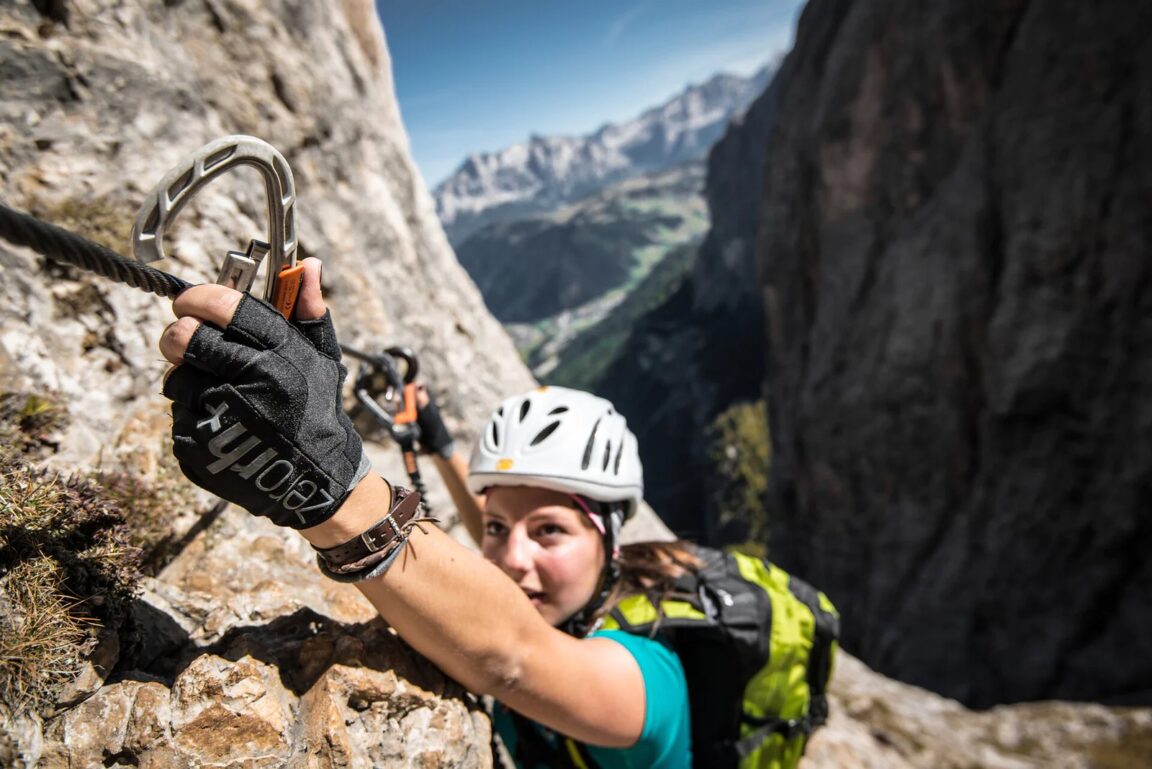
The name means iron path. A steel cable is bolted to the rock along the whole route, and on steep sections you will also find iron rungs, stemples and ladders fixed in place. You wear a climbing harness connected to the cable by a via ferrata set: two lanyards with large carabiners and a built-in energy absorber. The discipline is simple and absolute. At every anchor point you move one carabiner past the fixing, then the other, so that at least one is clipped to the cable at all times. You are never unclipped, and that is what separates the activity from scrambling.
Many Dolomites routes began as military infrastructure. During the First World War, Italian and Austrian troops fixed cables, ladders and tunnels across these peaks to move men and supplies through ground no army could otherwise hold, and the Lagazuoi tunnels above Cortina survive as an equipped trail in their own right. After the war, alpine clubs adopted and extended the network, and the routes became the sporting infrastructure visitors use today. The history matters practically as well as romantically: these are old mountain lines, maintained but not sanitised, and the exposure is real even where the technical difficulty is low.
How do the grades actually work?
Two grading habits coexist in the Dolomites, and beginners trip over the difference. Many guidebooks and operators use the Fletcher and Smith system: a number from 1 to 5 for technical difficulty, where grade 1 is little more than an assisted walk and grade 5 demands serious climbing skill, plus a letter from A to C for the route’s overall alpine commitment. The majority of Dolomites routes fall between grades 1 and 3. Italian sources also use descriptive bands, and Cortina’s official tourism site keeps it plainest of all, labelling each route Easy, Intermediate or For experts.
For a first ferrata, hold yourself to the bottom of every scale: grade 1, letter A or B, or a route the local tourist office calls Easy. The grade measures the hardest move on the route, not the average, so a single vertical ladder can lift an otherwise gentle line out of beginner territory. Exposure is the other half of the decision and no number captures it fully. A route can be technically easy and still traverse a ledge with a long drop beside your boots. If heights genuinely trouble you, an Easy route is a test, not a cure, and a guided first outing is the sensible way to run that test.
Which Cortina routes suit a genuine beginner?
Ra Gusela is the textbook first route, and Cortina’s tourist office describes it exactly that way: a via ferrata for beginners, also suitable for families, climbing towards the Rifugio Nuvolau. The day starts at Passo Giau, which you reach by car or bus from Cortina. From the pass, path 452 leads behind the restaurant, then path 443 heads towards the Cinque Torri, and path 438 climbs left to the fork where the equipped section begins and the metal rope takes over. The ledge at the start is wide, the wall section that follows is short, and the route crosses a plateau with an almost lunar feel before a final equipped wall delivers you to the hut.
The destination does half the route’s work. Rifugio Nuvolau was the first hut built in the Cortina area, in 1883, and it sits at 2,575 metres with a full circle view: Cinque Torri, the Tofane, Croda da Lago and the Marmolada. The return is a walk, not a descent of the ferrata: path 439 to Rifugio Averau, then path 464 towards Rifugio Fedare and path 452 back to Passo Giau. Allow the official 3 hours for the round trip and add hut time on top.
Ra Bujela is the shorter alternative, an Easy route of 1 hour 45 minutes under the Tofane, with suspension bridges as its party piece and views over the Ampezzo valley from the famous Schuss slope. It suits a first morning when the weather window is narrow. The Cascate di Fanes ferrata, graded Easy at 4 hours, trades altitude for water, looping around and under the Fanes waterfalls north of Cortina, and it is the best choice in the set for families. Local guides also point first-timers at the Ra Pegna ferrata, a short route designed as a training ground for people attempting this kind of route for the first time.
What should you rent, and where does the routine start?
The rental routine is standard across Cortina’s sports shops: a via ferrata set, helmet and harness are hired as a package, fitted in the shop, and returned the same evening. Fit matters more than brand. The harness should sit snugly above the hips, the helmet should not tip back, and you should practise opening both carabiners one-handed before you leave the shop, because that is the movement you will repeat several hundred times on the route. Gloves with leather palms protect your hands on the cable and are worth the small extra cost.
Build the day around a fitting the afternoon before if you can. Collect the kit, check the route status and the weather forecast, and be at Passo Giau early, because Easy routes are popular and a queue at the first ladder is a poor classroom. On the route itself, keep three points of contact on ladders, never let both carabiners rest on the same side of an anchor, and give the person ahead a full cable section of space. Walkers planning a longer Dolomites week can pair a ferrata day with the very different pleasures of canoeing the Dordogne beneath the chateaux on the journey home, or save their legs for walking Hadrian’s Wall Path in sections on a separate trip.
When should you go, and when should you bail out?
Summer is the season, and even then the mountains set the terms. Local guide services that track route conditions around Cortina state plainly that their information is not updated from November to mid-May, when snow and ice can make routes impassable or particularly dangerous. Treat any ferrata plan outside the summer window as unproven until a local guide or the tourist office confirms the specific route is clear. Within summer, the daily bail-out decision is about thunderstorms. Exposed metal cable on a ridge is the last place to be in lightning, and afternoon storms are the Dolomites’ summer pattern, which is the practical reason for the early start.
Every beginner route in this guide has honest exit logic. Ra Gusela’s approach paths let you turn around before the cable starts, and once on the equipped section the commitment is short. Ra Bujela and Ra Pegna are brief enough to fit a settled morning. The rule that protects beginners is to decide your turnaround conditions at the trailhead, not at the ladder: cloud building over the Tofane, wind rising on the pass, or any member of the group unsettled by the first ledge are all sufficient reasons, and the hut terrace at Nuvolau rewards even a partial day.
Should you hire a guide for a first ferrata?
It is not a legal requirement, and fit walkers with a full kit do climb grade 1 routes independently. A guide buys you three things: correct kit fitting, pacing and clipping coaching on the first sections, and a professional reading of the weather. Cortina’s official guide association runs a beginner outing on the Averau and Nuvolau ferratas as a worked example of the format: about 4 hours, beginner level with one vertical step, meeting at the guides’ office on Corso Italia in the morning, with a published group price and a minimum group size before the outing confirms. For a first route, that structure, a short route, a guide, a hut at the top, is the lowest-risk version of the day, and many walkers then repeat Ra Gusela independently later in the same week.
Frequently Asked Questions
What is the easiest via ferrata near Cortina?
Cortina’s official tourism site grades both Ra Gusela and Ra Bujela as Easy. Ra Gusela takes about 3 hours with 420 metres of ascent to Rifugio Nuvolau at 2,575 metres; Ra Bujela is shorter at 1 hour 45 minutes and includes suspension bridges.
Do I need my own equipment?
No. Cortina’s sports shops rent the full package of harness, via ferrata lanyard set and helmet. You do need all of it, including the helmet, even on Easy routes, plus your own mountain boots and gloves.
Can children do a via ferrata?
Cortina’s tourist office describes Ra Gusela as suitable for families, and local guides describe Ra Pegna as suitable for children accompanied by experts and secured with ropes. A guide is the right call for a child’s first route.
When is via ferrata season in the Dolomites?
Summer. Outside it, snow and ice can make routes impassable, and Cortina’s condition trackers pause updates from November to mid-May. Always check the specific route’s status locally before setting out.
What happens if a thunderstorm arrives mid-route?
Prevention is the answer: start early and check the forecast, because a steel cable on an exposed ridge is dangerous in lightning. If a storm builds before you start the equipped section, turn around at the trailhead decision point.
Photo: A climber clipping a carabiner onto the steel cable of the Via Ferrata Tridentina in the Sella group, Dolomites. Credit: IDM South Tyrol, via suedtirol.info, the official South Tyrol tourism website.