 Omar Haddad
The best week on the Lycian Way is its first one: roughly 115 kilometres from the trailhead above Ovacik to the ancient city of Patara, walked in six stages through pine forest, village farmland and high pastures, with the Mediterranean below you almost the whole way. The stages are honest mountain days of 14 to 19 kilometres, the red and white waymarks are maintained by the Culture Routes Society, and nearly every stage ends in a village with a family pension. Finish at Patara, where the trail delivers you to a Roman harbour city, an 18-kilometre beach and a museum site that charges foreign visitors 15 euros.
Quick Facts
- The week: Ovacik to Faralya 15.3 km, Faralya to Alinca 14.3 km, Alinca to Bel 13.9 km, Bel to Gavuragili 7.4 km, Gavuragili to Letoon and Xanthos 18.8 km, then Xanthos to Patara 34.4 km, which most walkers split.
- Total distance: Around 115 kilometres for the Fethiye to Patara section, the first of the trail’s west-to-east stages.
- Waymarking: Red and white paint flashes, maintained under the Culture Routes Society, which Kate Clow founded after researching and opening the route in 1999.
- Best windows: Mid-March to mid-May and mid-September to mid-November. Summer heat makes the exposed coastal stages punishing.
- Sleeping: Family pensions and village guesthouses at most stage ends, including Faralya, Kabak, Alinca, Bel and Gavuragili, with half-board the village norm.
- The finish: Patara ancient city, open daily 08:00 to 19:00 with the box office closing at 18:30, entry 15 euros for foreign visitors, per the Turkish Ministry of Culture and Tourism.
Why does the trail start above Ovacik?
The Lycian Way begins where the coast gets serious. Ovacik sits on the plateau above Oludeniz, a short ride from Fethiye, and the signed trailhead marks the start of a route that Kate Clow researched through the 1990s and opened in 1999, stitching together Roman roads, mule paths and forest tracks along the Teke Peninsula. The first steps already show the week’s pattern: a wide track under Babadag, the paragliding mountain, with the blue lagoon of Oludeniz below and the first red and white flash on a rock to confirm you are on the line.
The opening stage to Faralya is the week’s tone-setter at 15.3 kilometres, with the route’s stage data recording over 800 metres of climbing and descending as the path contours the mountain’s shoulder, passes through Kirme and Kozağaç villages, and drops towards the lip of Butterfly Valley. Faralya, the village strung along the clifftop above that valley, is the first night’s stop, and it teaches the week’s rhythm: walk, arrive mid-afternoon, tea, a pension dinner, and a terrace facing the sea. Walkers who enjoy this structure will recognise it from other great linear routes; our guide to walking Hadrian’s Wall Path in sections runs on the same village-to-village logic at a gentler altitude.
How do the middle stages build?
Faralya to Alinca, 14.3 kilometres, is the connoisseur’s day. The path passes above Kabak beach, where a swim is possible if you accept the climb back, then turns inland and upward through forest to Alinca, a village perched at altitude with the coast spread below it. The ascent is the stiffest of the week, and the stage data treats it with respect: start early, carry water for the whole climb, and expect the village, when it comes, to feel earned. Alinca’s pensions are small and family-run, and dinner on a terrace above a sea of ridgelines is the week’s signature evening.
Alinca to Bel, 13.9 kilometres, trades the coast for the interior: pine forest, farmland and the first real sense of the Lycian hinterland, ending in a farming village where tourism is a sideline rather than the economy. Bel to Gavuragili is the week’s short stage at 7.4 kilometres, a deliberate breather placed where tired legs need it, descending towards the coast again with views opening to the Patara plain. Use the short day properly: a late breakfast, a slow morning, laundry, and an early night, because the stages that follow are the longest of the week.
What do Letoon and Xanthos add to a walking week?
The 18.8-kilometre stage from Gavuragili crosses the plain to two of Lycia’s great sites, and it changes the week’s register from scenery to civilisation. Letoon was the federal sanctuary of the Lycian Union, a religious centre of temples set beside a spring, and Xanthos, a short walk on, was the union’s capital, its acropolis, theatre and famous funerary monuments layered above the river plain. Walking between them on the old line of the route, rather than arriving by tour bus, is the Lycian Way’s core argument: this coast’s history is continuous, and the trail reads it in sequence.
From Xanthos the official stage to Patara runs 34.4 kilometres, and the route guidance is blunt about treating it as two days, splitting at Uzumlu or shortening it with a village dolmus. That honesty is the correct way to end the week. Take the split, walk into Patara fresh, and give the site the afternoon it deserves rather than arriving emptied at closing time. Walkers who prefer their ruins with a paddle will find the same layering of landscape and history in canoeing the Dordogne past Beynac and La Roque-Gageac.
What is waiting at Patara?
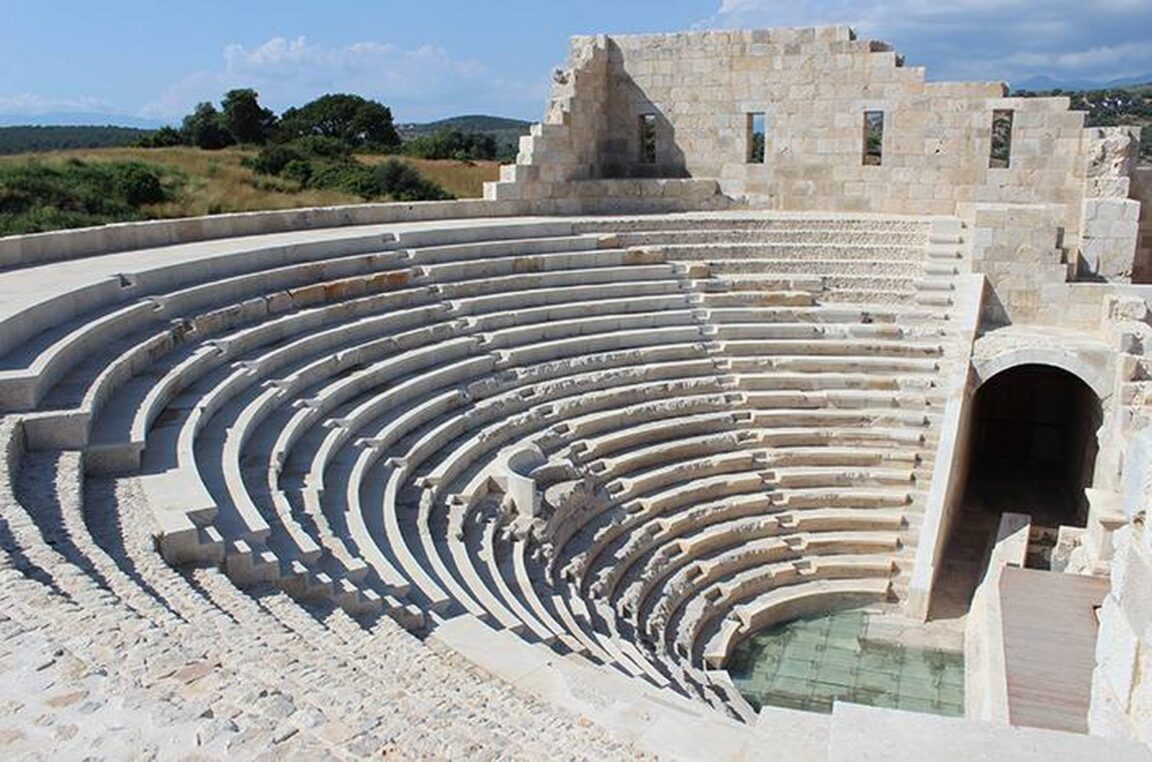
Patara was the major harbour of Lycia and, per the Ministry of Culture and Tourism, the capital of the Lycian Union. The remains justify the walk: a triumphal arch built around 100 AD at the entrance, a theatre rebuilt after the earthquake of 147 AD, the parliament building of the Lycian League, temples, baths and a granary, spread through dunes and scrub behind the beach. The Ministry lists the site as open every day from 08:00 to 19:00, with the ticket office closing at 18:30, and foreign visitor entry at 15 euros, so a walker finishing the stage by mid-afternoon can tour the ruins and still reach the sand.
The beach is the week’s full stop: 18 kilometres of sand, among the longest in Turkey, protected because it is a nesting ground for Caretta caretta loggerhead turtles, which is also why development has been kept off it. Saint Nicholas was born in Patara before becoming bishop of Myra, a fact the Ministry’s own account leads with, and it gives the finish a second layer: the trail’s first week ends in the birthplace of the original Santa Claus, at a harbour that silted up and slept for centuries. Stay the night in the village of Gelemis above the ruins, swim the next morning, and take the dolmus back towards Fethiye with the section done.
How should you handle water, heat and waymarking?
The stage data and the Society’s guidance agree on the calendar: mid-March to mid-May and mid-September to mid-November are the windows, because the route’s exposed traverses and waterless climbs are a different proposition in July. Village fountains and pension taps refill bottles at stage ends, but several stages cross long dry ridges, so carry capacity for the full day, not the distance between villages on the map. Waymarking is red and white flashes on rocks and trees, generally reliable on this popular western section, but the route also crosses fields, forest tracks and village lanes where a flash can hide; carry the Society’s route information or a downloaded track, and treat any half-hour without a mark as a stop-and-check moment rather than a reason to press on.
Practicalities are refreshingly simple. Luggage transfer is not a formal service on this section, so the week is walked with a rucksack, which village half-board makes light work of: breakfast and dinner at the pension, a packed lunch or a gozleme stop where the route passes a tea garden. Walking poles earn their place on the Alinca climb and the descents into Faralya. And the dolmus network is the week’s safety valve: nearly every stage end is a village with minibuses towards Fethiye or Kas, so a twisted ankle shortens the week rather than stranding it.
Frequently Asked Questions
How long is the Ovacik to Patara section?
Around 115 kilometres, walked here in six stages plus a split final stage: 15.3, 14.3, 13.9, 7.4 and 18.8 kilometres, then 34.4 kilometres from Xanthos to Patara, which most walkers divide at Uzumlu.
When is the best time to walk the Lycian Way?
Mid-March to mid-May and mid-September to mid-November, per the route’s stage guidance. Summer heat makes the exposed coastal stages and the Alinca climb genuinely hazardous.
How much does Patara ancient city cost?
The Turkish Ministry of Culture and Tourism lists foreign visitor entry at 15 euros, with the site open daily 08:00 to 19:00 and the box office closing at 18:30.
Is the Lycian Way well waymarked?
Yes, with red and white flashes maintained under the Culture Routes Society, which Kate Clow founded after opening the route in 1999. Carry the route track as backup for field and forest sections where marks can be missed.
Where do walkers sleep on this section?
In family pensions and guesthouses at stage-end villages including Faralya, Kabak, Alinca, Bel and Gavuragili, usually on a half-board basis. Book ahead in the spring and autumn peak weeks.
Photo: The ancient theatre at Patara, endpoint of the Lycian Way’s first week. Credit: Turkish Ministry of Culture and Tourism, via muze.gov.tr, the site’s official page.