 Lucas Meyer
Airport sleep is a market with three honest products and a lot of wishful thinking. You can rent a private, lockable sleep pod or suite by the hour, from operators such as Napcab at Munich and Minute Suites across the United States. You can take a cabin room at an airport pod hotel such as YOTELAIR at London Gatwick. Or you can use the free rest zones that a few generous airports, Singapore Changi above all, build into their terminals. Ranked by reality, privacy and a locked door come first, a free recliner in a quiet lounge comes second, and the bench by the gate is the baseline everything else beats.
Quick Facts
- Cheapest structured sleep: Napcab pods at Munich Airport charge 17 euros per hour by day (06:00 to 23:00) and 12 euros per hour at night (23:00 to 06:00), with a 34 euro minimum booking, per the operator’s own site.
- Most widespread US option: Minute Suites rents private suites past security at major US hubs by the hour, or overnight at select locations, each with a daybed sofa and a desk.
- Best free option: Singapore Changi provides free snooze lounges with reclining chairs in all four terminals, open 24 hours, confirmed on the airport’s own site.
- Pod hotel model: YOTELAIR at London Gatwick sits landside in the South Terminal and rents soundproofed cabins by the hour from a four-hour minimum, or on an overnight rate.
- First in Europe: Helsinki Airport introduced GoSleep pods in 2015, the first sleeping pods at a European airport, per Finavia.
- The golden rule: Airside products require a boarding pass for a flight from that terminal and are useless for an arrival-side layover. Check which side of security your bed is on before you book.
What actually counts as a sleeping pod?
The label covers three different machines, and the differences decide whether you sleep. A true sleep pod, the Napcab at Munich or the GoSleep pod at Helsinki, is an enclosed or semi-enclosed unit built around a single bed: Napcab’s standard cabin fits a bed of 80 by 200 centimetres with storage and a work surface, and its XL cabin doubles the bed width to 160 centimetres. A GoSleep pod works differently, as an ergonomic seat that converts to a flat bed, with luggage stowed beneath and a pull-up cover that blocks light and noise.
A minute suite is a small private room rather than a pod: door, daybed sofa, desk, and at Minute Suites locations a sound-mitigated space designed as much for work and nursing as for sleep. A pod hotel cabin, the YOTELAIR model, is a compact hotel room in an airport building, with a proper bed and an en suite rain shower, rented in blocks of hours. All three share the features that make airport sleep real: a door that closes, darkness, quiet and somewhere safe for your bags. A recliner in a rest zone delivers only some of those, which is exactly why it is free.
Which airports do free sleep properly?
Singapore Changi is the benchmark, and its provision is documented on the airport’s own site. Snooze lounges and rest areas operate in Terminals 1, 2, 3 and 4, free to all passengers, around the clock, with reclining chairs and charging points. The airport lists their locations terminal by terminal, from the Sanctuary Lounge in Terminal 2 to the rest areas on the mezzanine level of Terminal 4, so you can plan your terminal around a nap rather than discovering a lounge by accident. Terminal 2 also hosts a dedicated Calm Room, a quiet sensory space near the Dreamscape garden.
Changi’s model is the exception, not the rule. Most large airports provide seating, some of it lie-flat friendly, but few formalise it, and none in Europe or North America matches a free, listed, 24-hour rest-zone network across every terminal. Helsinki deserves its footnote: Finavia records that Helsinki Airport became the first in Europe to offer sleeping pods in February 2015, and GoSleep pods remain part of its lounge offer, now located inside the Plaza Premium Lounge by gate 40. When a free option exists, arrive with a plan for your valuables, a phone alarm set well before boarding, and a boarding pass already on your phone, because the cost of free sleep is that nobody wakes you up.
How do the paid pods price out?
Napcab publishes the clearest tariff in the business on its own guest pages: 17 euros per hour between 06:00 and 23:00, 12 euros per hour between 23:00 and 06:00, a minimum booking of 34 euros and a maximum stay of 24 hours, with check-in from age 18. At Munich, the operator’s largest installation, twelve standard cabins and one XL cabin are spread across four locations in Terminal 2, covering Schengen, non-Schengen and satellite gates, plus cabins in the public area of the terminal, which matters because public-area pods serve landside layovers that airside products cannot touch.
Minute Suites prices by the hour with overnight stays at select locations, and publishes its amenity list rather than a single network tariff: a private suite, a daybed sofa that sleeps two, a workstation, sound mitigation and access past security at hubs including Atlanta, where suites sit on concourses B, E and F. Priority Pass members get an hour included at select locations, with additional hours at a member rate, which makes the product close to free for cardholders facing a three-hour delay. YOTELAIR at Gatwick sells time in the other direction: a four-hour minimum stay, with an overnight window from 18:00 to 09:00 priced as a flat block, in soundproofed cabins with the brand’s SmartBed. For travellers comparing terminal rest with a proper bed before an early flight, the packing logic in our shoulder-season ferry packing guide applies equally to a cabin stay: one small bag, everything else checked or stored.
Airside or landside: which side of security is your bed on?
This is the question that decides whether any of the above exists for your itinerary. Airside pods and suites, Napcab’s gate-area cabins and every Minute Suites location, sit beyond security. You can only reach them with a boarding pass departing that terminal, and at many airports you cannot stay airside overnight unless you are in transit on a single ticket. Landside products, YOTELAIR at Gatwick and Napcab’s public-area cabins at Munich, sit before security and serve early departures, late arrivals and broken itineraries, but you must clear security afterwards, so the sleep they sell ends earlier than the clock suggests.
Match the product to the failure you are insuring against. A long scheduled connection in one terminal is an airside pod problem. A 06:00 departure after a late arrival is a landside cabin problem. A misconnect that strands you without a rebooked flight is a hotel problem, because no pod operator can sell you a bed you are not entitled to reach. Travellers with reduced mobility should also check step-free routes to the rest areas before relying on them, the same homework our Lisbon accessible transport guide recommends for city systems.
How do you sleep well in a free rest zone?
Treat the snooze lounge as a campsite with better chairs. Claim a recliner early in the evening bank of departures, because the good chairs go first. Keep one bag as a pillow and the bag with documents looped to your body, set two alarms fifteen minutes apart, and choose the lounge furthest from the food court, since foot traffic is the enemy. Earplugs and an eye mask convert a mediocre rest zone into a workable one, and they weigh nothing. At Changi, where the lounges are listed and open all night, this is a genuinely good night’s rest for the price of nothing. At an airport with no formal rest zone, the same kit plus the quietest gate area you can find is the fallback, and a pod booking, made before the delay strands two hundred other passengers with the same idea, is the upgrade.
Frequently Asked Questions
How much does a sleeping pod cost at Munich Airport?
Napcab’s own guest pages list 17 euros per hour from 06:00 to 23:00 and 12 euros per hour from 23:00 to 06:00, with a 34 euro minimum booking and a maximum stay of 24 hours. Munich Terminal 2 has twelve standard cabins and one XL cabin across four locations.
Which airport has the best free sleeping?
Singapore Changi. The airport’s own site lists free snooze lounges in all four terminals, open 24 hours, with reclining chairs and charging points, plus a dedicated Calm Room in Terminal 2.
Can I use an airside pod if I have just landed?
Usually not. Airside pods and suites require a departing boarding pass for that terminal. For arrival-side rest, look for landside products such as YOTELAIR at London Gatwick or the public-area Napcab cabins at Munich.
Are Minute Suites worth it for a short layover?
For a layover of three hours or more, a private suite with a daybed beats gate seating, and Priority Pass members receive an hour at select locations, with further hours at a member rate. For under two hours, a rest zone and an alarm do the same job for free.
What is the difference between a pod, a suite and a cabin?
A pod is a single-bed unit built for sleep, a suite is a small private room with a daybed and desk, and a cabin is a compact hotel room, typically with its own shower. Price and privacy rise in that order.
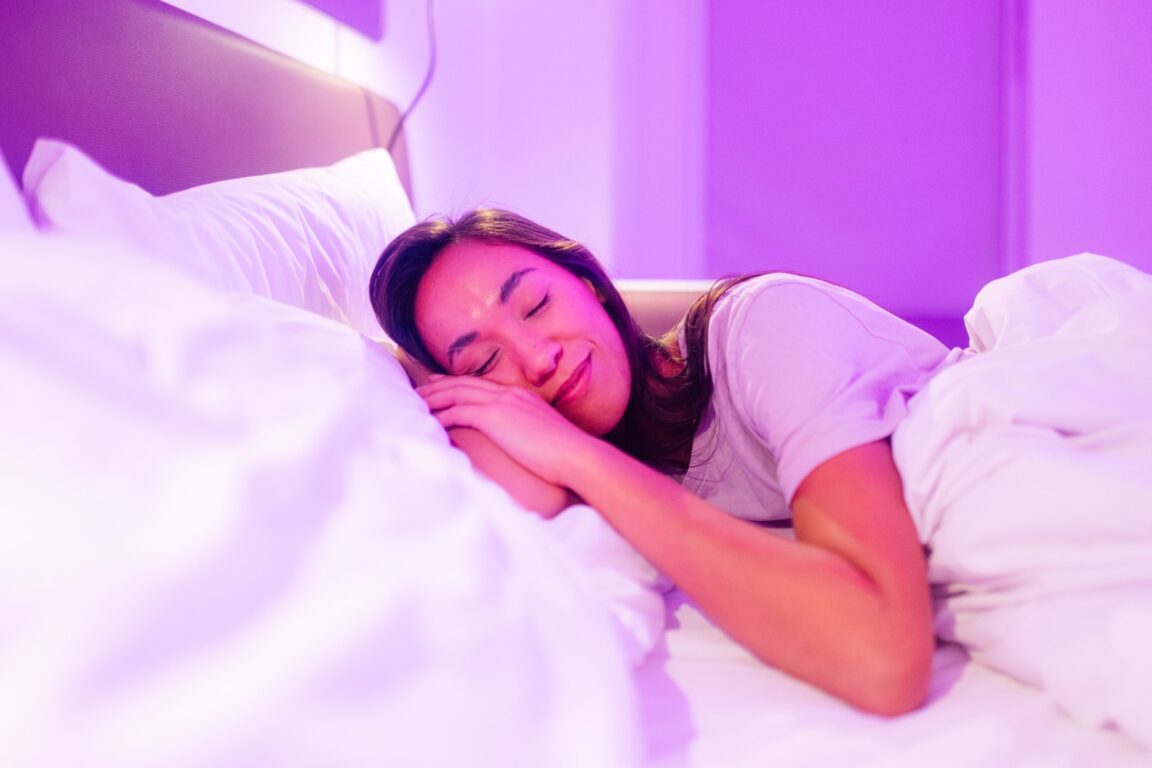
Photo: A guest asleep in the SmartBed of a YOTELAIR cabin, the airport pod hotel at London Gatwick. Credit: YOTEL, via yotel.com, the operator’s official website.