 Omar Haddad
A three or four day Cappadocia trip costs far less than its photographs suggest, provided the balloon does not eat the budget first. The honest maths: a standard sunrise balloon flight runs about 170 to 230 euros per person in the peak months of May, June, September and October, and 50 to 120 euros in deep winter, while everything else in Goreme is comparatively gentle. The Goreme Open Air Museum charges 20 euros, its Dark Church 6 euros more, the great underground cities of Derinkuyu and Kaymakli 13 euros each, and the 65 euro Museum Pass Cappadocia only pays off if a traveller works through three or more major sites inside its three day window. Cave hotels, not sights, are the second cost driver: budget cave rooms run about 45 to 70 euros a night for two, and mid range rooms with a balloon view terrace 100 to 180 euros. This guide prices the trip line by line, in the order the money actually leaves a wallet.
Quick Facts
- Base town: Goreme, walkable, about 1.5 kilometres from the Open Air Museum, with Uchisar and Urgup as quieter alternatives
- Balloon flight: Standard baskets about 170 to 230 euros in peak months, 50 to 120 euros in deep winter, operator priced and weather dependent
- Goreme Open Air Museum: 20 euros, open daily 08:00 to 17:00 in the winter listing, ticket office to 16:15, per the Turkish Ministry of Culture and Tourism
- Dark Church: 6 euros extra, on its own ticket inside the museum site
- Underground cities: Derinkuyu and Kaymakli 13 euros each; Zelve Pasabaglar 12 euros
- Museum Pass Cappadocia: 65 euros, three days from the first visit, one entry per museum, Dark Church excluded
- Access: Flights from Istanbul of about 80 minutes to Kayseri, about 75 kilometres from Goreme, or Nevsehir Kapadokya, about 40 kilometres
- Facts checked: November 23, 2026, against muze.gov.tr, the Turkish Ministry of Culture and Tourism, and current operator pricing surveys
How much of the budget does the balloon actually take?
On a mid range three day trip, the balloon is routinely a third of everything. A standard ticket covers a hotel pickup in the small hours, roughly an hour of sunrise flight, a toast on landing and a certificate, and the price is set mainly by basket size and season. Baskets of 16 to 24 people are the cheapest format; smaller comfort baskets of 12 to 16 cost more, and deluxe baskets of eight or fewer climb steeply. The seasonal spread matters more than the basket: the same standard flight that costs 170 to 230 euros in October can fall to 50 to 120 euros in January, because winter demand drops and cancellations rise. Travellers should also budget the small print honestly: photo packages, tips and any transfer not included typically add a modest sum on top of the ticket, and a flight booked through a hotel may carry a small premium over booking direct, in exchange for the hotel handling rebooking when wind intervenes.
The cancellation maths is a cost issue, not just a disappointment. Balloons fly only under a green flag from the Turkish civil aviation authority’s slot service, which divides the flight area into weather sectors; a yellow or red flag means no take off, whatever the sky looks like from a hotel terrace. Peak season cancellation risk is comparatively low, while winter mornings ground flights far more often. The budget consequence is simple: book the flight for the first morning, not the last, so a grounded day can roll to a spare morning at no extra ticket cost. A traveller with only one morning in Goreme is gambling the single most expensive line of the trip on one weather decision. Anyone pricing operators should confirm the company appears on the aviation authority’s licensed operator list, since licensing, insurance and the flag system are what separate a regulated flight from a cheap risk.
What do cave hotels cost, tier by tier?
Goreme’s cave rooms split into three recognisable bands. Budget cave rooms, clean and vaulted but simply furnished, run about 45 to 70 euros a night for two people, often with a shared or small rooftop. The mid range band, about 100 to 180 euros, buys the features photographs promise: a proper terrace facing the launch zones, a carved stone suite rather than a single room, and breakfast served where the balloons pass overhead. Luxury suites in Uchisar and Urgup climb well beyond that, from around 250 euros toward several times that figure at the famous addresses. Two pricing rules follow. First, the terrace is the premium: a room with a balloon view costs materially more than the same room without one, and terrace rooms for the May to October season sell out months ahead. Second, season moves hotel prices almost as much as it moves balloon prices, so a January trip can halve both lines at once. Travellers who skip the flight entirely should know that a balloon view terrace at dawn, plus the free viewpoints above town, delivers much of the spectacle for the price of a coffee, which is the single best saving in this guide. For a contrast in how pass and transport costs stack up on a mountain trip, our guide to getting around Interlaken and the Jungfrau villages without a car runs the same line by line logic in the Alps.
Does the Museum Pass Cappadocia pay off?
Only with arithmetic, not optimism. The pass costs 65 euros, runs for three days from the first museum visit rather than from purchase, and allows one entry per museum. Add the headline single tickets together: the Open Air Museum at 20 euros, Derinkuyu at 13, Kaymakli at 13 and Zelve at 12 come to 58 euros, which is less than the pass. Add Ihlara Valley at 15 euros and the same list reaches 73 euros, at which point the pass wins by 8 euros and saves repeated card payments at rural ticket offices. So the pass is a clear buy for a traveller doing the museum, both underground cities and one valley site inside three days, and a clear skip for anyone whose plan is the Open Air Museum plus one underground city. Two exclusions catch people out. The Dark Church keeps its own 6 euro ticket even for pass holders, because it is sold as a separate entry inside the museum. And Uchisar Castle, the rock citadel that is the region’s highest viewpoint, is run by the municipality rather than the ministry, takes no pass at all, and charges its own modest entry of roughly 9 to 10 euros. The ministry’s own listings, checked for this guide on November 23, 2026, also carry a seasonal warning: some smaller sites close or shorten hours in winter, and the museum’s ticket office closes well before the site itself, at 16:15 against a 17:00 close in the winter listing.
When does a rental car beat paid tours?
The organised day tours, usually sold as colour coded routes through the valleys and one underground city, bundle transport, a guide and lunch into a single per person price, and for a solo traveller staying two days they are hard to beat. The maths flips for couples and groups, and for anyone whose list includes the outer sights. Goreme itself needs no car at all: the Open Air Museum is a walk, the valleys around town are reached on foot or by local minibus, and balloon mornings start with a hotel pickup. A rental car earns its day rate on the wide arc: Ihlara Valley lies far to the southwest, the underground cities sit south of town, and Zelve and Pasabag lie northeast, so a single self driven day can chain three paid sites at the traveller’s pace instead of a tour’s. The honest comparison is the car day, fuel and parking included, against two or more tour seats, plus the value of leaving a site when it fills rather than when the group moves. Travellers based in town for three or more days usually find one car day is the sweet spot, with the remaining days walked. The same base town logic applies to older valley settlements elsewhere: our visit to Ait Benhaddou beyond the film sets shows how staying put, rather than day tripping, changes both cost and experience.
What does food and daily spending add?
Daily costs in Goreme stay modest by European standards. A sit down dinner in a proper restaurant, built around dishes such as testi kebab, meat and vegetables slow cooked in a clay pot and cracked open at the table, sits in the mid range band rather than the splurge band, and lunch in a lokanta style canteen costs a fraction of dinner. Breakfast is included at most cave hotels, which quietly removes one meal a day from the budget. The spending traps are specific rather than general: balloon photo packages sold at landing, terrace breakfast upgrades for non guests, and ceramics workshops in Avanos that end in a showroom. None is a scam, but each is priced for the moment, and a traveller who has priced the big lines in advance tends to enjoy them as choices rather than surprises. Small cash remains useful for minibuses, small shops and tips, even though museum tickets and most hotels take cards without fuss.
What does a realistic three day total look like?
Built from the lines above, a mid range three day trip for one person, sharing a room, lands in a recognisable band. The room share at 100 to 180 euros a night contributes roughly 150 to 270 euros across three nights. One peak season balloon adds 170 to 230 euros. Site entries add 46 euros on single tickets for the museum, the Dark Church and one underground city, or 65 euros if the itinerary grows enough to justify the pass. Food, minibuses and one rental car day shared between two add a further modest block. The total, excluding flights to Turkiye, typically falls between about 500 and 800 euros per person in peak season with the balloon, and drops sharply outside it: the same trip in winter, with the balloon at its low season price and rooms discounted, can cost little more than half. The levers, in order of size, are the balloon season, the terrace premium, and only then the museum pass question, which is why this guide priced them in that order.
Frequently Asked Questions
How much does a Cappadocia balloon flight cost?
Standard flights run about 170 to 230 euros per person in the peak months of May, June, September and October, 150 to 200 euros in high summer, and 50 to 120 euros in deep winter, based on current operator pricing checked on November 23, 2026. Smaller baskets cost more per person.
Is the Museum Pass Cappadocia worth buying?
At 65 euros for three days from the first visit, it pays off only when a traveller visits sites whose single tickets pass that total: the Open Air Museum (20 euros), both underground cities (13 euros each), Zelve (12 euros) and Ihlara (15 euros) together reach 73 euros. The Dark Church (6 euros) is never included.
What does the Goreme Open Air Museum cost and when is it open?
Entry is 20 euros, with the Dark Church at 6 euros extra on its own ticket. The ministry listing checked on November 23, 2026 shows daily opening 08:00 to 17:00 with the ticket office closing at 16:15 in the winter schedule.
How much are cave hotels in Goreme?
Budget cave rooms run about 45 to 70 euros a night for two, mid range rooms with a balloon view terrace about 100 to 180 euros, and luxury suites in Uchisar and Urgup from around 250 euros upward, with strong seasonal variation.
Which airport is cheaper or easier for Cappadocia?
Both Kayseri, about 75 kilometres away, and Nevsehir Kapadokya, about 40 kilometres away, are served from Istanbul in about 80 minutes. Nevsehir is closer; Kayseri usually offers more flight choice. Pre booked shuttles meet scheduled flights at both.
What happens to the balloon money if the flight is cancelled?
Licensed operators roll a weather cancelled flight to the next available morning or refund it, which is why the flight should be booked for the first morning of the stay and through an operator on the civil aviation authority’s licensed list.
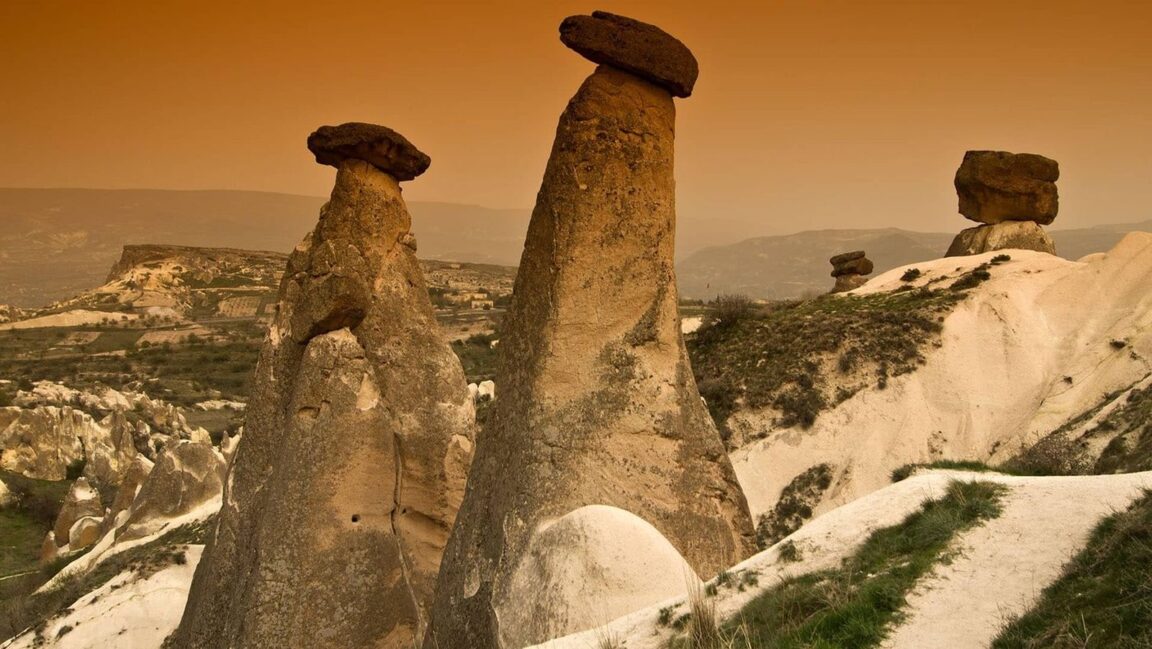
Image: Capped fairy chimneys above a Cappadocia valley at sunset, Pasabag style tuff towers with their harder rock caps. Photo: GoTurkiye, Turkiye’s official tourism portal, via goturkiye.com, used with credit.