 Thandiwe Nkosi
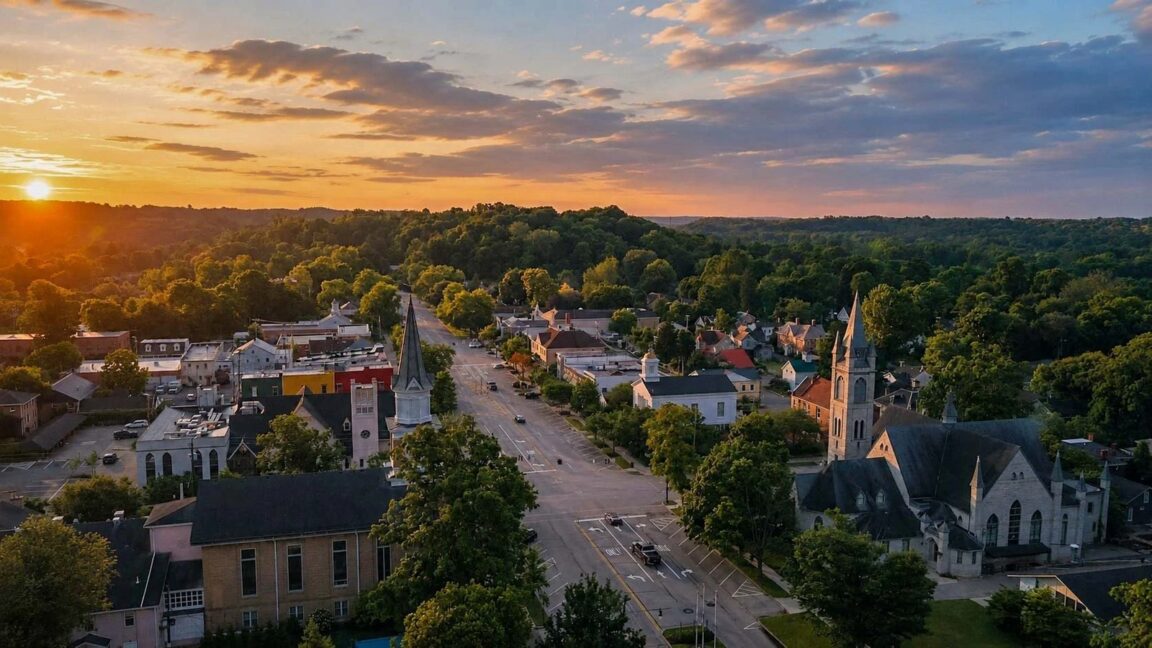
Granville is the New England village that Massachusetts and Connecticut settlers deliberately rebuilt in central Ohio in 1805, and a weekend here runs on the plan they left behind: a broad main street called Broadway, white churches and Greek Revival storefronts, and, on the hill above it all, Denison University, founded in 1831, whose campus walk down into the village is the weekend’s natural spine. Add the Saturday farmers market in season, the Buxton Inn receiving travellers since 1812, and the farm stands of the Welsh Hills beyond the village line, and you have a complete small weekend about thirty five miles east of Columbus that never needs to raise its voice.
Quick Facts
- Where: Granville, Licking County, Ohio, roughly 35 miles east of Columbus, in the Welsh Hills.
- Founded: 1805, by settlers from Granville, Massachusetts, and Connecticut, who laid out a New England village plan on Ohio ground.
- The university: Denison University, a residential liberal arts college founded in 1831, on a hilltop campus above the village, at 100 West College Street.
- The inn: the Buxton Inn, 313 East Broadway, operating since 1812 and described by the inn itself as one of Ohio’s most historic inns; it is currently being refreshed, with dining returning in stages, so check buxtoninn.com for what is open on your dates.
- The market: the Granville Farmers Market runs on Saturday mornings in season, May through October, in the heart of the village.
- The other inn: the Granville Inn, a 1924 Jacobethan style landmark on Broadway, gives the village a second historic stay and dining room.
Why does an Ohio village look like New England?
Because it was meant to. The settlers who arrived in 1805 from Granville, Massachusetts, with Connecticut families alongside, did not improvise a frontier camp; they transplanted a town form, with a wide central street, a village green pattern, church sites at the centre and house lots laid out in the New England manner. They and their children built accordingly, in Greek Revival and Federal styles, and the village protected the result: its historic district holds more than a hundred buildings listed on the National Register of Historic Places. Broadway today is that decision still working, a main street of brick and painted storefronts, cafes and small shops, with church spires closing the views.
The Welsh Hills name belongs to the second settlement layer: Welsh families who farmed the ridges east of the village in the nineteenth century, whose farm country still surrounds Granville and supplies its market and stands. The two inheritances, Yankee village and Welsh farmland, are the whole weekend in one sentence.
How does the Denison walk structure a day?
Denison sits on the hill locals call the Hill, and the walk up from Broadway is the village’s daily ritual. The campus, roughly 900 acres including a large biological reserve, is arranged around an academic quad of brick and limestone buildings, with Swasey Chapel, the college’s landmark chapel, at its heart. Visitors walk the quad freely, and the college’s calendar of concerts, exhibitions at the Denison Museum and public lectures is open to the town in term time. Come down the hill the way students do, onto Broadway, and the village half of the day begins exactly where the college half ends.
Small college towns live or die on that seam between campus and main street, and Granville’s is unusually intact; compare the Methow Valley rhythm of Winthrop, Washington, where a museum street and river trails do similar work, or the stone main street of Fredericksburg, Texas, another town whose founding plan still directs the visitor’s day.
What is the Saturday order?
In market season, Saturday has a fixed and pleasant shape. The Granville Farmers Market fills its village site on Saturday morning from May through October with Licking County and Welsh Hills growers, bakers and makers, and the village treats it as a weekly meeting rather than an errand. Go early for the full choice, carry cash alongside cards, and build breakfast around it in a Broadway cafe. Late morning belongs to the village’s small museums and houses: the Robbins Hunter Museum, in the 1842 Avery Downer House, a Greek Revival mansion whose columned front is Broadway’s architectural signature, and the Granville Historical Society’s museum, which tells the 1805 story with the artefacts to prove it.
The afternoon is for the hill or the hills: Denison’s quad and chapel if you skipped them on Friday, or a drive into the Welsh Hills for farm stands and the ridge roads. The Bryn Du Mansion estate, a 52 room nineteenth century mansion on the village edge, hosts events, polo and community gatherings on its grounds through the year and is worth checking against your dates.
Where do the Buxton Inn’s ghosts fit in?
At 313 East Broadway, the Buxton Inn has been taking in travellers since 1812, through stagecoach days, and it carries the full set of honours and stories a two century old inn collects: presidents and writers in the guest tradition, and, in the telling every Granville visitor hears, resident ghosts, most famously a lady in blue associated with a former keeper of the inn. The inn is candid that some of its stories are documented and some are whispered, and it is currently in a careful refresh, with rooms being renewed and dining returning in stages. Treat a stay or a courtyard evening there as the weekend’s set piece, verify what is open on the inn’s own site before you book, and let the ghost stories be what they are: the village entertaining itself with its own history, after dinner, in the building where it happened.
Sunday, then, is deliberately small: a late breakfast, a last walk the length of Broadway, the climb to Swasey Chapel for the view over the rooftops and the Licking River valley, and the short drive back toward Columbus or onward into Ohio’s hill country, with Newark’s great Hopewell earthworks, a UNESCO World Heritage Site about fifteen minutes west, as the one extension that genuinely competes with going home.
Frequently Asked Questions
How far is Granville from Columbus?
About 35 miles east, typically under an hour by road via Interstate 70 and Route 37 or Route 161 and Route 37. It is close enough for a day trip, but the village rewards an overnight, with the inns on Broadway as the point of the trip.
When is the Granville Farmers Market?
On Saturday mornings in season, May through October, in the centre of the village. Arrive early for the best selection, and check the market’s current site and hours before a winter or early spring visit, when the outdoor season has not begun.
Can visitors walk the Denison University campus?
Yes. Denison’s hilltop campus is open to walk, with the academic quad and Swasey Chapel as the natural route, and the Denison Museum and public concerts and lectures welcome visitors in term time. The college address is 100 West College Street.
Is the Buxton Inn really haunted?
The inn’s ghost stories, including a lady in blue linked to a former innkeeper, are a beloved part of its two centuries of lore. The inn itself separates documented history from whispered legend, and presents both as part of its character rather than as a promise.
What else is nearby?
The Newark Earthworks, the largest surviving geometric earthworks of the Hopewell culture and a UNESCO World Heritage Site, are about fifteen minutes west. The Welsh Hills farm country begins at the village edge, and Columbus is under an hour away.
Image: An aerial view of the village of Granville, Ohio, at sunset, looking along Broadway with its church spires. Photo via the Buxton Inn, the village landmark’s official website (buxtoninn.com), used with credit.