 Jordan Ellis
Tombstone works best when you visit it in two layers at once. The performance layer is easy and fun: a gunfight reenactment three times a day at the O.K. Corral, costumed interpreters on Allen Street, and a theatre that has been selling atmosphere since 1881. The record layer is quieter and better: an 1882 courthouse museum run by Arizona State Parks, the original Bird Cage Theatre preserved rather than rebuilt, and a newspaper office that printed the first reports of the famous fight. Go for the show, by all means. Just spend at least as long with the evidence, and Tombstone stops being a theme set and becomes what it actually is, a silver boomtown that survived its own legend.
Quick Facts
The town: Tombstone, Arizona, about 70 miles southeast of Tucson, founded on silver in 1879 and home to the Gunfight at the O.K. Corral on 26 October 1881.
O.K. Corral Historic Complex: 326 East Allen Street. Open 9 a.m. to 5 p.m. daily except Thanksgiving and Christmas Day. Gunfight reenactments at 11 a.m., 1 p.m. and 3 p.m. Admission $10 with the reenactment and $6 for the complex only, children 5 and under free, per the operator.
Tombstone Courthouse State Historic Park: 223 East Toughnut Street. Open daily 9 a.m. to 4:30 p.m. from October 1 to May 31 and 9 a.m. to 3 p.m. from June 1 to September 30, per Arizona State Parks. Admission $10 for ages 14 and over, $5 for ages 7 to 13, free for ages 6 and under.
Bird Cage Theatre: 535 East Allen Street. Open daily 9 a.m. to 6 p.m. for self guided tours, per the theatre. Opened on 26 December 1881 and operated as a theatre, saloon and gambling hall.
The historic district: Allen Street’s core blocks are closed to motor traffic and free to walk. Most attractions open between 9 and 10 a.m. and close between 5 and 6 p.m.
Facts checked: 24 November 2026, against Arizona State Parks, the O.K. Corral’s official site and the Bird Cage Theatre.
What actually happened on 26 October 1881?
The documented core is short. In about 30 seconds, in a vacant lot off Fremont Street near the O.K. Corral’s rear entrance, Wyatt, Virgil and Morgan Earp and Doc Holliday faced Tom and Frank McLaury and Billy Clanton. The two McLaurys and Billy Clanton were killed. Virgil and Morgan Earp and Doc Holliday were wounded. That is close to the whole of the undisputed record, and everything beyond it, who fired first, whether the cowboys were surrendering, what the Earps intended, was argued in a courtroom within weeks and has been argued ever since.
Two details matter for a visitor. First, the fight did not happen inside the O.K. Corral itself, whatever the branding implies; the corral complex today marks the site honestly, with life sized figures of the eight participants positioned from a map drawn by Wyatt Earp, displayed on site. Second, the fight was a law enforcement confrontation in a mining town with a real ordinance against carrying firearms in town, not a duel arranged for honour. The courthouse exhibits make that context plain, which is why they belong early in a visit rather than as an afterthought.
Which Tombstone is theatre, and which is record?
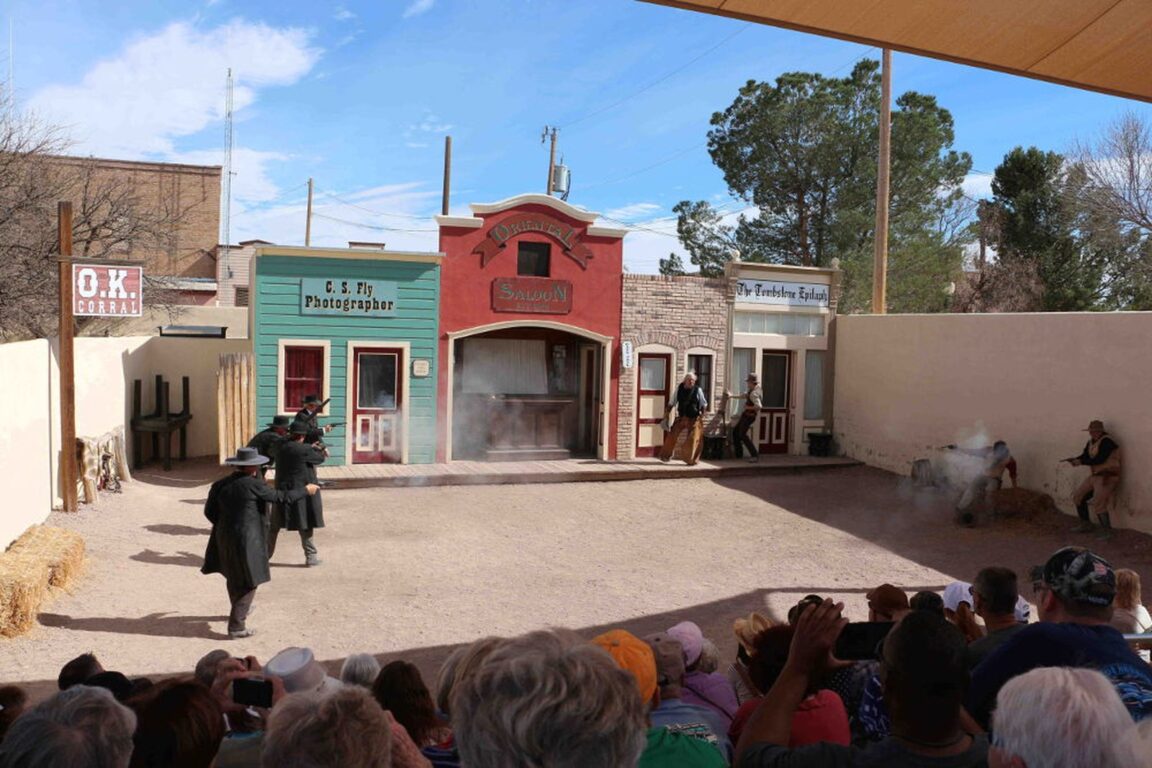
The reenactment at the O.K. Corral, performed daily at 11 a.m., 1 p.m. and 3 p.m. in the Streets of Tombstone Theater, is theatre and does not pretend otherwise. It is a staged version of the fight with narration, played in front of facades that include C.S. Fly’s photography studio and the Oriental Saloon. Enjoy it as a performance that fixes the cast and the sequence in your head, then go and test it against the record. The same ticket covers the corral grounds, the Historama multimedia show and the Epitaph Museum, and the operator notes that shows can sell out, with tickets bought ahead on the day.
The Bird Cage Theatre is the opposite case: a real 1881 building that survived because Tombstone’s economy collapsed before anyone could afford to rebuild it. It opened the day after Christmas in 1881 as a variety theatre and ran, by its own account, around the clock in its early years, combining a stage, a saloon, gambling and the caged balcony boxes that gave it its name. What you walk through on the self guided tour is the preserved interior, with original furnishings, bullet holes in the walls and ceilings, and the basement poker room. Treat the ghost tour marketing as theatre and the fabric of the building as record, and the Bird Cage becomes the single most honest room in town.
Between the two sits Allen Street itself: a genuine historic street, closed to traffic, lined with real 1880s buildings and modern businesses in costume. The street is both layers at once, which is exactly Tombstone’s charm and its trap.
Why should the courthouse come first?
Because it is the only major stop in town run as a museum rather than an attraction. Tombstone Courthouse State Historic Park occupies the two storey red brick courthouse built in 1882, a year after the gunfight, when Tombstone was the seat of Cochise County. The county seat moved to Bisbee in 1931, which is why the building survived to become a state park. Inside are exhibits on the mining boom, ranching, law enforcement and the gunfight itself, the restored courtroom, and a replica gallows in the courtyard. Arizona State Parks puts an average visit at about an hour.
The seasonal hours are the planning catch. From October through May the courthouse is open 9 a.m. to 4:30 p.m., but from June 1 to September 30 it closes at 3 p.m., and it closes early on Thanksgiving and Christmas Eve and all day on Christmas Day. In summer, do the courthouse in the morning, the Bird Cage in the heat of the afternoon, and the reenactment at one of its fixed times fitted around both. Admission is $10 for adults, $5 for ages 7 to 13 and free for younger children, and the park notes that construction work may be under way during a visit.
What else belongs on an honest Tombstone day?
The Epitaph Museum, on Fifth Street, preserves the office of the newspaper founded in 1880 that reported the gunfight the morning after, and a reprint of the 1881 edition with its original reports is included with an O.K. Corral ticket. Reading the contemporary reporting, cautious and partisan in its own way, is the fastest corrective to a century of film versions. Boothill Graveyard, on Highway 80 at the edge of town, is the real early burial ground, although many of its famous markers are later replacements and some inscriptions are folklore rather than record; read it as a memorial, not a document. Schieffelin Hall, the 1881 adobe theatre and meeting hall on Fremont Street, is one of the largest standing adobe buildings in the Southwest and a reminder that boomtown Tombstone had an opera audience as well as a gunfight.
Tombstone also pairs naturally with its neighbour. Bisbee, the copper town in the hills about 25 miles south, kept the county seat and a very different afterlife as an arts town, and travellers building a southern Arizona loop can set Tombstone’s day against the wider national parks country covered in our guide to Zion’s Kolob Canyons district, another place where the famous headline hides the better visit. For a second day of old trails and gorge walking in a different landscape entirely, our Finger Lakes gorge trails guide shows the same plan first, walk early approach applied to New York.
Frequently Asked Questions
Did the gunfight really happen at the O.K. Corral?
Not inside it. The fight took place in a vacant lot on Fremont Street, a short distance from the corral’s rear entrance. The O.K. Corral Historic Complex at 326 East Allen Street interprets the site, displays a map drawn by Wyatt Earp showing the participants’ positions, and stages the daily reenactments nearby.
How long does Tombstone need?
One full day covers the courthouse, the Bird Cage, the O.K. Corral with a reenactment, the Epitaph Museum and Boothill without rushing. Travellers who add an evening ghost tour or a side trip to Bisbee should stay overnight in the area rather than drive back to Tucson in the dark.
What does a Tombstone day cost?
The two anchor admissions are the O.K. Corral at $10 with the reenactment or $6 without, and the courthouse at $10 for adults, both checked on 24 November 2026. The Bird Cage charges for its self guided tour, with prices published by the theatre, and Allen Street itself is free to walk.
Is the Bird Cage Theatre original or a reconstruction?
Original. The building opened on 26 December 1881 and survived largely intact because Tombstone declined before it could be remodelled. Its stage, bar, balcony cages and basement rooms are the preserved 1880s fabric, which is why historians rate it so highly.
When is the best time of year to visit Tombstone?
October through May brings the courthouse’s longer hours, to 4:30 p.m., and desert temperatures that suit walking Allen Street. Summer visits are entirely possible but should start early, both for the heat and because the courthouse closes at 3 p.m. from June through September.
Featured image: A gunfight reenactment under way at the O.K. Corral in Tombstone, Arizona, in front of the C.S. Fly, Oriental Saloon and Tombstone Epitaph facades. Photo from the O.K. Corral’s official website, ok-corral.com.