 Jonas Lindqvist
The best time to visit Iceland’s South Coast depends on which South Coast you want. Come from late May to mid August for puffins, long light and waterfall rainbows in the spray at Skogafoss and Seljalandsfoss. Come from November to March for guided ice caves under Vatnajokull and dark skies, and accept short days, storm risk and roads that can close with little warning. May and September sit between the two worlds and suit travellers who want decent daylight, thinner crowds and lower prices, and who can give up either the puffins at their peak or the ice caves entirely. There is no single best month. There is a best month for your list, and this guide works through the trade offs in the order they should decide your trip.
Quick Facts
The route: The South Coast runs east from Reykjavik along Route 1, taking in Seljalandsfoss, Skogafoss, Dyrholaey, Vik and Reynisfjara, then Skaftafell and the Jokulsarlon glacier lagoon further east.
Puffin season: Atlantic puffins come ashore from late April or early May and leave by mid to late August. June and July are the most reliable months, with Dyrholaey near Vik the easiest South Coast colony to reach.
Ice cave season: Natural blue ice caves under Vatnajokull are visited only in winter, roughly November to March, and only with a licensed glacier guide. The caves form anew each year and close when spring warmth makes them unsafe.
Daylight extremes: Reykjavik gets about 21 hours of daylight around the June solstice and only about four to five hours in late December, and the South Coast follows the same swing.
Waterfall facts: Skogafoss drops about 60 metres and is about 25 metres wide, and its spray regularly throws rainbows on sunny days. Seljalandsfoss also drops about 60 metres and has a path that runs behind the falls.
The daily checks: Road conditions at road.is, weather and wind warnings at vedur.is, and travel alerts at safetravel.is, checked every morning before driving, in every season.
Facts checked: 24 November 2026, against Visit Iceland, the Icelandic Met Office, the Icelandic Road and Coastal Administration and Vatnajokull National Park sources.
What are you actually choosing between?
Most best time advice for Iceland treats the country as one climate. The South Coast rewards a narrower question, because its headline experiences split cleanly into two seasons that never overlap. Puffins and ice caves cannot be done on the same trip. Midnight sun hiking and northern lights cannot be done on the same trip. Once you accept that, the calendar stops being a puzzle and becomes a shortlist of two or three months that fit what you came for.
The coast itself is a string of sights along one road, which is why the season matters more here than in Reykjavik. Seljalandsfoss and Skogafoss are waterfall stops in any month, although their paths ice over in winter. Dyrholaey is a puffin headland in summer and a wind exposed viewpoint in winter. Reynisfjara, the black sand beach near Vik, is dangerous in every season because of sneaker waves that surge far up the beach without warning, and it demands the same respect in July as in January. Further east, Skaftafell in Vatnajokull National Park offers glacier hikes all year with licensed guides, while the ice caves nearby are a winter only product. Jokulsarlon and Diamond Beach change character completely between summer boat season and winter ice on the sand.
For packing by season, our guides to what to pack for Iceland in summer and what to pack for Iceland in winter build the full layer systems, because the right month still fails in the wrong clothes.
When can you see puffins on the South Coast?
Puffins arrive at the colonies from late April and May and leave again around mid August, and June and July are the months when a South Coast stop is most likely to deliver birds close to the paths. The easiest colony to reach on this route is Dyrholaey, the 120 metre headland west of Vik, where puffins nest in burrows in the grassy cliff tops. Ingolfshofdi, the flat topped mountain in the coastal plain east of Vik, hosts guided puffin tours in season, and the Westman Islands, reached by ferry from Landeyjahofn, hold one of the largest colonies in the country.
Two cautions belong in any puffin plan. First, Dyrholaey is a protected nature reserve, and the Nature Conservation Agency of Iceland can restrict access during the early nesting period, roughly from the start of May into late June, with the site closing overnight in that window. Check the signs at the entrance and the current notices before you build an evening around it. Second, the burrows are in the turf at the cliff edge, so stay on marked paths and behind ropes, keep a respectful distance, and never fly a drone near the colony. Early morning and evening tend to be the liveliest times, when birds are moving between the burrows and the sea.
If puffins are the point of the trip, book late May to early August, sleep in or near Vik so Dyrholaey is a short drive rather than a day trip add on, and treat a puffin free day as a weather problem to solve with a second attempt, not as a reason to climb past a rope.
When do the waterfall rainbows happen?
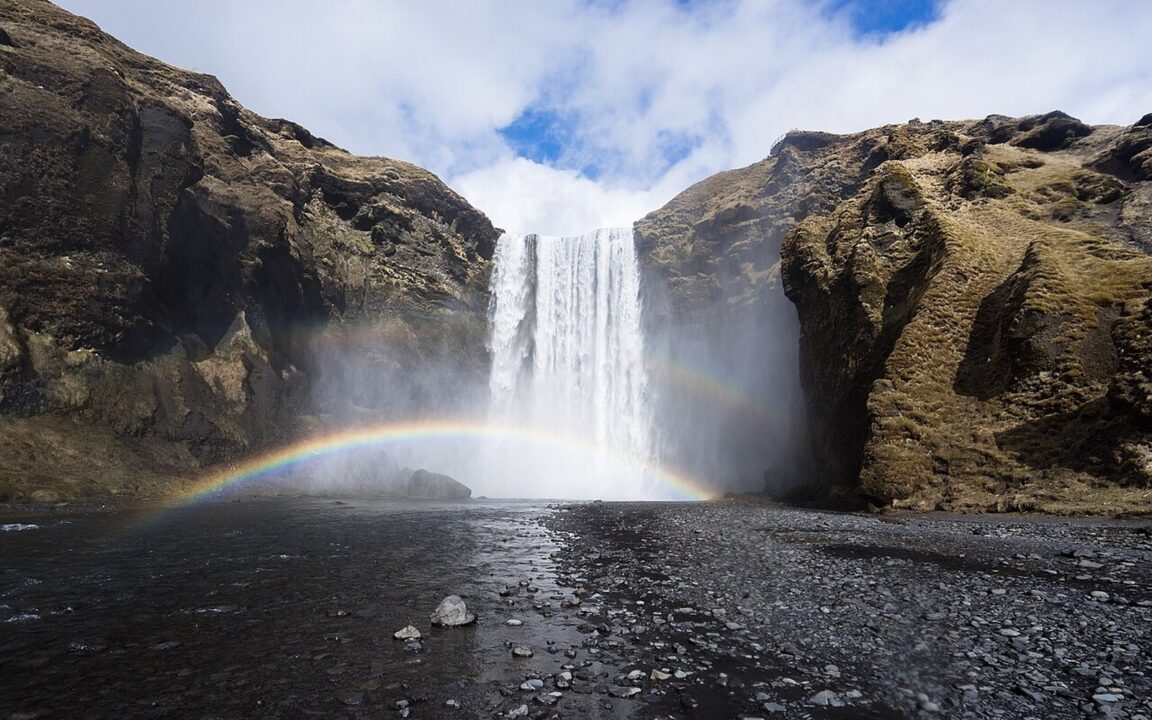
Skogafoss earns its rainbows honestly. A 60 metre curtain of water falling in one straight drop produces a permanent cloud of spray at its base, and when the sun is out and reasonably low, that spray carries a rainbow, sometimes a double one. The photograph at the top of this guide, taken at Skogafoss in spring light, shows the standard result on a bright day. Summer gives you the most daylight hours in which to catch one, and the long evenings of June and July mean the light stays workable far later than most visitors expect.
Seljalandsfoss, west of Skogafoss on the same road, is the waterfall you can walk behind, on a path that loops through the cave like space behind the curtain. It faces west, so late afternoon and evening light are its best hours in summer. In winter the path behind the falls can close when ice makes it unsafe, and the falls themselves are floodlit after dark in the darkest months, which is a different and quieter spectacle. Neither waterfall has a season in which it stops being worth the stop. What changes is the path surface, the crowd level and the hours of light you have to work with, which is why both belong in a trip in any month, with footwear matched to the season.
When is ice cave season, and what replaces it in summer?
Natural ice caves under Vatnajokull, Europe’s largest ice cap by volume, are a winter product, roughly November to March. Meltwater carves new caves each summer and autumn, cold weather stabilises them, and licensed guides take small groups inside during the cold months only. By spring the same warmth that makes the roads easier makes the caves unsafe, and the season ends. There is no summer version of the same cave, and any operator offering natural ice cave tours in high summer should be treated with suspicion. One exception is the man made ice tunnel and cave experiences elsewhere in Iceland, which are engineered attractions rather than natural caves and run on their own schedules.
Summer does not leave the glacier country empty. Guided glacier hikes on Solheimajokull, near Vik, and at Skaftafell run all year, with crampons and axes provided by the operator, and the Svartifoss waterfall in Skaftafell, framed by dark basalt columns, is a summer friendly hike. Jokulsarlon’s amphibious and zodiac boat tours among the icebergs run in the warmer months, roughly May to October, while in winter the lagoon shore and Diamond Beach, where ice washes up on black sand, become the main event and need no booking at all.
How does daylight change the trip, month by month?
Daylight is the South Coast’s second climate. Around the June solstice, Reykjavik sees about 21 hours of daylight and the remaining hours are twilight rather than true darkness, so a June traveller can visit Skogafoss at ten in the evening in full light and near silence. By late December the day shrinks to about four to five hours, which compresses every drive into a narrow window and makes the northern lights a realistic evening plan from September through April on dark, clear nights.
May and September are the hinge months. May offers long and lengthening days, puffins returning, waterfalls running high on meltwater and roads in good shape, without peak season crowds or prices. September offers the first dark nights for aurora watching, the last puffins departing in its opening days only, autumn colour on the low vegetation, and a noticeably emptier Route 1. Travellers who do not need a guaranteed colony or a guaranteed cave usually get the best value, and the most relaxed version of the coast, in one of those two months.
What can winter roads do to a South Coast plan?
Winter on the South Coast is not mainly about cold. Temperatures near the coast often hover around freezing. It is about wind and water. The coastal plain between the mountains and the sea funnels strong winds across Route 1, the Vik area is among the wettest parts of Iceland, and storms can bring road closures, blowing sand or ice, and gusts strong enough that the Road and Coastal Administration advises against driving at all. A closure between Reykjavik and Vik can strand a plan built on a single night in the east, which is why winter itineraries need slack that summer itineraries do not.
The working rules are simple and non negotiable. Check road.is for conditions and closures and vedur.is for wind and weather warnings every morning, and again before a long afternoon drive. Register your travel plan at safetravel.is, especially if you are hiking. Rent a vehicle suited to the season and never drive a closed road or ignore a wind warning to protect a booking. Build the itinerary so the longest drives fall early in the trip, keep the last night within easy reach of the airport, and hold one flexible day that can absorb a storm. In summer these checks still matter, because wind and heavy rain close paths and raise rivers, but the odds of a lost day fall sharply.
Which month should you choose?
Choose June or July if puffins, midnight light, glacier lagoon boats and the easiest driving matter most, and book accommodation and tours well ahead, because this is peak season and the coast’s small towns fill. Choose late May or early September for the balanced trip, with long days, open services and room to breathe at the waterfalls. Choose November to February if ice caves and northern lights are the purpose, travel with flexible days, and keep the route short, basing in Vik or Kirkjubaejarklaustur rather than attempting the whole coast in the dark. Choose March for the last ice caves with noticeably longer days, or October for autumn colour and aurora chances before the cave season opens. Whichever month you pick, start the trip with a night in the capital to recover from the flight, using our two day Reykjavik plan as the soft landing, then drive east rested, in daylight, with the forecast already checked.
Frequently Asked Questions
What is the single best month to visit Iceland’s South Coast?
For the widest range of experiences in one trip, June is the strongest single month, with puffins on the cliffs, about 21 hours of daylight near the solstice, boat tours running at Jokulsarlon and all roads and services open. It is also the busiest and most expensive month, so travellers who value quiet over range should choose May or September instead.
Can you see puffins and ice caves on the same trip?
No. Puffins are on land from late April or early May to mid to late August, and natural ice caves are open only in winter, roughly November to March. The seasons do not overlap, so a single trip must choose one or the other, or substitute a guided glacier hike for the cave in summer.
Is the South Coast safe to drive in winter?
It can be, with preparation and flexibility. Check road.is and vedur.is daily, respect closures and wind warnings, rent a suitable vehicle, keep drives short and in daylight, and build in a spare day for storms. If a warning says not to drive, do not drive, whatever the booking at the other end says.
When are the northern lights visible on the South Coast?
Dark nights return from late August and the season runs through to about mid April, with the darkest months from November to February offering the longest viewing windows. You need clear skies as well as darkness, so a stay of several nights greatly improves the odds.
Do I need to book South Coast tours in advance?
In summer, yes for the popular products. Ice cave tours in winter, glacier hikes, Jokulsarlon boat tours in summer and Ingolfshofdi puffin tours in season all have limited group sizes and sell out on peak dates. Waterfalls, beaches and viewpoints need no booking, only parking payments where signed.
How many days does the South Coast need?
Two days is the honest minimum, one night in or near Vik for the waterfalls, Dyrholaey and Reynisfjara, and one night further east for Skaftafell and Jokulsarlon. Three to four days lets the plan absorb weather, which on this coast is not a luxury but the difference between seeing the sights and reading about them from a guesthouse window.
Featured image: Skogafoss waterfall on Iceland’s South Coast, with a rainbow in its spray. Photo by Jeremy Goldberg via Unsplash, CC0.