 Lucas Meyer
Pack for the wind first and everything else second. In Patagonian shoulder season, meaning October and November in spring or March and April in autumn, the cold is manageable and the rain is survivable, but the wind is the climate: it can exceed 100 kilometres per hour on exposed ground, it turns ordinary rain horizontal, and it decides whether a layer system works or fails. The good news is that a refugio-based trek, the standard way to walk Torres del Paine’s W or O routes, lets you pack far lighter than a camping trek, because the refugios sell beds, bedding upgrades and full-board meals. This guide builds the kit around that reality: a shell system engineered for wind, boots chosen for both trail and refugio floor, and a hard weight saving everywhere a refugio service makes an item unnecessary. Bedding and meal details below were checked against Vertice Patagonia’s own published season terms, one of the two refugio operators in Torres del Paine, on November 24, 2026.
Quick Facts
- The main climate: wind. Gusts above 100 kilometres per hour are a normal shoulder season event on exposed ridges and lakeshores, and wind chill, not air temperature, sets the real conditions.
- Shoulder season shape: October and November bring long days, spring snow still possible on high passes and fewer trekkers. March and April bring autumn colour, colder nights and some services winding down.
- The refugio bed rule: at Vertice refugios a simple bed includes a mattress cover, a pillow and a pillowcase only, so it assumes your own sleeping bag. A full bed adds bedding and a bed cover, and is offered at the Grey and Paine Grande refugios.
- The food saving: refugios sell dinner, breakfast, lunch and box lunch services, including full-board options, so a full-board trekker carries trail snacks and water, not a week’s food.
- The boot rule: one broken-in waterproof trekking boot for the trail, plus a light indoor shoe for refugio floors. Refugios are shared indoor spaces, and muddy boots belong at the door.
- The pack liner rule: a rain cover alone fails in Patagonian wind, because gusts lift it. Line the pack from inside with a waterproof liner or dry bags as the primary defence.
What does the wind layer system actually consist of?
Build four layers, each with one job. The base layer is a snug merino wool or synthetic top and bottom set whose only task is moving sweat off skin; cotton has no place in it, because wet cotton in a 100 kilometre per hour wind is a hypothermia mechanism, not a garment. The mid layer is a light fleece or active insulation piece you can actually walk in without overheating on a climb. The insulation layer is a packable puffy jacket, down or synthetic, worn at stops, at viewpoints and on the cold dawn start toward the base of the Torres, then stuffed away the moment you move. The shell is the system: a fully waterproof jacket with taped seams, a stiff, well-shaped hood that stays up and cinches in gusts, and pit zips for venting, worn over waterproof overtrousers that go on before the rain arrives, not after you are already wet.
Two details separate a Patagonia shell from a city rain jacket. First, closures matter more than fabric ratings: cuffs that seal, a hem that cinches, and zips you can operate with gloves on, because every gap is a wind inlet. Second, extremities are shell territory too. A warm hat, a buff, waterproof or windproof gloves plus a dry spare pair, and sunglasses or goggles for wind-driven grit complete the system. Trekkers who have packed for gentler ranges, including readers of our Camino Frances shoulder season packing guide, should treat Patagonia as a category change, not a variation: the same calendar words, shoulder season, describe a far more serious sky.
What is the refugio boot rule?
It is two rules wearing one name. On the trail, wear a broken-in, waterproof, mid or high-cut trekking boot with real ankle support and a sole that grips wet rock and boardwalk. Shoulder season trails mix mud, snow patches, stream crossings and polished stone, and a trail runner that served you all summer is the wrong tool when a gust catches you on a lakeshore traverse with a full pack shifting your balance. Break the boots in at home over weeks, because a refugio trek offers no shoe shop and no rest day in which to heal a blister.
Inside the refugio, the same boots come off. Refugios are shared dormitory lodges with shared floors, shared dining rooms and other people’s sleep on the line, and the standing etiquette is outdoor footwear at the door. Pack a light indoor shoe, a sandal or a camp shoe, that serves three jobs: refugio floors in the evening, showers, and giving your feet air after the trail. It weighs almost nothing and it is the item first-time refugio trekkers most often forget. While you are at the door, add the rest of the refugio kit that operators do not supply as standard: a towel, earplugs for dormitory nights, a padlock for lockers where fitted, and a head torch for dormitory politeness and pre-dawn starts.
How much weight does full board actually save you?
More than any other single decision. Vertice’s own season terms describe the structure plainly: meal services of dinner, breakfast, lunch or box lunch are sold at its Dickson, Grey and Paine Grande refugios, bedding kits of sheets and a bed cover can be added to a simple bed, and camping gear can be hired rather than carried. The other operator, Las Torres Patagonia, likewise sells refugio beds with full board along the eastern and central W. A trekker who books a made-up bed and full board at each night stop drops, in one stroke, the sleeping bag, the sleeping mat, the tent, the stove, the cook kit and nearly all food weight. What remains is clothing, the layer system, personal kit, trail snacks for the day and water. That is the difference between a expedition-weight pack and a trekking pack you can carry up the French Valley without resenting it.
The savings come with homework. The two operators run separate booking systems with separate rules, and a full W trek normally means booking nights with both, so the bedding and meal product you bought on one side of the park may not match the other. Read each night’s product name literally before you delete an item from your pack list. Simple bed means bring a sleeping bag. Full bed means bedding is provided. If even one night of your route is a simple bed or a campsite, the sleeping bag goes back in the pack, and if one sector is campsite-only in the season you travel, the whole calculation changes. Verify the product, night by night, on the operator’s own site in the week you pack, exactly as you would verify a cabin choice in our carry-on only packing system before trusting its weight maths.
What else earns its place in a shoulder season pack?
Trekking poles earn theirs twice over, as balance insurance in gusts and as knee protection on descents, and in winter-regime conditions the park can require poles and traction devices outright, which is one more reason to carry both rather than rent hopefully. A waterproof pack liner plus individual dry bags protect the puffy jacket and sleep clothing, the two items that must stay dry for the trip to remain safe rather than merely uncomfortable. Sun protection is not a summer-only line: Patagonian sun through thin high-latitude air burns fast, so sunscreen, lip balm and sunglasses stay in the kit in April as firmly as in November. A small repair kit, blister treatment, a whistle, a rubbish bag for packing out waste, and a portable battery for a phone that cold and wind will drain faster than expected round out a list that is short on comfort items and long on consequence items, which is the correct ratio for this range.
What stays home matters too. Leave the second pair of trail shoes, the just-in-case jeans, the full-size toiletries and the book you will be too tired to read. Leave cotton entirely. And leave behind any assumption borrowed from northern-hemisphere shoulder seasons: October in Patagonia is spring by the calendar and winter by the wind, and the pack that respects that sentence is the pack that works.
Frequently Asked Questions
Do you need a sleeping bag in a refugio?
It depends on the bed product you booked. A simple bed at a Vertice refugio includes a mattress cover, a pillow and a pillowcase, and assumes your own sleeping bag. A full bed adds bedding and a bed cover, and bedding kits can also be added to a simple bed as an extra service. Check each night’s booking before you pack.
What boots should you wear for a Patagonia refugio trek?
A broken-in, waterproof trekking boot with ankle support and a grippy sole for the trail, plus a light indoor shoe for refugio floors and showers. Outdoor boots come off at the refugio door, and a camp shoe is the item most first-timers forget.
Is full board worth booking on the W trek?
For pack weight, yes. Dinner, breakfast and box lunch services at the refugios remove food, stove and cook kit from your pack entirely, and combined with a made-up bed they also remove the sleeping bag and mat. It is the single largest weight saving available to a refugio trekker.
How strong does the wind really get in shoulder season?
Strong enough to plan around. Gusts above 100 kilometres per hour occur in any month and are most feared on exposed passes and lakeshores. Build the layer system, the pack liner and your walking technique, including poles, around wind rather than around temperature.
Should you rely on a pack rain cover?
No. Gusts lift covers and drive rain underneath them. Line the pack from inside with a waterproof liner or dry bags as the main defence, and treat a cover, if you carry one at all, as a supplement.
When is shoulder season in Patagonia?
October and November in spring, and March and April in autumn. Expect long days and possible pass snow in spring, autumn colour and colder nights in autumn, and four-season weather in any week of either window.
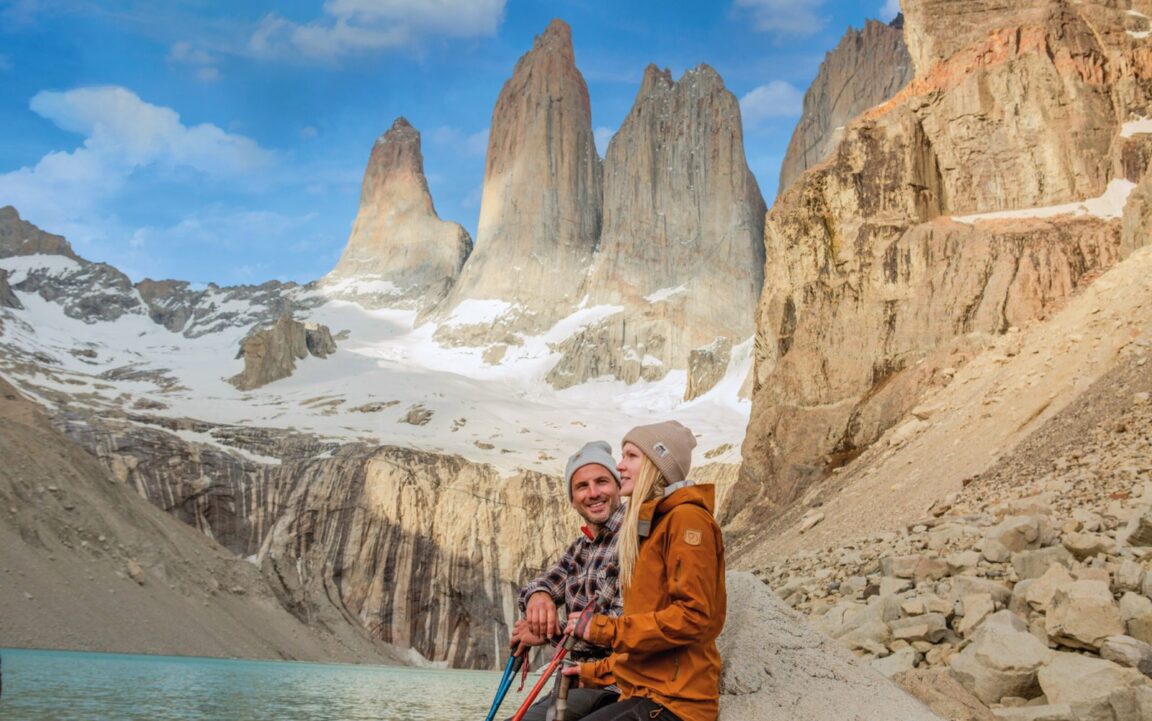
Image: Two trekkers with poles resting at the lake below the granite towers of Torres del Paine, Chilean Patagonia. Photo: Las Torres Patagonia, via lastorres.com, the W trek refugio operator’s official website, used with credit.