 Elena Vasquez
Topkapi Palace works as a sequence, not a single building: enter through the Imperial Gate into the First Courtyard, pass the Gate of Salutation into the Second Courtyard for the council rooms, kitchens and the entrance to the Harem, then go through the Gate of Felicity into the Third Courtyard for the Audience Chamber and the Imperial Treasury, and finish on the terraces of the Fourth Courtyard. Buy the combined ticket that covers the palace, the Harem and Hagia Irene, allow at least three hours, and never plan the visit for a Tuesday, when the palace is closed.
Quick Facts for Topkapi Palace
- Managed by: Directorate of National Palaces (Milli Saraylar Baskanligi), which has run Topkapi Palace since 2019
- Closed: Every Tuesday, plus 1 January and the first day of Ramazan Bayrami
- Ticket office: 09:00 to 17:00 on open days, in the First Courtyard
- Main ticket: One combined ticket covering the palace, the Harem and Hagia Irene, valid on the day of purchase only, priced in Turkish lira
- Harem access: Included in the combined ticket, or bought as a separate section ticket by card holders
- Passes: Muzekart is valid for the main palace but not for the Harem or Hagia Irene sections
- Time needed: Three hours for the palace and Harem, three and a half to four hours with Hagia Irene
- Location: Sultanahmet, Fatih, behind Hagia Sophia, at Bab-i Humayun Caddesi No. 1
Who runs Topkapi Palace, and why it matters for tickets
Topkapi Palace is run by the Directorate of National Palaces, the Milli Saraylar Baskanligi, under the Presidency of the Republic of Turkiye. It has been administered that way since 2019, which makes it different from most of the big museums around it in Sultanahmet. The Istanbul Archaeology Museums, for example, belong to the Ministry of Culture and Tourism museum system, while Topkapi sits in the National Palaces portfolio alongside Dolmabahce Palace and Beylerbeyi Palace.
That split explains the two things that confuse visitors most. First, Topkapi prices its tickets in Turkish lira on the National Palaces tariff, and lira prices change during the year, so any price copied from an older blog post or guidebook is likely to be out of date. Current prices are published on the official National Palaces site at millisaraylar.gov.tr, and that page, or the ticket office itself, is the only figure worth trusting on the day. Second, pass rules here follow National Palaces rules, not the standard ministry museum rules, so the Harem and Hagia Irene are handled as separate sections with their own tickets.
Which ticket should you buy?
For almost every international visitor the answer is simple: buy the combined ticket. The official tariff is built around a single combined ticket that covers Topkapi Palace, the Imperial Harem and Hagia Irene together, and there is no cheaper palace-only ticket for foreign visitors on the current list. The combined ticket is valid for one day only, so the palace, the Harem and Hagia Irene all have to be seen on the same visit. Splitting them across two days is not possible on one ticket.
Separate section tickets for the Harem and for Hagia Irene also exist, and they matter mainly to people who enter the main palace on a card. The National Palaces information states that Muzekart, the Turkish museum card, is valid at National Palaces sites but not in the Topkapi Harem or Hagia Irene sections. A card holder therefore walks into the main palace on the card and then pays the separate section price at the Harem entrance and again for Hagia Irene. Children aged six and under enter free.
Museum Pass Istanbul needs a careful check rather than an assumption. Because Topkapi is a National Palaces site rather than a ministry museum, pass coverage has changed over time and summaries online disagree with each other. Before relying on the pass for Topkapi, check its current museum list on the official Museum Pass site at muze.gov.tr, and budget for the Harem as a separate section regardless, since the Harem has consistently been treated as a separately ticketed section for card holders. If the combined ticket price at the office is close to what a pass day is worth to you, the combined ticket is the simpler, unambiguous option.
Buy at the official ticket office in the First Courtyard, after the security check at the Imperial Gate. Lookalike websites using the palace name sell marked-up tickets and guided bundles, and the palace name alone in a web address does not make a seller official. The only official web address is millisaraylar.gov.tr.
What order should you walk the courtyards in?
The palace plan is a gradient of privacy. Mehmed II laid out a complex of low pavilions and halls around four courtyards, each one more restricted than the last, and the modern visitor route still follows that logic. Walking it in order is what makes the place legible.
The First Courtyard and Hagia Irene
The Imperial Gate, Bab-i Humayun, opens into the First Courtyard, the outer court that was once accessible to the public on set days. This is where the ticket offices and security sit, and it is also where Hagia Irene stands. Hagia Irene is one of the oldest church buildings in Istanbul, older than Hagia Sophia in its surviving form, and it is used mainly as a concert and exhibition space, so the interior is atmospheric rather than furnished. Because it is included in the combined ticket and sits before the main ticket control, it works best either first, while you are fresh, or last, as a calm finish. Give it 20 to 30 minutes.
The Gate of Salutation and the Second Courtyard
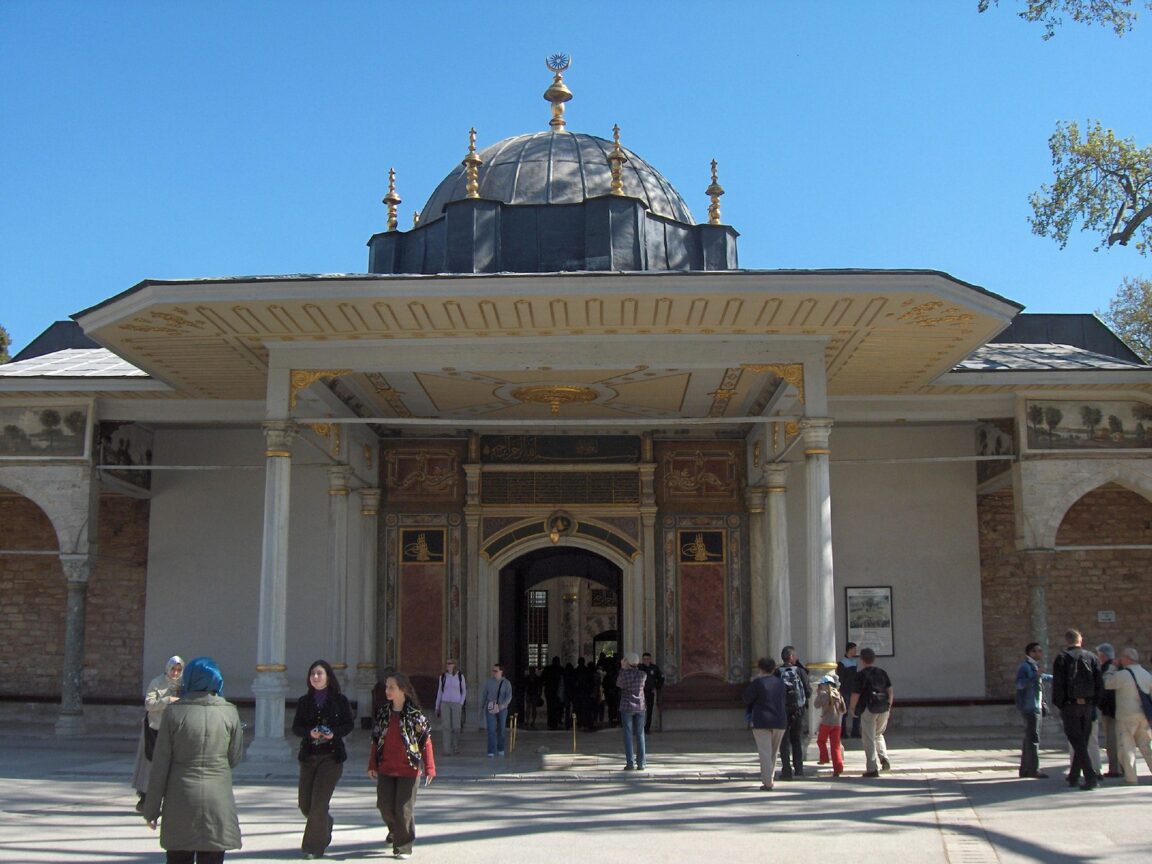
Tickets are controlled at the Gate of Salutation, Bab-us Selam, the twin-towered middle gate between the First and Second Courtyards. Only the sultan could pass through it on horseback, and everyone else dismounted, a rule that tells you exactly where public ground ended. Beyond it, the Second Courtyard was the administrative heart of the empire. On one side stands the Imperial Council Hall, where the grand vizier and ministers met under its dome while the sultan could listen unseen from a grilled window in the Tower of Justice above. On the other side, the vast Palace Kitchens, with their rows of chimneys, now display porcelain, silver and kitchenware collections that repay more time than most visitors give them.
The entrance to the Harem is also in the Second Courtyard, near the Tower of Justice. That placement matters for planning: the Harem is not at the end of the route, and its entrance can queue separately, so decide early whether to go in as you pass or to return after the Third Courtyard.
The Gate of Felicity and the Third Courtyard
The Gate of Felicity, Bab-us Saade, guards the Third Courtyard, the sultan’s inner palace, which no one entered without his permission. Immediately inside is the Audience Chamber, where the sultan received viziers and ambassadors. The Third Courtyard holds the two collections most visitors come for. The Imperial Treasury displays gold, jewelled ceremonial objects and famous pieces including the Topkapi Dagger and the Spoonmaker’s Diamond, and it is the single most crowded interior in the palace. The Pavilion of the Holy Mantle and the Sacred Relics rooms, at the far end of the courtyard, hold relics venerated in Islam and are visited quietly, with dress and behaviour expectations clearly signed. The Library of Ahmed III, a small, elegant building in the centre of the courtyard, completes the circuit.
The Fourth Courtyard terraces
The Fourth Courtyard was the sultan’s private garden level, a sequence of terraces and kiosks above the Bosphorus and the Golden Horn. The Baghdad Kiosk and the Revan Kiosk, built to commemorate the campaigns their names record, are richly tiled inside, and the terrace views back across to Asia and down the Bosphorus are the natural end point of the visit. There is a cafe on this level, and it is the one sensible place to sit down inside the grounds.
How should you order the Treasury and the Harem?
Crowds decide this. The Treasury and the Harem are the two interiors everyone wants, and both funnel visitors through narrow doorways. The reliable strategy is to arrive for the 09:00 ticket office opening, walk briskly through the Second Courtyard, and go straight to whichever of the two matters more to you, then pick up the other before mid-morning tour groups fill both. If the Harem is the priority, enter it from the Second Courtyard on the way through. If the Treasury is the priority, continue through the Gate of Felicity first and return to the Harem afterwards. Either order works at opening time. Neither works well at midday in peak season, when both involve queuing and slow, single-file movement inside.
Inside the Harem, the route is fixed and one-way: the courtyards of the eunuchs and the concubines, the apartments of the Queen Mother, the Imperial Hall with its tiled and painted decoration, and the sultan’s private apartments and baths. It is a warren of around 300 rooms in total, of which the visitor route shows the most significant sequence. Allow 45 minutes to an hour, and note that photography restrictions apply in several palace interiors, including the Treasury and the Sacred Relics rooms, so follow the signs rather than the crowd.
How long do you actually need?
Two hours is a rushed highlights visit: Second Courtyard, Treasury, one terrace, no Harem depth and no Hagia Irene. Three hours is the honest standard visit, covering the council hall and kitchens, the Harem, the Audience Chamber, the Treasury and the Fourth Courtyard terraces at a readable pace. Three and a half to four hours is right if Hagia Irene and the kitchen collections get proper time, or if you want a cafe stop on the terrace. Half a day is not excessive in peak season, when security, ticket and Harem queues all add waiting time to the same route. Anyone pairing Topkapi with Hagia Sophia and the Basilica Cistern on one Sultanahmet day should give Topkapi the morning and the other two the afternoon, and should eat beforehand: Sultanahmet rewards an early start, a point covered in our guide to what to eat in Istanbul, which is useful for planning lunch once you leave the palace grounds.
For another palace visit where tickets, timed sections and a strict visiting order matter just as much, compare the approach in our guide to visiting the Acropolis in Athens: different city, same discipline of arriving at opening, doing the most crowded section first and checking the official tariff on the day.
Frequently asked questions
Is Topkapi Palace closed on Tuesdays?
Yes. The palace is closed every Tuesday, and the closure covers the Harem and Hagia Irene as well. It is also closed on 1 January and on the first day of Ramazan Bayrami, and open on the other days of the religious and national holidays listed by the National Palaces administration. Build a Sultanahmet itinerary around that Tuesday closure, because Hagia Sophia and other nearby sights keep different patterns.
Does the Harem need a separate ticket?
It depends how you entered. The combined visitor ticket includes the Harem, so most international visitors need nothing extra. Visitors entering the main palace on Muzekart need a separate Harem section ticket, because the card is not valid in the Harem or Hagia Irene. Hagia Irene follows the same separate-section logic.
Can you buy Topkapi tickets online from the official site?
Do not assume so. The National Palaces site publishes the tariff and visiting information, and the standard, reliable route for Topkapi remains the official ticket office in the First Courtyard on the day. Third-party sellers offer advance tickets at higher prices. Whatever you buy, the combined ticket is valid only on its day of use.
How long does the Harem take on its own?
Allow 45 minutes to an hour. The route is one-way and passes the eunuchs’ and concubines’ courtyards, the Queen Mother’s apartments, the Imperial Hall and the sultan’s apartments. In busy periods, add queuing time at the Harem entrance in the Second Courtyard.
What is the best time of day to visit?
Opening time. Be at the ticket office for 09:00, go directly to the Treasury or the Harem, and work backwards through the quieter rooms as groups arrive. Late afternoon is the second-best window, but the 17:00 ticket office close limits how late a full visit can start.
Is Topkapi Palace worth it if time in Istanbul is short?
Yes, with the combined ticket and a three-hour block. No other site in the city explains how the Ottoman Empire was actually governed, housed and fed as directly, and the Fourth Courtyard views alone justify the visit on a clear day.