 Elena Vasquez
The Stephen A. Schwarzman Building, the main branch of The New York Public Library at Fifth Avenue and 42nd Street, is free to enter, and the smart way to visit it is to treat it as a working research library first and a landmark second: start with the free Polonsky Exhibition of the library treasures, time the Rose Main Reading Room for its morning visiting hour or a free reading room tour, and leave the marble lions, Patience and Fortitude, for the walk out into Bryant Park. Done in that order, a visit takes 90 minutes to two hours, costs nothing, and shows the building as it was designed to work, with readers at long oak tables under a painted sky, rather than as a quick photo stop between Midtown sights.
Quick Facts
- Address: 476 Fifth Avenue at 42nd Street, New York, NY 10018, with Bryant Park directly behind the building.
- Cost: Entry, the Polonsky Exhibition, building tours and reading room tours are free, according to the library.
- Building: Beaux-Arts landmark designed by Carrere and Hastings, opened on 23 May 1911, built on the site of the Croton Reservoir.
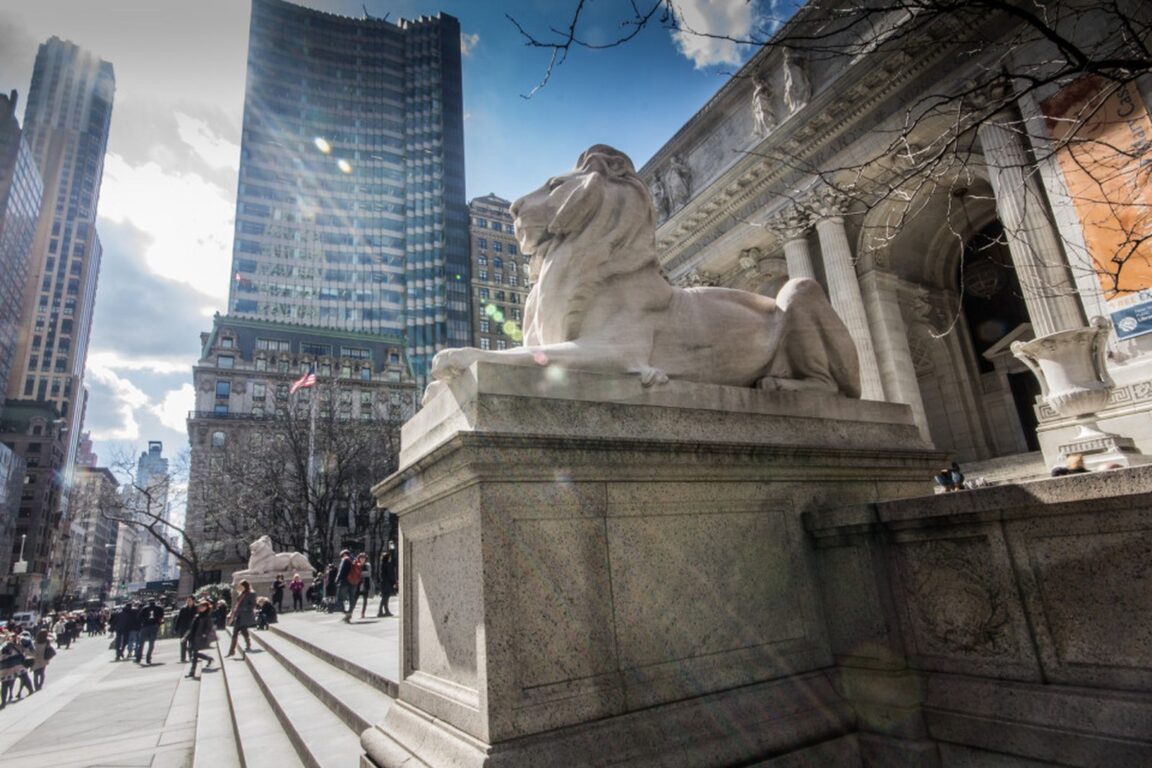
- The lions: The marble lions on the Fifth Avenue steps are named Patience and Fortitude, the qualities Mayor Fiorello La Guardia said New Yorkers needed in the 1930s.
- Rose Main Reading Room: Room 315 on the third floor, about 297 feet long, a working study room with limited visitor access.
- Best first move: Book free timed entry for the Polonsky Exhibition and a building tour place online before you arrive, because tour places are limited.
Why This Building Rewards a Plan
Most visitors arrive up the Fifth Avenue steps, take a photograph beside a lion, walk through the tall doors into Astor Hall, look up at the marble stairs, and then drift. The drift is understandable, because the building is beautiful in every direction, but it misses the point of the place. The Schwarzman Building is a non circulating research library. Its books do not leave the building, its reading rooms are filled with people working, and many of its finest rooms only open to visitors at set times or on tours. A small amount of planning is therefore the difference between seeing a lobby and understanding a library.
The library itself explains the building as the home of research collections in the humanities and social sciences, formed from the Astor and Lenox libraries and the Samuel J. Tilden trust, combined in 1895 to create The New York Public Library. The collections now run to some 15 million items in this building alone, from medieval manuscripts and ancient Japanese scrolls to baseball cards, dime novels and comic books. That range is exactly what the Polonsky Exhibition is designed to show, and it is why the exhibition, rather than the reading room, should be the anchor of a first visit.
For the wider New York context, pair the library with the Fifth Avenue landmarks covered in our guide to The Plaza Hotel on Fifth Avenue, a short walk north, and, in winter, with our checklist for what to pack for New York in December, because the library makes an excellent warm, free pause on a cold Midtown day.
Start With the Polonsky Exhibition
The Polonsky Exhibition of The New York Public Library Treasures sits on the ground floor and presents the permanent highlights of the collections in one calm gallery. It is the only place in the building where a visitor can see, in a single hour, the kinds of objects the reading rooms above exist to serve: early printed books, manuscripts, maps, photographs and personal papers drawn from across the library holdings. Because entry is by free timed ticket, the gallery rarely feels crowded, and the labels give each object a clear story rather than a bare date.
How to book it
Reserve the free timed ticket on the library website for the day of your visit and aim for the first slot of the morning. That timing leaves the rest of the building, and the reading room visiting hour, open afterwards. If the exhibition is the only thing you book, the visit still works: walk in through Astor Hall, spend 45 to 60 minutes in the gallery, then take the stairs up through the McGraw Rotunda toward the third floor. Allow time at security and bag check, keep bags small, and note that food and drink, including water bottles, are not taken into the reading areas.
The Rose Main Reading Room: Who May Enter, and When
The Rose Main Reading Room is the room in the photographs: a space about 297 feet long and 78 feet wide, lit by tall arched windows, with long oak tables, brass lamps and a ceiling of painted clouds framed in gilded plaster. It is also, first of all, a place of work. Readers request material from the closed stacks, staff deliver it to the desk in the centre of the room, and silence is the working rule. Visitors are welcome to see it, but on the library terms, and those terms are specific.
The library runs a morning visiting hour for the room, Monday to Saturday, when visitors may enter quietly and look, with last entry shortly before the hour ends, and it also runs short free reading room tours during the day that begin from the third floor. Outside those windows, the room is for registered readers. The practical conclusion is simple: if the reading room matters to you, build the morning around it. Arrive for the exhibition early or leave the exhibition until after, be on the third floor in good time, keep phones silent, and do not treat the tables as a rest stop. Readers who need the room for study can register for access and request material in advance through the library catalogue, a separate process from a visitor tour.
What the room explains about the building
Standing in the doorway, the design of the whole building becomes clear. The reading room sits on top of seven levels of book stacks, so that a book requested at the desk could be raised quickly from below. That arrangement came from Dr John Shaw Billings, the library first director, whose rough sketch placed an enormous reading room above the stacks with the fastest delivery system of its day. The room was restored in the 1990s with a gift from the Rose family, whose name it now carries, and it closed again for two years after 2014 for ceiling repairs before reopening in 2016. None of that history is visible in a corridor glimpse, which is why the tour, short as it is, is worth taking.
The Building Tours: The Beaux-Arts Interior Explained
Free one hour building tours run on scheduled days and explain the parts of the building a self guided walk tends to rush: Astor Hall in white Vermont marble, the McGraw Rotunda with its murals on the making of the written word, the staircases and the reading room doors. Tour places are released online in advance, each tour is capped at a small group, and places go quickly in busy weeks, so book as soon as your dates are fixed through the library tours page. A free audio tour on the Bloomberg Connects app is the fallback when tour places have gone, and it covers the same ground floor and third floor highlights at your own pace.
The architecture repays the hour. Carrere and Hastings gave New York what is widely regarded as the finest American example of Beaux-Arts design: a marble facade with Corinthian columns, arched windows, carved fountains and a triple arched entrance, behind a forecourt where the two lions rest on their pedestals. Inside, the same classical language continues in coffered ceilings, carved woodwork in the reading rooms and stone stairs worn by more than a century of readers. The building was declared a National Historic Landmark in 1965, and its interior rooms, including the reading room and the rotunda, carry their own landmark protection.
The Lions Outside: Patience and Fortitude
The two lions were carved from Tennessee pink marble by the Piccirilli brothers, to designs by sculptor Edward Clark Potter, and placed on their pedestals before the library opened in 1911. They were not always called Patience and Fortitude. Those names were given by Mayor Fiorello La Guardia during the Great Depression, on the reasoning that New Yorkers would need patience and fortitude to get through it, and the names have stayed. The lion on the south side, uptown, is Patience; the lion on the north side, downtown, is Fortitude. The library dresses them for the city big moments, with wreaths in the holiday season and other honours for championship teams and graduation days, and they remain the most useful meeting point in Midtown: meet at Patience, on the left as you face the building, is an instruction every New Yorker understands.
A Workable Order for a First Visit
Arrive at the Fifth Avenue entrance shortly before the building opens and photograph the lions while the steps are quiet. Take the morning visiting hour in the Rose Main Reading Room first, while the light through the east windows is at its best, then come down for a booked building tour, and finish in the Polonsky Exhibition, where an hour is enough for the highlights. Cross to Bryant Park behind the building for coffee, and, if you need a circulating library, a book to take away or the free rooftop terrace, walk across Fifth Avenue to the Stavros Niarchos Foundation Library, the library main circulating branch, which sits directly opposite at 40th Street. That sequence respects the one fixed point in the day, the reading room morning window, and leaves everything else flexible.
Frequently Asked Questions
Is the New York Public Library main branch free to visit?
Yes. Entry to the Schwarzman Building, the Polonsky Exhibition, building tours and reading room tours are free. The exhibition and tours use free timed reservations booked on the library website, so reserve ahead rather than relying on walk up places.
Can anyone go inside the Rose Main Reading Room?
Visitors can enter during the morning visiting hour, Monday to Saturday, and on the free reading room tours run during the day. At other times the room is reserved for registered readers working with library material, and visitors should not expect to walk in.
Do I need a library card to visit?
No. A library card is not needed to enter the building, see the exhibition or join a tour. A card and reader registration are needed to request research material to use in the reading rooms.
How long does a visit take?
Allow 90 minutes to two hours for the exhibition, a building tour and the reading room together. The exhibition alone takes 45 to 60 minutes, and a building tour takes about an hour.
Can I take photographs inside?
Photography for personal use is generally allowed in public areas, without flash or tripods, but the reading rooms are working spaces: follow staff guidance, keep phones silent and do not photograph readers at work.
Where are the lions, and which is which?
The lions flank the Fifth Avenue steps at 42nd Street. Patience is the southern lion, on your left as you face the building from Fifth Avenue, and Fortitude is the northern lion on the right.
Image: Patience, one of the marble lions outside the Stephen A. Schwarzman Building of The New York Public Library on Fifth Avenue. Image from The New York Public Library official website, nypl.org.