 Sofia Rossi
Book the Uffizi’s earliest entry, go straight to the top floor, and give the Botticelli rooms the slow first hour they deserve: that is the whole strategy, and everything else is refinement. The gallery is open Tuesday to Sunday from 8.15am to 6.30pm, closed on Mondays, and its standard ticket costs 25 euros bought on the day or 29 euros booked in advance, per the Uffizi’s own published prices. The reopened Vasari Corridor, visited on a combined ticket at 43 euros on the day or 47 euros in advance with entry to the corridor set two hours after your Uffizi entry, is worth its separate price only if the Medici passage itself is a priority for you. For most first visits, the gallery alone, taken in the right order, is the better morning.
Quick Facts
- Hours: Tuesday to Sunday, 8.15am to 6.30pm. Closed Mondays, 1 January and 25 December. Ticket office closes 5.30pm, per uffizi.it
- Standard ticket: 25 euros on the day, 29 euros booked in advance, per the Uffizi’s published ticket list
- Combined Corridor ticket: Uffizi plus Vasari Corridor, 43 euros on the day or 47 euros in advance. Reservation required, entry to the Uffizi two hours before corridor access
- Five day pass: PassePartout covering Uffizi, Pitti Palace and Boboli Gardens, 40 euros, or 58 euros with the Corridor included
- Start: Second floor first, where the main chronological route and the Botticelli rooms sit
- Audioguide: 6 euros, available until 5pm, per the gallery’s services list
- Checked: Hours and prices checked 25 November 2026 against uffizi.it
The earliest slot, and why it matters more here than anywhere
Queue burnout at the Uffizi is not caused by the building. It is caused by arriving at the same time as everyone else, then spending the visit inside a moving crowd that reaches every famous room at the same moment you do. The 8.15 entry breaks that pattern completely. Booked visitors enter on their timed slot, clear the cloakroom, where the gallery requires umbrellas and cumbersome bags to be left, and ride straight to the second floor while the day’s groups are still assembling in the courtyard below. For the first hour the chronological route, Giotto and the early Renaissance rooms opening the sequence, can be read as it was designed to be read, as a story told in order.
The building itself helps. The gallery occupies the first and second floors of the long U shaped palace Giorgio Vasari built between 1560 and 1580 as offices for Florence’s magistrates, which is what uffizi means. Its top floor corridor, lined with ancient sculpture and windows over the Arno, is both the circulation system and part of the collection, and starting at the top means the views of the river and the Ponte Vecchio arrive as punctuation between rooms rather than as a reward at the end.
The Botticelli rooms, taken slowly
The Botticelli rooms are the emotional centre of the visit, holding the Birth of Venus and the Primavera, and they are where the early start pays for itself. These are large, delicate paintings that reward distance and time: the Venus reads from across the room, the Primavera rewards close looking figure by figure. Arrive inside the first hour and both are possible. Arrive at eleven and you will see them over shoulders, in fragments, at the pace of a crowd shuffling past. The rule for this section is counterintuitive and absolute. Slow down. Give these rooms more time than the route seems to allow, and recover the time later in the faster, denser middle sections of the gallery, where smaller works and portrait rooms can be taken at a brisker rhythm without real loss.
From Botticelli the route continues through Leonardo’s early works, including the Annunciation, and into the High Renaissance rooms, Michelangelo’s Doni Tondo and the Raphael paintings chief among them. Taken in this order, on a quiet morning, the Uffizi delivers the clearest single building account of how Renaissance painting was invented, and that, not any individual masterpiece, is what the earliest slot is really buying. Travellers building a wider Tuscan trip around a Florence morning will find the same slow logic rewarded in Pitigliano, the tuff town of southern Tuscany, where arriving early matters just as much.
The Vasari Corridor decision, priced honestly
The Corridor is the enclosed passage Vasari built in 1565 above the streets, running from the Uffizi across the Ponte Vecchio to the Pitti Palace, so the Medici could move between palace and offices without meeting the public. Closed in 2016 for safety works, it has been fully restored and is accessible again on a special ticket, per the Uffizi’s Corridor page. The mechanics matter: reservations are required, the first group of the day enters the Corridor at 10.15am, the last group leaves at 4.45pm, you enter the Uffizi two hours before your Corridor access, and the meeting point is Room D19 on the first floor. The combined single ticket costs 43 euros bought on the day or 47 euros in advance, and it is nominative and non refundable.
So, is it worth it? For a visitor whose Florence is about the Medici, architecture or the simple thrill of walking a private Renaissance skyway above the goldsmiths of the Ponte Vecchio, yes, and the two hour gallery lead in actually improves the main visit by enforcing an early start. For a first time visitor with one morning whose priority is painting, no. The Corridor is a walk and a view, not a gallery of major works, and its combined price is close to double the standard ticket. Decide by interest, not by fear of missing out, and note the pass arithmetic too: the five day PassePartout at 40 euros, or 58 euros with the Corridor included, beats single tickets quickly for anyone staying long enough to use the Pitti and the Boboli Gardens as well. Italy’s other repriced visitor passes reward the same careful reading, as the Cinque Terre Card changes show on the Ligurian coast.
The second half of the visit, and the exit strategy
After the High Renaissance rooms, work the first floor at a steadier pace: Venetian painting, the Caravaggio rooms near the end of the route, and the foreign schools, Flemish and Dutch works among them, that the gallery’s own history of the collection emphasises. The cafeteria on the second floor, with its terrace over the rooftops toward Palazzo Vecchio, is the correct mid visit break, and it is better used before the final rooms than after them. Keep an eye on the clock in the gallery’s favour: the ticket office closes at 5.30pm and visitors are invited toward the exit at 6.30pm, so an afternoon entry is a viable second strategy in quieter months, with the famous rooms emptying as closing approaches. What never works is the unbooked middle of a peak season day. That is the queue burnout this guide exists to prevent, and it is prevented entirely at the booking stage, days before you reach Florence.
Frequently Asked Questions
How much does the Uffizi cost?
The standard single ticket is 25 euros bought on the day of entry or 29 euros booked in advance, per the Uffizi’s published prices. The combined Uffizi and Vasari Corridor ticket is 43 euros on the day or 47 euros in advance, and the five day PassePartout for the Uffizi, Pitti Palace and Boboli Gardens is 40 euros, or 58 euros with the Corridor included.
What are the Uffizi’s opening hours?
Tuesday to Sunday from 8.15am to 6.30pm, closed on Mondays, 1 January and 25 December. The ticket office closes at 5.30pm, and visitors are invited to make their way to the exit at 6.30pm.
What is the best entry time for the Uffizi?
The earliest slot, 8.15am. It puts you on the top floor route and into the Botticelli rooms inside the quiet first hour, before tour groups and the day’s walk up crowd reach them, and it converts the whole visit from queue management into looking at paintings.
Is the Vasari Corridor worth the extra money?
It depends on your interest. The Corridor is a restored Medici passageway walked in reserved groups, entered two hours after your Uffizi entry, at a combined 43 or 47 euros. It rewards architecture and Medici history enthusiasts. Painting first visitors with one morning will usually get more from the gallery alone at 25 or 29 euros.
How long does a visit to the Uffizi take?
Two and a half to three and a half hours for the full route at a humane pace, with the Botticelli rooms taken slowly and a cafeteria break. Add about an hour, plus the fixed two hour lead in, if your ticket includes the Vasari Corridor.
What must I leave in the Uffizi cloakroom?
Umbrellas, cumbersome bags and backpacks must be left in the cloakroom, which is free and located immediately after the entrances under the eastern colonnade of the courtyard, per the gallery’s services information. Travel light to make entry faster.
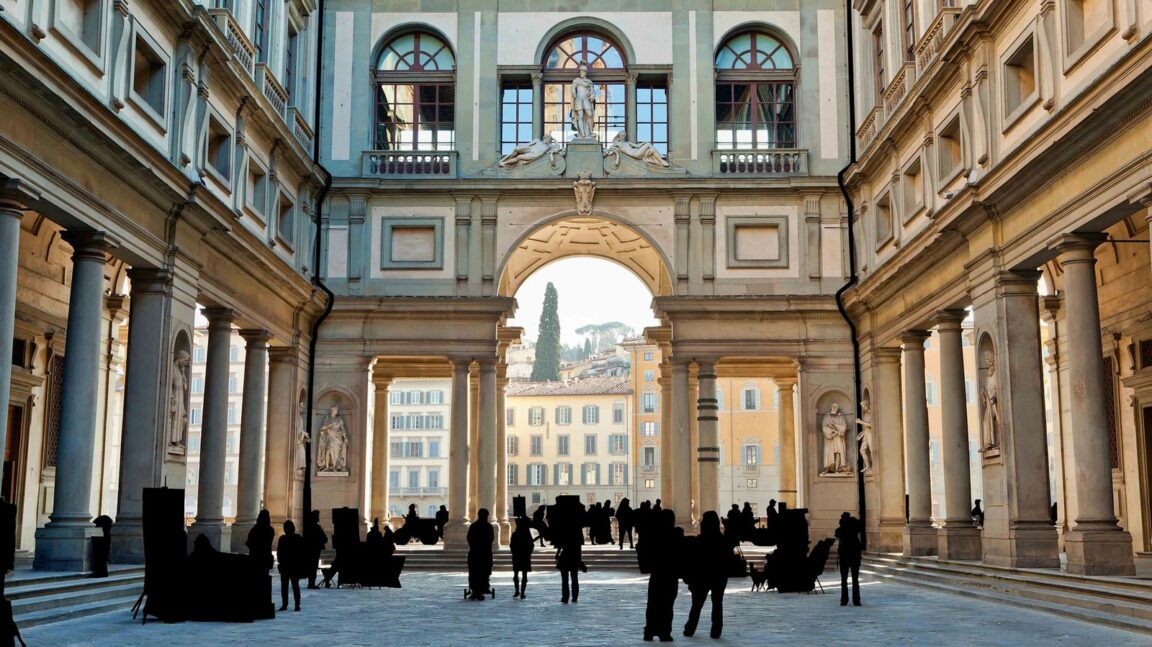
Image credit: The Uffizi courtyard and colonnade, Florence. Photo by Matteo Lezzi, via Unsplash (Unsplash License), via VoyaBear.