 Sofia Rossi
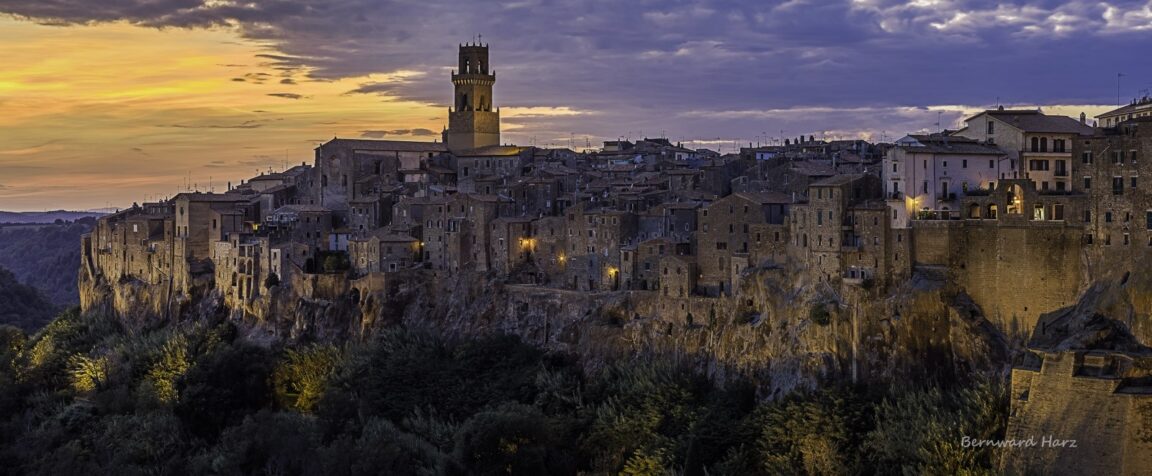
Pitigliano announces itself before you reach it: a town that does not sit on its hill so much as continue it, houses rising vertically out of a sheer tuff cliff 313 metres above the Lente and Meleta river valleys in Tuscany’s southern Maremma. That single view explains the place. The cliff made walls almost superfluous, the soft volcanic rock let Etruscans, medieval builders and a Jewish community that gave Pitigliano its name of Little Jerusalem carve cellars, synagogues, baths and whole sunken roads into the stone, and the same tuff triangle, Pitigliano with Sovana and Sorano, fills one of the great day trips in southern Tuscany. Come for the skyline at dusk, stay for the quarter where kosher wine was made underground and the vie cave, the Etruscan excavated roads, run for over a kilometre through walls of rock up to 20 metres high.
Quick Facts
- Where: Pitigliano, province of Grosseto, in the southern Maremma of Tuscany, close to the Lazio border. It is listed among I Borghi Piu Belli d’Italia, Italy’s most beautiful villages association.
- The setting: The town stands on a tuff ridge at 313 metres above sea level, ringed on three sides by ravines cut by the Lente, Meleta and Prochio rivers, per Visit Tuscany.
- The nickname: Little Jerusalem, for the Jewish community settled here since the 15th century. The synagogue, Museum of Jewish Culture, ritual bath, kosher wine cellar and unleavened bread oven can all be visited.
- The first sight: Palazzo Orsini, the Aldobrandeschi fortress rebuilt by the Orsini in the 15th and 16th centuries, now housing the Civic Archaeological Museum and the Palazzo Orsini Museum.
- The Etruscan layer: The vie cave, corridors carved into tuff by the Etruscan civilisation, some over a kilometre long with walls up to 20 metres high. The Alberto Manzi open-air Archaeological Museum organises the Gradone via cava into city of the living and city of the dead routes.
- The day trip: Sovana, with its necropolis and co-cathedral, and Sorano, with the Citta del Tufo Archaeological Park, complete the tuff towns triangle in one day.
- The taste: Bianco di Pitigliano, among the first Italian white wines to claim DOC status, and the Sfratto, a Jewish pastry of honey, nuts, nutmeg and citrus peel.
A town grown out of rock
Tradition, recorded by Visit Tuscany, gives Pitigliano a double Roman founder, Petilio and Celiano, whose combined names supposedly form the town’s. The archaeology is older and better evidenced: prehistoric settlement, then clear Etruscan presence in the tombs and walls across the area, then Rome. Power passed to the Aldobrandeschi, lords of the Maremma for about 500 years, then to the Roman Orsini, whose Renaissance rebuilding gave the town its palace and much of its present outline, then briefly to Siena, and finally to the Medici and their Lorraine heirs. Through every transfer the geology stayed in charge. Houses were built vertically onto the cliff face, cellars were dug rather than constructed, and the town’s silhouette, best seen from the Madonna delle Grazie viewpoint on the approach road, reads as geology first and architecture second. Arrive late in the day if you can: the tuff takes the evening light, the windows come on one by one, and the distinction between cliff and town disappears completely.
Little Jerusalem: the Jewish quarter
Pitigliano’s Jewish history is the reason this small town carries a name known far beyond the Maremma. A Jewish community settled here from the 15th century and, under the Orsini and later rulers, lived with a degree of integration unusual in central Italy, working as merchants, artisans and lenders at the heart of town life rather than at its margins. The historic ghetto quarter preserves the physical record in the tuff itself. Visitors can walk through the synagogue, first built in the late 16th century, and then descend into the rooms cut beneath it: the Museum of Jewish Culture, the oven where unleavened bread was baked, the cellar where kosher wine was produced, the kosher butcher’s shop, the ritual purification bath and the dyers’ rooms. It is a complete communal infrastructure preserved in a few lanes, and it explains the nickname better than any plaque. The community’s story continued into the 20th century, when local families sheltered Jewish neighbours during the Second World War, a chapter the town remembers with pride. Even the baking carries the history: the Sfratto, a stick-shaped pastry filled with honey, walnuts, nutmeg and citrus peel, is a Jewish Pitiglianese speciality whose name recalls an eviction order, turned over generations into the town’s signature sweet.
Palazzo Orsini, the cathedral and the aqueduct
The secular landmark is Palazzo Orsini, entered before the lanes narrow into the old town. Built as an Aldobrandeschi fortress and restored by the Orsini between the 15th and 16th centuries, it now holds two museums: the Civic Archaeological Museum, where finds from the surrounding Etruscan sites, including the Poggio Buco necropolis, give the vie cave their context, and the Palazzo Orsini Museum of sacred art. From the palace, the lanes run to the Cathedral of Saints Peter and Paul, medieval in origin and repeatedly remodelled, its late Baroque facade and tuff bell tower presiding over the town’s main piazza. On the southern edge, look for the Medici aqueduct, its arches riding the cliff, and the Fontana delle Sette Cannelle, the fountain of seven spouts built in the 16th century as the aqueduct’s monumental end point. None of these sights takes long alone. Together, walked slowly with the cellar doors and ceramics shops of the lanes between them, they fill a morning exactly.
The vie cave: roads cut through the rock
Below and beyond the town lies the strangest inheritance in the Maremma. The vie cave are corridors excavated into the tuff, created by the Etruscan civilisation and still not fully explained: processional or sacred routes, drainage works, defensive passages and ordinary roads have all been proposed, and the truth may be several of those at once. Their scale argues they mattered enormously. Some run for over a kilometre, with walls rising up to 20 metres, and walking one is a distinct sensation: cool, green, silent, the sky narrowed to a strip above walls cut by hand more than two thousand years ago. The most accessible introduction is at the Alberto Manzi open-air Archaeological Museum on the Gradone, which lays out two routes, the city of the living and the city of the dead, pairing a via cava with dwellings and necropolis. Wear shoes with grip, carry water in summer, and give the vie cave the unhurried hour they reward. They pair naturally with another underground Tuscany story in our pages, Saturnia’s Free Hot Springs, an hour’s drive north in the same Maremma landscape.
Sovana and Sorano: completing the triangle
The tuff towns work as a trio, and a day that starts in Pitigliano should end having seen at least one sibling. Sovana, a short drive west, was a major Etruscan centre before it was a quiet village: its necropolis, part of the Citta del Tufo Archaeological Park shared with Sorano, holds monumental tombs cut into the rock, and its Romanesque co-cathedral of Saints Peter and Paul is among the finest small churches in Tuscany. Sorano itself rises from its own tuff spur under the Orsini fortress, with the archaeological park’s vie cave and rock settlements in the woods around it. The three towns share geology and history but not atmosphere: Pitigliano is the lived-in town, Sovana the archaeological pause, Sorano the wilder edge. Drivers should note that the roads between them are slow, winding Maremma lanes, which is part of the pleasure, and that parking sits outside each historic centre, with the centres walked on foot. The pattern matches other boulder and cliff towns we cover, such as Monsanto, Portugal: The Village of Granite Boulders, where the houses and the rock face are likewise one structure.
Eating, drinking and when to come
Pitigliano eats Maremma food: wild boar, lamb, handmade pasta and the produce of the Fiora valley, served in small trattorias along the main lanes. The wine is the headline. Bianco di Pitigliano, grown in volcanic tuff soils, was one of the first Italian whites to claim DOC status, and the town’s cellars, many of them ancient excavations under the houses, still store it where kosher wine was once made. In September the harvest festival SettembrediVino opens the historic centre’s cellars for four days of wine, food and music, the town’s biggest annual event. Spring and autumn give the best walking weather for the vie cave and the clearest evening light on the cliff; summer is hot in the ravines at midday and best split between a morning in the lanes, a long lunch and the vie cave in the shade of late afternoon. However you time it, end at the viewpoint as the light goes. Pitigliano at dusk is the photograph everyone takes, and for once the photograph understates it.
Frequently Asked Questions
Why is Pitigliano called Little Jerusalem?
For its Jewish community, settled since the 15th century and unusually integrated into town life. The synagogue, Jewish culture museum, ritual bath, kosher butcher and kosher wine cellar survive in the former ghetto quarter and can be visited.
What are the vie cave?
Corridors carved into the tuff rock by the Etruscans, some over a kilometre long with walls up to 20 metres high. Their exact purpose is still debated. The Alberto Manzi open-air museum at the Gradone is the easiest way to walk one with context.
How long do I need in Pitigliano?
A full day covers the town, the Jewish quarter, Palazzo Orsini and one via cava. Add Sovana and Sorano and the tuff triangle makes a long, satisfying day trip or a relaxed two days based in Pitigliano.
What should I eat and drink?
Bianco di Pitigliano DOC white wine, Maremma dishes such as wild boar and lamb, and the Sfratto, the honey and nut pastry of Jewish origin that is the town’s signature sweet.
When is the best time to visit?
Spring and autumn for walking weather and evening light. September brings SettembrediVino, the four-day harvest festival when the old cellars open. Summer works if you walk the vie cave early or late in the day.
Facts checked 21 November 2026 against Visit Tuscany, the official tourism portal of Tuscany. Museum opening arrangements vary seasonally: confirm on arrival in town.