 Priya Nair
Saturnia’s famous hot springs are free, and the free part is not a catch: the Cascate del Mulino, a staircase of travertine terraces and milky blue pools beside an old stone mill in the southern Tuscan Maremma, is open around the clock with no ticket, no gate and no booking, fed by the same spring that supplies the five-star Terme di Saturnia resort a short distance away. The water leaves the spring at a constant 37.5 degrees Celsius, at about 500 litres per second, after a forty-year underground journey from Monte Amiata, as the Terme itself describes it. The honest complications are crowds, a paid car park, a sulphur smell that follows your swimsuit home, and having no facilities at the pools themselves. Go at dawn, and most of those complications disappear. This guide explains the terraces, the timing, and how the free falls differ from the spa next door.
Quick Facts
- Where: The Cascate del Mulino, just outside the village of Saturnia, in the municipality of Manciano, province of Grosseto, in southern Tuscany’s Maremma.
- Cost: Free. Entry to the falls has no ticket and no hours. The car park is the cost most visitors pay, reported at about 2.50 euros per hour in recent seasons, so read the signs on arrival.
- Water: Sulphurous thermal water, emerging at the spring at 37.5 degrees Celsius and flowing at about 500 litres per second, slightly cooler by the lowest terraces.
- Hours: The falls are open day and night, all year. The Terme di Saturnia thermal park next door keeps set hours, roughly 9:30 a.m. to 5 p.m. in winter and to 7 p.m. in season.
- The spa alternative: Terme di Saturnia day entry to its thermal park has been listed from 30 euros in 2026; check the official site for the current tariff before planning around it.
- Getting there: A car is close to essential. Saturnia sits about two and a half hours from Rome and around three from Florence, with the nearest stations at Grosseto and Albinia.
- Facts checked: November 21, 2026, against Terme di Saturnia’s official site and Visit Tuscany.
What exactly are the Cascate del Mulino?
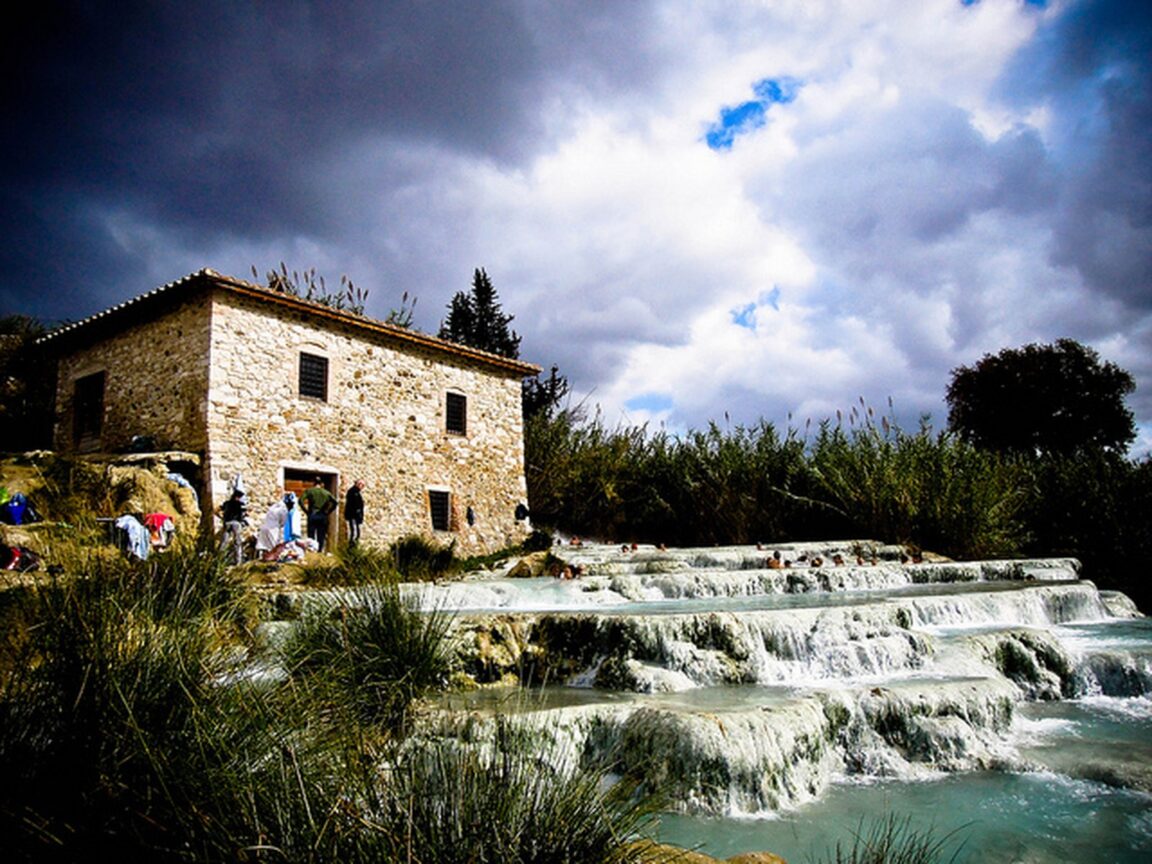
Below the hilltop village of Saturnia, on the road toward Montemerano, a thermal stream called the Gorello drops over a series of natural travertine terraces beside a weathered stone mill, the mulino that gives the falls their name. The water has carved the terraces into shallow, interconnected pools, white-rimmed and milky blue, each spilling into the next. The spring behind it is the real engine: rain that fell on Monte Amiata decades ago travels underground for some forty years, in the Terme’s own account, gathering minerals and heat before rising at Saturnia at 37.5 degrees and flowing, in the resort’s phrase, through the meadows to form the cascades. The water is classified as sulphurous and carbonic, rich in hydrogen sulphide and carbon dioxide, which explains both the milky colour and the unmistakable smell of eggs near the source. The legend is better than the geology, and the Terme tells it on its own site: Saturn, furious at mankind’s warring, hurled a thunderbolt that split the rock and released the hot water to calm everyone down. Etruscans and Romans bathed here long before the resort existed, and the free falls are the continuation of that older, public Saturnia. Travellers building a southern Tuscany loop can pair the springs with the tuff towns covered in our reading of the region, and our Lucca guide covers the region’s gentler north.
The dawn strategy: how to have the terraces nearly to yourself
The Cascate del Mulino is one of Italy’s most photographed natural sites, and by mid-morning in season the terraces fill, the car park fills, and the quiet the place is famous for is gone until evening. The fix is built into the site’s own rules, or rather its lack of them: because the falls never close, dawn is a legitimate visiting hour. Arrive in the first light and the pools are at their most beautiful and their emptiest, steam rising off 37-degree water into cold morning air, the mill in soft shadow, and the day’s first choice of terrace. Winter dawns are the connoisseur’s version: the contrast between cold air and warm water is at its strongest, visitor numbers are at their lowest, and the steam is thick enough to make the whole staircase of pools look like a landscape breathing. The trade-offs are real: no facilities are open that early, the travertine is at its most slippery in the half light, and you will change in the cold. Bring a head torch for the path, water shoes with grip, and a towel and warm layer staged in order so the exit routine takes a minute, not ten.
Which terrace, and how warm is the water really?
Temperature at the falls is a gradient, not a number. The spring emerges at 37.5 degrees, body temperature, and the water loses a little heat on its journey and across each terrace, so the upper pools nearest the mill and the main fall run warmest, and the lower, larger pools run a degree or two cooler and feel more like a warm bath than a hot one. In summer that gradient barely matters; in winter it decides where you settle, and regulars work upward toward the fall as they acclimatise. Depth varies as much as temperature: some terraces are ankle-deep shelves made for lying back in the current, others are proper sitting pools. The travertine underfoot can be gritty and is slippery where algae coats it, so move between pools slowly, in water shoes, and never dive: these are natural rock basins, not a swimming pool, and there is no lifeguard at any hour. Expect the sulphur to do two things the photographs cannot convey: the smell, strongest near the source, and the chemistry, which darkens silver jewellery. Leave rings and bracelets in the car, and give an old swimsuit the job, because the smell clings to fabric through several washes.
The free falls or the Terme: an honest comparison
Both experiences draw on the identical spring, and the choice is about everything except the water. The Cascate del Mulino is free, open always, wild in the literal sense: no changing rooms or lockers at the pools, no sunbeds, no attendants, a small refreshment point with paid showers nearby in season, and your belongings watched by whoever came with you. The Terme di Saturnia, whose resort has stood at the spring since 1919, sells the managed version: a thermal park of outdoor pools fed directly from the source, with hydromassage, changing rooms, showers, loungers, a restaurant and lifeguarded order, plus the hotel’s own spring pool, the Sorgente, for guests and club visitors. Day entry to the thermal park has been listed from 30 euros in 2026, with hours that run roughly 9:30 a.m. to 5 p.m. in the winter season and to 7 p.m. from April into autumn; the resort also runs a white dress code for towels and robes, rentable on site. The sensible verdict: do the falls first, at dawn, because they are unique in Europe and free; add the Terme on the same trip only if you want a full spa day with treatments, or if winter weather makes the unmanaged version unappealing. Many visitors find the falls alone are the memory of the trip. If spa towns are your circuit, our Sky Lagoon guide covers Iceland’s managed end of the same geothermal idea.
Getting there, parking and where to stay
Saturnia is deep Maremma countryside, and the drive is part of the logistics: about two and a half hours from Rome, roughly three from Florence via Siena and Grosseto, on roads that narrow as the hills empty. The nearest railway stations, Grosseto and Albinia, are each the better part of an hour away, which is why almost everyone arrives by car. The falls sit a few kilometres below the village, and parking is in designated areas near the entrance: recent guides put the municipal car park at about 2.50 euros per hour in season, with the warning that it fills by mid-morning on summer weekends, which is one more argument for the dawn arrival, when the park is empty and the walk down is yours alone. For a base, the village of Saturnia itself has small hotels and agriturismi within minutes of the falls; Montemerano, a few kilometres away, is the prettier medieval village; and the Terme resort is the splurge, waking you at the spring itself. Staying nearby matters more than staying grandly, because the whole point of the visit is the hour of day, and a dawn soak followed by breakfast in a village cafe beats a noon soak after a two-hour drive on every measure.
What to bring, and the small rules of the place
Pack for a wild site: swimwear worn under your clothes, because changing space is improvised; water shoes, for the slippery, gritty travertine; a towel and a warm layer for the exit; drinking water; and a dry bag for your phone and keys, which stay with you or locked in the car, never in an unattended pile. Bring nothing valuable that sulphur can ruin. The etiquette is the etiquette of any shared natural place, with one local addition: the terraces are a fragile mineral formation built grain by grain by the water itself, so walk in the pools and on the paths, not across the dry travertine lips between them, and take everything you brought back up the hill with you. Night bathing is legal here, since the falls never close, and on a clear night it is extraordinary; go in a pair, take a torch, and be doubly careful on wet rock in the dark.
Frequently Asked Questions
Are the Saturnia hot springs really free?
The Cascate del Mulino is. Entry has no ticket, no gate and no closing time, day or night, all year. The costs around it are the car park, reported at about 2.50 euros per hour in recent seasons, and anything you spend in the village.
How hot is the water at the Cascate del Mulino?
The spring emerges at 37.5 degrees Celsius, and the upper terraces near the mill stay close to that. Lower pools run slightly cooler, and the water is warm rather than hot, comfortable for long soaks even in winter.
What is the difference between the falls and Terme di Saturnia?
Same spring, different setting. The falls are free, natural and unmanaged, with no facilities at the pools. The Terme is the paid resort at the source, with landscaped pools, changing rooms, showers and treatments, day entry listed from 30 euros in 2026.
When is the best time to visit the Cascate del Mulino?
At dawn, in any season, when the terraces are emptiest and steam rises off the warm water. Winter mornings are the quietest of all. By mid-morning on summer weekends, both pools and car park can be full.
Can I swim at the falls at night?
Yes. The site is open around the clock. Go carefully: there is no lighting or lifeguard, the travertine is slippery, and a torch and a companion are sensible precautions.
Will the water damage jewellery or swimwear?
The sulphur can darken silver jewellery, so leave it in the car. The smell also clings to swimwear through several washes, which is why regulars bring an older suit for Saturnia.
Sources checked November 21, 2026: Terme di Saturnia official site (termedisaturnia.it) for the spring’s temperature, the forty-year underground journey and the resort’s history; Visit Tuscany (visittuscany.com) for the Cascate del Mulino; current-season guides for parking and thermal park tariffs, which change and should be confirmed on the official site. Photo: the Cascate del Mulino and its stone mill, via Visit Tuscany.