 Maya Chen
Hanoi eats by the clock, and the order matters more than the restaurant list: pho bo for breakfast, ideally before eight in the morning when the broth pots are at their freshest; bun cha at lunch, when the charcoal grills come out on the pavement; and ca phe trung, egg coffee, in the afternoon as the finish. Follow that sequence in and around the Old Quarter and you eat the city the way Hanoians built the day around it, one single-dish shop at a time. This guide sequences the three dishes, names the defining addresses, and explains how to order at each stop without a word of Vietnamese beyond the dish names themselves.
Quick Facts
- The order: Pho bo at dawn, bun cha at midday, egg coffee in the afternoon.
- Breakfast address: Pho Gia Truyen, 49 Bat Dan Street, in the Old Quarter, the queue-every-morning beef pho shop named by Vietnam Tourism’s own Hanoi guide.
- Lunch address: Bun Cha Huong Lien, 24 Le Van Huu Street, south of Hoan Kiem Lake, where Barack Obama and Anthony Bourdain ate bun cha together in May 2016.
- Coffee address: Cafe Giang, 39 Nguyen Huu Huan Street, down a narrow alley in the Old Quarter, where egg coffee was invented in 1946.
- Budget: Vietnam Tourism’s Hanoi guide puts a street food meal at 25,000 to 62,000 Vietnamese dong, so the full three-stop day costs less than most hotel breakfasts.
- Cash: The famous one-dish shops are effectively cash operations. Carry small dong notes.
- Prices checked: November 21, 2026, against Vietnam Tourism’s published Hanoi guide ranges.
Why does Hanoi eat in this order?
Each of the three dishes belongs to a part of the day, and the shops enforce it. Pho is a breakfast dish in Hanoi: the best-known shops open around 6 a.m., and many sell out by ten or eleven, because the broth is made for the morning and the regulars come early. Bun cha is a lunch dish, best from about 11 a.m. to 2 p.m., when the charcoal grills are smoking outside the shops and the pork patties and belly slices are cooked to order. Egg coffee is the pause between lunch and evening, a small, rich cup designed to be sat over slowly. Eat pho at noon and bun cha at dawn and you will find the wrong pots, the wrong grills, or a closed shutter. Eat them in sequence and each stop takes twenty to forty minutes, which leaves the rest of the day for the city itself. For the wider planning frame, our Kuala Lumpur itinerary shows how we sequence food days in Southeast Asian capitals, and the same logic runs through our two days in Singapore.
Stop one: pho bo at dawn
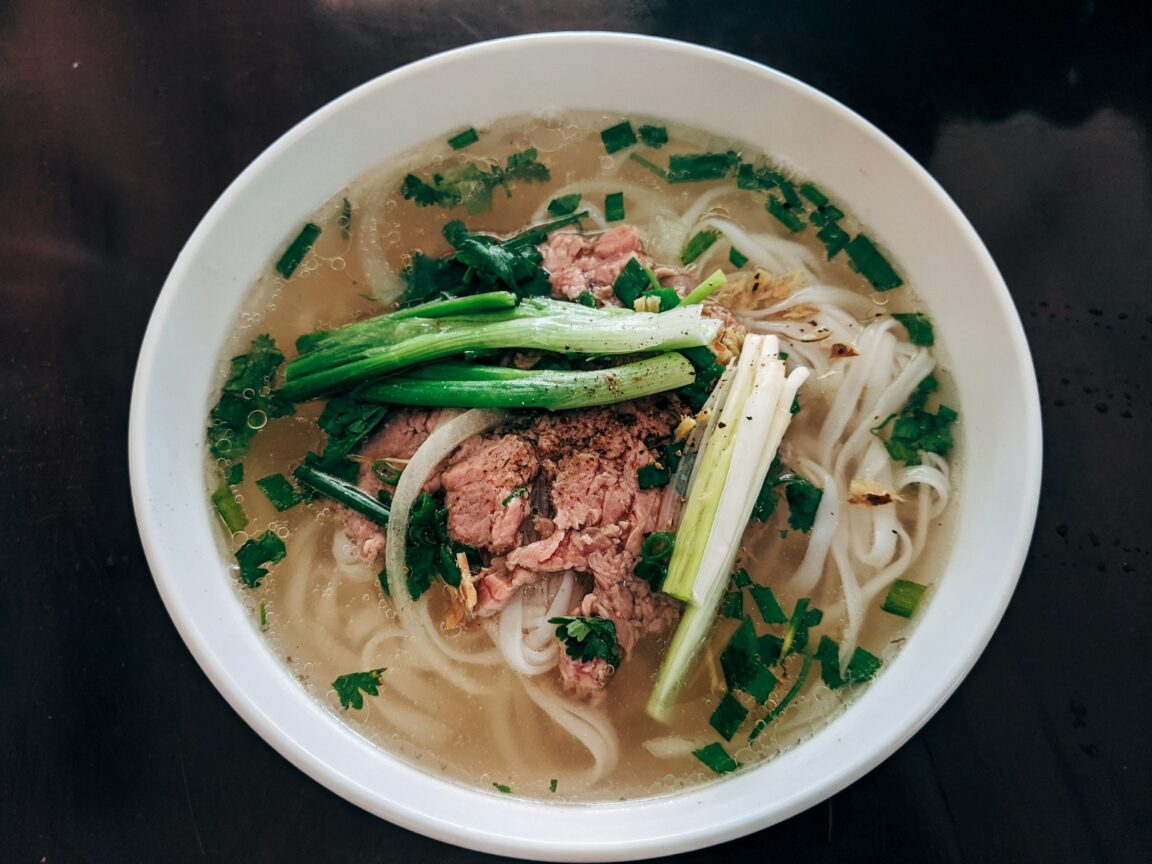
Pho bo is beef noodle soup in a clear, lightly spiced broth, poured over flat rice noodles with thin slices of beef, spring onion and coriander. The Hanoi version is deliberately plainer than the southern style: no plate of basil and bean sprouts, no sweet hoisin, just lime, fresh chilli and pickled garlic at the table. Vietnam Tourism’s Hanoi food guide starts the local day with pho for a reason, calling it not only a typical breakfast but a symbol of Vietnamese gastronomy, and it names Pho Thin among the legendary brands. The other name every Hanoi food source agrees on is Pho Gia Truyen at 49 Bat Dan, where you order and pay at the counter and carry your own bowl to a table.
How to order pho like a regular
The vocabulary is short. Tai is rare beef, sliced thin and cooked by the hot broth in the bowl. Chin is well-done brisket. Nam is flank, and tai chin mixes rare and cooked, which is the order that gives you both textures in one bowl. Quay, the fried dough sticks, are the classic side, torn and dipped into the broth. Pho ga, chicken pho, is the lighter alternative, with shredded poached chicken and lime leaf. Order at the counter, pay, find a seat, and expect the bowl within minutes. The etiquette is equally short: eat while it is hot, season at the table rather than asking the kitchen to change the bowl, and leave when you finish, because the queue behind you is the shop’s whole business model.
Stop two: bun cha at noon
Bun cha is Hanoi’s lunch obsession: charcoal-grilled pork patties and slices of pork belly served in a warm, sweet-sour fish sauce broth with green papaya, alongside a plate of cold rice vermicelli and a pile of fresh herbs. You assemble each mouthful yourself, noodles and herbs into the broth, a piece of pork on top. The dish was documented by the food writer Vu Bang in 1959, and its most famous serving came in May 2016, when Barack Obama and Anthony Bourdain sat down at Bun Cha Huong Lien at 24 Le Van Huu, south of Hoan Kiem Lake. The shop still sells the combination from that meal, and the table is preserved as part of the room’s story. In the Old Quarter itself, Bun Cha Dac Kim on Hang Manh is the other famous name. Whichever you choose, arrive before the peak: the grills are busiest between eleven and one, and many bun cha shops sell out by early afternoon, because lunch is the whole point of the dish.
What makes a bun cha set complete?
A full set is the broth bowl with both cuts of pork, the vermicelli plate, and the herb plate, and many shops offer nem, fried spring rolls, as the add-on. If the set arrives without herbs, ask, because the herbs are not garnish: they cut the richness of the grilled pork and the sweetness of the broth. Eat the pork while it is hot from the charcoal, and do not pour the broth over the noodles; the dipping direction runs the other way, noodles into broth, a small bundle at a time.
Stop three: egg coffee in a hidden lane cafe
Ca phe trung, egg coffee, is the finish the board promised, and its story is precise. In 1946, Nguyen Van Giang, a bartender at the Metropole Hotel, faced a wartime milk shortage and whipped egg yolk with sugar and condensed milk into a foam to stand in for fresh milk, poured over strong robusta coffee. Vietnam Tourism’s Hanoi guide describes the same drink the same way: egg yolk beaten with sweetened condensed milk until it becomes an airy, meringue-like cream over the coffee. Giang later opened his own cafe, and his family still runs Cafe Giang at 39 Nguyen Huu Huan, reached down a narrow alley off the street, which is the hidden lane cafe of the title. Order it hot on a first visit: the cup arrives sitting in a small bowl of hot water to keep the foam warm, and you eat the top with a spoon before stirring the coffee up through it. An iced version exists for hot afternoons. One cup is rich enough to close the day’s eating properly.
How much does the full Hanoi food day cost?
Vietnam Tourism’s Hanoi guide gives the honest frame: a street food or local stall meal runs about 25,000 to 62,000 dong, and a full local restaurant meal 75,000 to 150,000 dong. On those ranges, the three-stop sequence, pho, bun cha and an egg coffee, lands comfortably inside the cost of a single mid-range lunch, even at the famous addresses. What the famous names charge for is the room and the story, not a different dish: the Obama combination at Huong Lien and the counter ritual at Bat Dan are priced as the street food they are. Carry cash in small notes, because card machines are not part of the one-dish shop tradition, and keep the day’s other spending for the evening, perhaps a bia hoi, the fresh draft beer sold at pavement stalls, which the same official guide prices from about 6,000 dong a glass. If street food days are your travel style, our Istanbul food guide applies the same one-dish-at-a-time method to a very different city.
What if you only have a morning in Hanoi?
Then pho is the stop, and it is not close. Bun cha can be found in other Vietnamese cities and egg coffee has spread across the country’s cafes, but a dawn bowl of pho bo in the city where the dish took its modern form, eaten at a counter shop that has already served half the neighbourhood by eight, is the single most Hanoi food experience there is. Go early, order tai chin, add quay, and watch the Old Quarter start its day around you. Add the egg coffee if your morning stretches to mid-morning, because Cafe Giang keeps cafe hours rather than breakfast hours, and treat bun cha as the reason to come back for a lunch.
Frequently Asked Questions
What time should I eat pho in Hanoi?
Early. The best-known pho shops open around 6 a.m. and many sell out by ten or eleven. Arriving before eight puts you in the heart of the breakfast service, with the freshest broth and the local crowd.
Is bun cha a breakfast or lunch dish?
Lunch. Bun cha is built around charcoal grills that fire up for the midday service, roughly 11 a.m. to 2 p.m. Many shops close or sell out by early afternoon.
Where was egg coffee invented?
At the Metropole Hotel in Hanoi in 1946, by bartender Nguyen Van Giang, who whipped egg yolk with condensed milk to replace scarce fresh milk. His family’s Cafe Giang at 39 Nguyen Huu Huan still serves the original style.
How much cash should I carry for a Hanoi street food day?
Enough for meals priced in the 25,000 to 62,000 dong range per stop, per Vietnam Tourism’s Hanoi guide, plus small notes for coffee and beer. The full pho, bun cha and egg coffee sequence is inexpensive by any capital-city standard.
What is the difference between Hanoi pho and Saigon pho?
Hanoi pho is plainer and clearer: a lightly spiced broth, spring onion and coriander, with lime, chilli and pickled garlic at the table. The southern style adds bean sprouts, basil and hoisin, and runs sweeter.
Can I visit all three stops on foot?
Yes. Bat Dan and Nguyen Huu Huan are both in or beside the Old Quarter, and Le Van Huu is a short walk south of Hoan Kiem Lake. The whole sequence fits inside the historic centre.
Sources checked November 21, 2026: Vietnam Tourism (vietnamtourism.gov.vn and vietnamtourism.com) Hanoi food and city guides for dish definitions, addresses, the egg coffee origin and price ranges. Photo: a bowl of pho bo, via Unsplash.