 Aiko Tanaka
South Africa’s remote work visa lets a foreign employee live in the country for more than three months and up to three years while working for an employer based outside South Africa, and the gate is a single number: a gross salary of no less than the equivalent of R650,796 per year, proved with three months of bank statements. Formally it is a visitor’s visa under section 11(1)(b)(iv) of the Immigration Act, endorsed for the prescribed activity of remote work, with the Department of Home Affairs checklist effective 9 October 2024 as the governing document. It is not a work permit for the South African labour market, it cannot be used to take a job with a South African employer, and it is built around an employment contract: the checklist requires a valid contract signed by both the applicant and the foreign-based employer. This guide works through the threshold, the paperwork sequence and the tax registration rule, all checked against the Home Affairs checklist itself.
Quick Facts
- Official name: Visitor’s visa, section 11(1)(b)(iv), for the prescribed activity of remote work, per the Department of Home Affairs checklist effective 9 October 2024.
- Duration: Exceeding 3 months, up to 3 years.
- Income threshold: Gross salary of no less than the equivalent of R650,796 per annum on the Home Affairs checklist, proved by three months of bank statements. The gazetted regulation prints R650,976; show at least the higher figure.
- Employer rule: The employer must be foreign-based, and the contract must be signed by both parties. You may not work for a South African employer on this visa.
- Core documents: Signed application form, statement of purpose and duration, return ticket or reservation, three months of bank statements, passport valid at least 30 days beyond intended departure, employment contract, fee payment, and a yellow fever certificate where applicable.
- Tax: Registration with the South African Revenue Service is built into the category; the timing turns on the 183-day rule and whether your home country has a double taxation agreement with South Africa.
What is the remote work visa, in law?
South Africa did not create a stand-alone digital nomad permit. It created a prescribed activity inside the visitor’s visa system. Section 11(1)(b)(iv) of the Immigration Act covers a foreigner who is required to stay in the Republic in order to conduct work for a foreign employer pursuant to a contract, which partially requires conducting certain activities in South Africa. The Home Affairs requirements sheet, headed “Visitors Visa Section 11(1)(b)(iv) for Prescribed Activity of Remote Work (Exceeding 3 Months to 3 Years)” and effective 9 October 2024, is the document that turns that legal wording into a checklist, and it is the document an applicant should work from, rather than any agency summary. The category sits alongside the points-based work visa reforms gazetted the same day in Government Gazette 51366, but it is a separate route with a separate logic: no South African job offer, no local employer, and no points test, just a foreign salary above a set floor.
The three-year ceiling deserves emphasis because it is unusually generous. Most remote work visas worldwide run for six to twelve months. South Africa’s runs from just over three months to three years, which makes it a relocation instrument as much as a long holiday: long enough to sign a proper lease in Cape Town, base in the Winelands or work from a Kruger-adjacent town, and long enough that the tax and paperwork rules below genuinely matter rather than being fine print. If a shorter stay is all you need, ordinary visitor entry may cover it, and our explainer on South Africa’s new ETA covers the short-stay digital route rolling out for visa-exempt travellers.
What is the income threshold, exactly?
The Home Affairs checklist defines sufficient financial means as a gross salary of no less than the equivalent of R650,796.00 per annum, in the form of three months of bank statements. One wrinkle must be handled honestly: the gazetted regulation itself, the Third Amendment of the Immigration Regulations published on 9 October 2024, prints the figure as R650,976 per annum, R180 a year higher than the checklist. The gazette is the law and the checklist is the department’s own summary of it, so the safe course is to evidence at least R650,976 a year, roughly R54,248 a month, and to make sure the three months of statements show that salary arriving regularly from the foreign employer named in your contract. The threshold is assessed on gross salary, not on savings, investments or projected freelance income, and the evidence the department asks for is the bank statement trail, not a letter asserting the number.
Two consequences follow. First, currency movement matters: if you are paid in dollars, euros or pounds, your salary must clear the rand threshold at the time your statements are assessed, so a salary sitting exactly on the line in a strong-rand month can fall below it in a weak one. Build headroom rather than aiming at the floor. Second, the checklist’s structure favours salaried employees. It requires a valid contract of employment signed by both the applicant and the foreign-based employer, which a freelancer with a roster of client contracts does not cleanly have. Self-employed applicants should expect missions to test that point hard and should take advice before paying fees, because the published category is written for employees.
What paperwork does the checklist require, in order?
The Home Affairs sheet lists eight items, and the sensible sequence is to assemble them in this order. First, the duly completed and signed application form for a visitor’s visa. Second, a statement or documentation explaining the purpose and duration of the visit: this is where you say, plainly, that you will live in South Africa while working remotely for your foreign employer, and for how long. Third, proof of sufficient financial means, the three months of bank statements evidencing the threshold salary. Fourth, the valid contract of employment signed by you and the foreign-based employer, which should state the gross annual remuneration in terms that match the bank statements. Fifth, a valid return air flight ticket or proof of a reservation. Sixth, a passport that expires no less than 30 days after your intended date of departure from South Africa, per regulation 9(1)(a). Seventh, a yellow fever vaccination certificate if you have travelled from, or will transit through, a yellow fever endemic area, with the checklist’s own exception for direct transit. Eighth, proof of payment of the applicable fee.
Apply from outside South Africa, through the South African mission or the visa facilitation centre serving it in your country of residence, and apply before you travel: this is a pre-entry category, not a status you convert to after arriving as a visitor. Missions may ask for supporting documents beyond the core sheet for a stay of this length, so treat the checklist as the floor and the mission’s own list as the final word for your file. Keep the whole set consistent: the salary in the contract, the deposits in the statements, the employer name in the purpose statement and the dates on the return reservation should all tell the same story, because adjudication of this category is essentially a consistency check across those four documents.
What happens about tax once you are in South Africa?
The checklist builds tax registration into the category rather than leaving it as an afterthought. Its second page addresses registration with the South African Revenue Service, and the dividing line is the 183-day mark in any 12-month period, read together with whether your country of tax residence has a double taxation agreement with South Africa. In practical terms: a remote worker who stays beyond 183 days should expect to register with SARS and to work through how the double taxation agreement between South Africa and their home country allocates taxing rights over the foreign salary. This is an area where the cost of guessing wrong is real money, and the visa guidance is a framework, not advice: anyone planning a stay measured in years should take South African tax advice before the 183rd day, not after it. What the visa itself is unambiguous about is the employment boundary: the work you do from South Africa must be for the foreign employer on the contract in your file. Taking employment in South Africa is outside the category entirely.
Where should you base yourself on a multi-year remote work stay?
The visa is national, so the choice is lifestyle rather than law. Cape Town is the default for a reason: a deep rental market, reliable coworking supply and a city that works at walking pace under Table Mountain, and our itinerary for two days in Cape Town doubles as a neighbourhood-scouting route for a longer stay. The Winelands towns, Stellenbosch and Franschhoek, trade city depth for vineyard quiet within commuting distance of Cape Town. Johannesburg offers the country’s largest professional services market and its main international airport. Wherever you land, the paperwork discipline is the same: keep your foreign contract, statements and SARS position current for the full stay, because a three-year visa is a three-year compliance file, not a one-off application.
Frequently Asked Questions
How much do I need to earn for South Africa’s remote work visa?
A gross salary of no less than the equivalent of R650,796 per annum according to the Department of Home Affairs checklist, proved by three months of bank statements. The gazetted regulation prints R650,976 per annum, so evidence at least that higher figure, roughly R54,248 a month, to be safe against the discrepancy.
How long can I stay on the remote work visa?
The category covers stays exceeding three months and up to three years, per the Home Affairs checklist effective 9 October 2024. It is a visitor’s visa under section 11(1)(b)(iv) of the Immigration Act, endorsed for remote work for a foreign employer.
Can I work for a South African company on this visa?
No. The visa covers work conducted for a foreign employer under a contract concluded with that foreign employer. It is not a work permit for the South African labour market, and taking employment in South Africa falls outside its conditions.
Can freelancers apply, or is it employees only?
The published checklist is written for employees: it requires a valid contract of employment signed by both the applicant and the foreign-based employer, and a gross salary evidenced by bank statements. A freelancer with client contracts rather than an employment contract does not fit that wording cleanly and should take advice before applying.
What passport validity do I need?
Your passport must expire no less than 30 days after your intended date of departure from South Africa, per the checklist’s reference to regulation 9(1)(a). In practice, for a stay that can run to three years, a passport with years of validity remaining avoids a mid-stay renewal problem.
Do I have to register for tax in South Africa?
The category carries a South African Revenue Service registration element, with the 183-day mark in any 12-month period as the key threshold and double taxation agreements shaping how a foreign salary is treated. Plan to register and take advice as you approach that mark rather than after passing it.
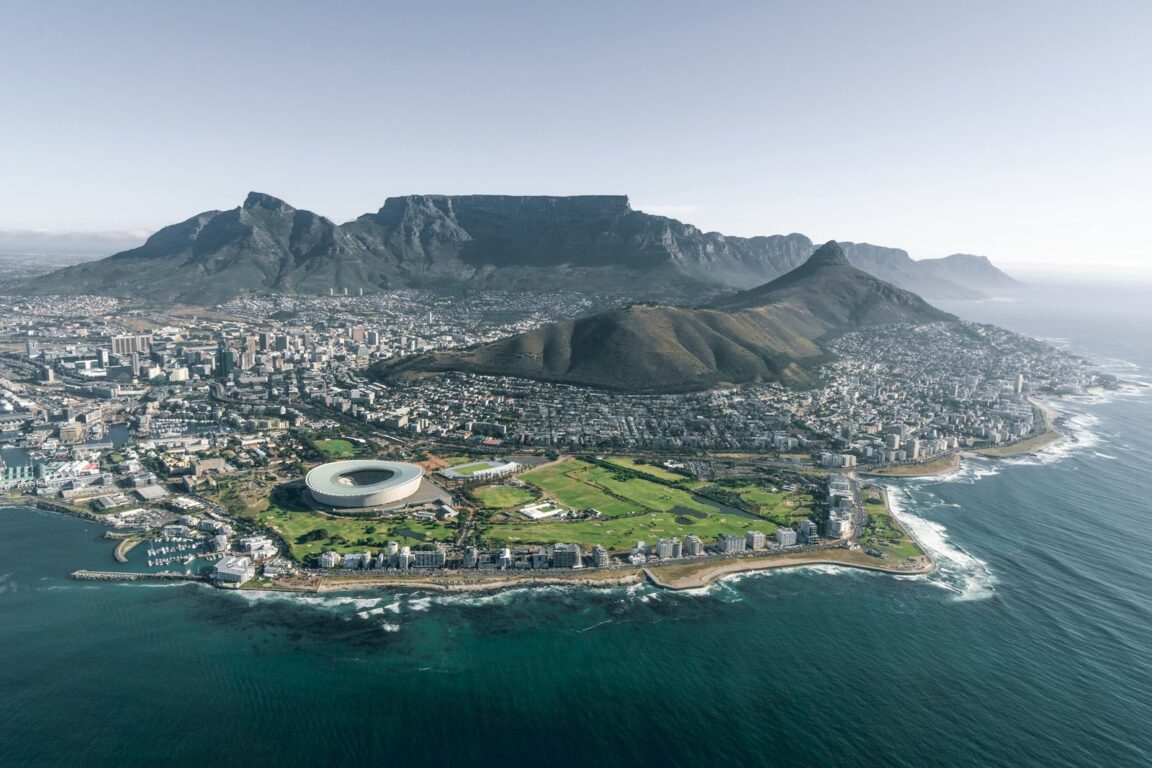
Photo: Cape Town and Table Mountain from the air, with the city bowl and Cape Town Stadium, via Unsplash. Visa details checked against the Department of Home Affairs remote work checklist effective 9 October 2024 on 18 November 2026. This guide is general information, not immigration or tax advice; confirm your file with the South African mission handling your application.