 Lucas Meyer
Lastovo is Croatia’s farthest inhabited island, and the visit only works if you sequence three things in the right order: the ferry, the town, and the coves. The ferry comes first, because Jadrolinija’s car ferry from Split takes the better part of five hours to reach Ubli, the island port, and not every sailing continues beyond Korcula. The town comes second, because Lastovo village does not sit on the sea at all. It climbs an inland amphitheatre in the heart of the island, where 15th and 16th century stone houses carry the tall cylindrical chimneys locals call fumari, each one different from the next. The coves come last, worked clockwise once you understand the island: Zaklopatica on the north coast, Skrivena Luka hidden on the south coast, and Pasadur in the west, all of it inside the Lastovo Archipelago Nature Park, which has protected the whole archipelago of 46 islands, islets, rocks and reefs since 2006. Plan in that order and Lastovo stops being a remote curiosity and becomes a coherent, unhurried trip.
Quick Facts
- Where: Lastovo Island, Dubrovnik-Neretva County, in the southern Adriatic, 14 kilometres south of Korcula. Croatia’s official tourism site, croatia.hr, calls it the most remote inhabited Croatian island, and the nature park calls it the southernmost populated island in Croatia.
- Nature park status: The Croatian Parliament declared the Lastovo archipelago a nature park on 29 September 2006. The park covers 196 square kilometres in total, 53 of land and 143 of sea, across 46 islands, islets, rocks and reefs, the largest of them Lastovo and Susac.
- The chimneys: The fumari are the cylindrical chimneys on the 15th and 16th century family houses of Lastovo town. No two are identical, and the broad terraces called Lastovski sulari are, with the fumari, a trademark of the town.
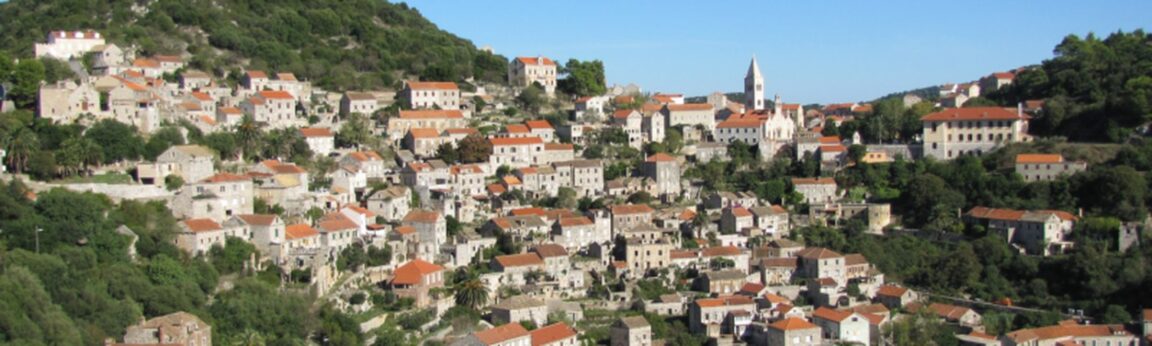
- The town: Lastovo village is an old medieval town in a natural amphitheatre surrounded by mountains, in the heart of the island rather than on the coast. Its stone steps, the Scalinade, envelop the old core around the parish church of St. Kuzma and Damian.
- Getting there: Jadrolinija car ferry line 604 runs from Split to Ubli, the port of Lastovo, calling at Vela Luka on Korcula. Allow about three hours to Vela Luka and about another hour and a half on to Ubli, and check that your sailing actually continues to Ubli.
- Settlements: Five in the park’s count: Lastovo, Zaklopatica, Skrivena Luka, Ubli and Pasadur. The island’s only hotel, Solitudo, is at Pasadur, according to the nature park.
- Climate: One of the sunniest islands in the Adriatic, with an average of about 2,700 hours of sunshine a year, an average January temperature of 8.3 degrees Celsius and an average August temperature of 24.9 degrees, per the nature park.
- Highest point: Hum, whose sightseeing point stands 417 metres above sea level, with Mali Hum at 415 metres and Plesevo brdo at 400 metres close behind, per Croatia’s parks portal.
Why does the ferry decide everything else?
Lastovo can only be reached by sea, and the crossing is long enough to shape the whole stay. Jadrolinija’s line 604 is the car ferry route: Split to Vela Luka on Korcula, then on to Ubli on Lastovo. The first leg takes about three hours and the second about another hour and a half, so the full journey runs to roughly four hours and forty five minutes to five hours and a quarter depending on the sailing. That is not a day trip. It is a commitment, and it is the filter that keeps Lastovo quiet while nearer islands fill up.
The detail that catches planners out is the pattern of the timetable. Outside the summer period, which Jadrolinija defines for 2026 as 29 May to 27 September, the weekday pattern changes and some sailings from Split terminate at Vela Luka instead of continuing to Ubli. In the summer period the route runs daily, with morning and late afternoon departures from Split reaching Ubli the same day. In every season, the rule is the same: choose Ubli as your destination when you search and book, confirm the sailing continues past Korcula, and build your first and last nights around the ferry times rather than the other way round. Return sailings from Ubli can leave very early in the morning, so a final night near the port side of the island, at Ubli itself or at Pasadur a short walk away, removes the pre dawn drive across the island.
Sequence the stay accordingly. Arrive, settle, and give the town its own late afternoon and evening rather than racing straight to a beach. Spend the middle days on the coves and the high ground. Keep the departure morning empty. Travelers who treat Lastovo like Hvar, where the Pakleni Islands sit a short water taxi ride from town, misread the scale here. Lastovo rewards the opposite approach: fewer moves, made in the right order.
What are the fumari, and how do you actually see them?
The fumari are the signature of Lastovo town, and they repay slow looking. The nature park describes the town’s preserved family houses from the 15th and 16th centuries, decorated with cylindrical chimneys that locals call fumari and with high, broad terraces, the Lastovski sulari, which together have become a trademark of Lastovo. Croatia’s parks portal adds the human story behind the skyline: no two chimneys on the island are identical. One widely told explanation is that households built each new chimney bigger and more elaborately ornamented than the one before, to mark out differences between families and to signal wealth, and that the rivalry never really stopped. Some chimneys still carry animal horns, placed there in the belief that they protect against spells. The oldest chimney is believed to be the one on the Renaissance house of the Antica-Biz family.
Seeing them properly means understanding where the town sits. Lastovo village is not a harbour town. It spreads over the slopes of a natural amphitheatre, facing a fertile field, with its back turned to the sea, an arrangement the park notes is unusual on the Adriatic and one reason the town feels so inward and calm. The Scalinade, the stone stair streets, wrap around the old core near the church of St. Kuzma and Damian, with the Rector’s Palace and the Kastel among the landmarks the park lists. Walk the lanes in the late afternoon, when cooking fires make the purpose of a chimney obvious again, then climb to the edge of the amphitheatre and look back across the rooftops. From above, the pattern reads clearly: terrace after terrace, and above every roof a small tower of a chimney, none of them matching. It is the same instinct for stone showmanship you see in miniature in Trogir, Croatia’s island old town across the water, except that in Lastovo the display sits on family houses rather than palaces, and the audience was always the neighbours.
What does nature park status actually change for a visitor?
The designation is not a badge on a brochure. The Lastovo Archipelago Nature Park, run by its own public institution, covers the entire archipelago, land and sea together, and it is bounded by the lighthouses of Susac, Tajan, Glavat and Struga. For a visitor, that means the whole trip takes place inside a protected landscape: the dense forests, the fertile fields with their small ponds, the high coastal cliffs, and the land and underwater caves the park was created to protect. The park runs marked walking trails across the island, boat tours along the northern coast past the bays of Krucica, Zaklopatica, Mihajla and Lucica toward the Lastovnjaci islets, and guided stargazing under a night sky it actively works to keep dark, including public astronomy evenings marking occasions such as World Space Week.
Two practical consequences follow. First, the wildlife is part of the itinerary, not decoration. The parks portal records more than 200 kilometres of walking and cycling trails, a single snake species on the islands that is not poisonous, the Raca cave at 70 metres long with traces of human presence reaching back to ancient history, and seabird colonies on the eastern islets, including the shearwaters that nest near Zaklopatica and call through the night. Second, the island’s history sits inside the park story. In 1252 the islanders accepted the rule of the Dubrovnik Republic in return for written guarantees of local autonomy, and the Statute of Lastovo followed on 10 January 1310. That long habit of self government on the edge of the map helps explain both the fumari rivalry and the island’s fiercely kept carnival.
How should you order the coves, bays and high ground?
Work the coast in a loose circle from the town, one side of the island per day. Start north. Zaklopatica sits only 2 kilometres from Lastovo village on the northern coast, looks across to Korcula, and is known for swimming, diving and sunsets, with restaurants along the bay. Nearby Lucica, which the parks portal calls the last surviving example of a Baroque fishing village, and Mihajla, a bathing spot about 1 kilometre from the town centre that croatia.hr describes as a favourite of locals and visitors alike, make an easy first swimming day without a long drive.
Give the south coast its own day. Skrivena Luka, whose name literally means hidden port, cannot be seen from the open sea and shelters one of the island’s best known anchorages. At its entrance, on Cape Struga, stands the Struga lighthouse, built in 1839 at the edge of a steep cliff above the open sea. The beach in the cove, known as mali zal, has shallows stretching up to 10 metres out, which croatia.hr notes makes it suitable for children and non swimmers. Jurjeva Luka, one of the most protected coves on the island, offers a small pebbly family beach with natural shade. Finish on the west side, where Ubli, the ferry port in the southwest, holds the remains of an early Christian basilica of St. Peter from the 5th to 6th century, and a 3 kilometre promenade runs from Ubli to Pasadur, the bay linked by a stone bridge to the islet of Prezba and the base for most visiting yachts.
Save Hum for a clear day. The viewpoint at 417 metres gives the endless blue panorama the parks portal describes, across hills, deep coves and fertile fields to the scattered islets of the archipelago. Pair it with the town rather than a beach: Hum in the morning, the fumari lanes in the afternoon, and you have read the island from the top down and the inside out.
What is the Poklad, and is it worth timing a trip around?
The Lastovo Poklad is the island’s traditional carnival, and croatia.hr calls it a colourful spectacle that turns the whole island into one big stage. The parks portal traces the custom to 1483, when Moorish forces besieging Korcula sent an emissary to demand Lastovo’s surrender. The islanders detained him, a storm destroyed the attacking fleet, and the prisoner was paraded around the island on a donkey in ridicule, then lowered on a long rope from the hill called Pokladareva grza. The carnival has been preserved and enriched ever since, passed down orally from generation to generation, and the nature park continues to run workshops on safeguarding its future. It falls in the carnival season before Lent, in the depths of the island’s quiet winter, when average temperatures sit in single figures and the ferry pattern is at its thinnest. Timing a trip around it means accepting the full remote island experience in exchange for one of Croatia’s most distinctive living traditions. For most first time visitors, late spring to early autumn remains the practical window, with the summer ferry pattern, warm seas and the full trail network.
Frequently Asked Questions
How long is the ferry from Split to Lastovo?
Jadrolinija’s car ferry line 604 takes about three hours from Split to Vela Luka on Korcula and about another hour and a half from Vela Luka to Ubli on Lastovo, so allow roughly five hours in total depending on the sailing. Always check that your chosen departure continues to Ubli, because outside the summer period some sailings end at Vela Luka.
Can you visit Lastovo as a day trip?
Not sensibly by ferry. With around five hours of sailing each way and a limited daily pattern, a day trip leaves almost no time on the island. Lastovo works as a stay of several nights, with the town, one coast per day, and a clear morning kept for Hum.
What are the fumari of Lastovo?
They are the tall cylindrical chimneys on the 15th and 16th century stone houses of Lastovo town. No two are identical. The parks portal explains them as a friendly rivalry between households, each new chimney built bigger or more ornamented than the last, sometimes topped with horns believed to protect against spells. The oldest is believed to stand on the Renaissance Antica-Biz house.
Why is Lastovo a nature park?
The Croatian Parliament declared the archipelago a nature park on 29 September 2006 because of its landscape value, dense forests, fertile fields, high coastal cliffs, land and underwater caves, and its many marine and land species and habitats. The park covers 196 square kilometres across 46 islands, islets, rocks and reefs.
Where do you stay on Lastovo?
The nature park notes that the island’s only hotel, Solitudo, is at Pasadur, and most other accommodation is in private apartments and houses in Lastovo town and the bays. Basing in Lastovo town puts the fumari lanes and the Scalinade on your doorstep, while Pasadur and Ubli suit the early ferry departure best.
When is the best time to visit Lastovo?
Late spring through early autumn gives the daily summer ferry pattern from 29 May to 27 September, swimmable seas and the sunniest weather on one of the Adriatic’s sunniest islands, with about 2,700 sunshine hours a year. The Poklad carnival is the reason to come in winter instead, accepting colder weather and fewer sailings.
Prices and sailings checked 20 November 2026 against Jadrolinija, the Lastovo Archipelago Nature Park and croatia.hr. Timetables change by season, so confirm your sailing on Jadrolinija before you travel.