 Kwame Mensah
Elmina Castle and Cape Coast Castle, two whitewashed fortresses about 15 kilometres apart on Ghana’s Central Region coast, are among the most important and most sobering heritage sites in West Africa: European trading forts that became departure points in the transatlantic slave trade, and are now UNESCO World Heritage Sites and places of pilgrimage for the African diaspora. Both are visited on guided tours that move from the governors’ rooms and chapels above to the dungeons and the Door of No Return below, and both deserve time, preparation and quiet rather than a rushed photo stop. Paired with the rainforest canopy walkway at Kakum National Park, about an hour inland, they form Ghana’s essential heritage circuit. This guide explains what each castle is, how the tours work, and how to plan the visit honestly.
Quick Facts
- Location: Elmina and Cape Coast, Central Region, Ghana, on the Gulf of Guinea, roughly 150 kilometres west of Accra by road
- Elmina Castle: Built by the Portuguese in 1482 as Sao Jorge da Mina. The oldest European building in sub Saharan Africa. Later held by the Dutch and then the British
- Cape Coast Castle: Timber fort built by the Swedish Africa Company in 1653 as Carolusborg, rebuilt in stone and expanded under the British, who made it the headquarters of their Gold Coast operations
- UNESCO status: Both inscribed in 1979 as part of the Forts and Castles, Volta, Greater Accra, Central and Western Regions listing
- Visit format: Guided tours only inside, typically about an hour at each castle, including the dungeons, the museum rooms and the Door of No Return
- Nearby pairing: Kakum National Park, 375 square kilometres of rainforest, with a canopy walkway of seven bridges suspended about 40 metres above the forest floor
- Time needed: A very long day trip from Accra is possible. Two nights on the coast is the honest recommendation
- Conduct note: Photography rules vary by room and are strictest in the dungeons. Follow the guide’s instructions, and treat the sites as places of memory, not backdrops
What are Elmina and Cape Coast castles?
Elmina Castle came first. The Portuguese built Sao Jorge da Mina in 1482 on a rocky peninsula beside a natural harbour and a thriving local town, making it the earliest European building in sub Saharan Africa. It was built for trade, above all in gold, which is why this coast became known to Europeans as the Gold Coast. The Dutch captured it in 1637 and held it for more than two centuries, and the British took it in 1872. Across those changes of flag, the castle’s function darkened: from gold warehouse to a central holding point in the transatlantic slave trade, in which enslaved Africans were imprisoned in its dungeons before being forced through a narrow door onto ships for the Americas.
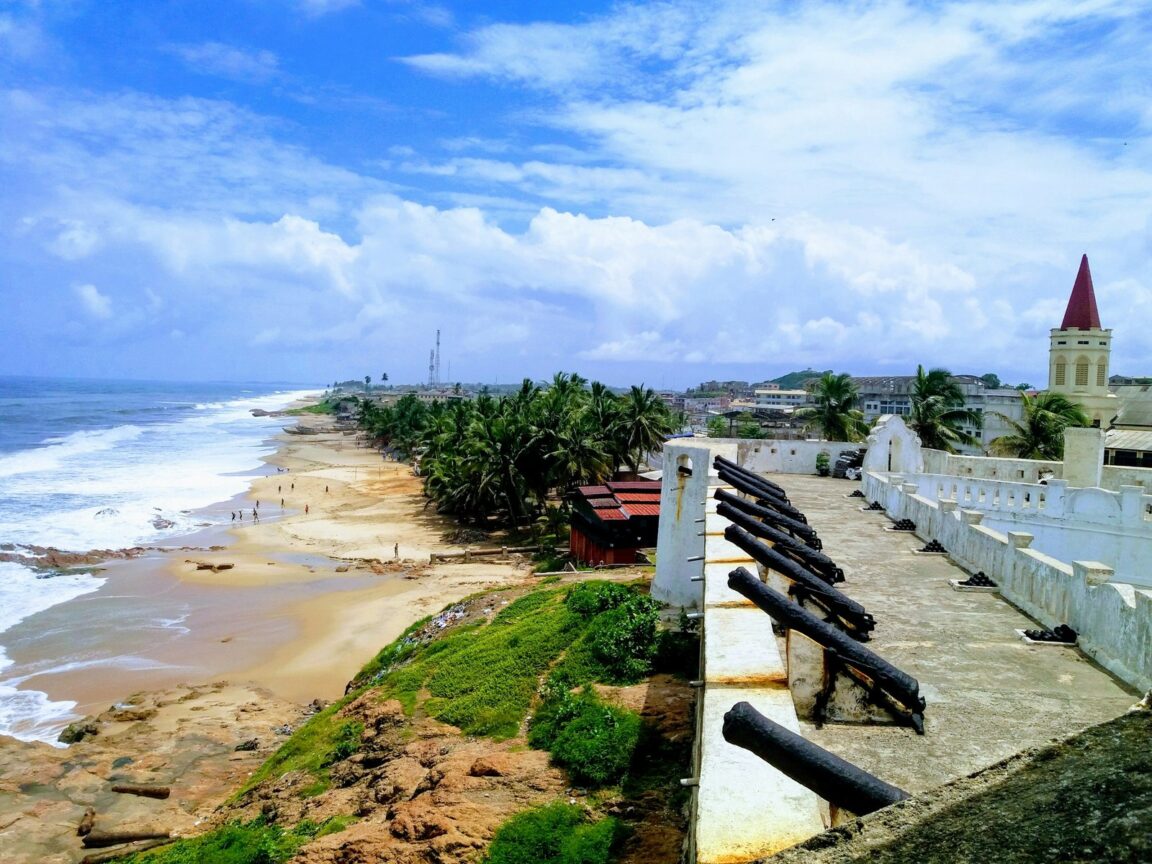
Cape Coast Castle, a short drive east, followed a parallel path a century and a half later. The Swedish Africa Company built a timber fort, Carolusborg, in 1653, initially for trade in timber and gold. The site passed between Swedish, Danish, Dutch and British hands before the British made Cape Coast the capital of their Gold Coast possessions and expanded the castle into the large whitewashed complex that stands today, with its seaward bastions, cannons and church above ground, and below ground the vast dungeons cut into the rock. In 1979 both castles were inscribed on the UNESCO World Heritage List, as part of the serial listing of Ghana’s forts and castles, in recognition of their testimony to the Atlantic gold and slave trades. Their museums are managed under Ghana’s museums and monuments authorities, and the tours are led by site guides.
How does a castle tour actually unfold?
Visits run as guided tours, and the structure is deliberately a descent. A typical tour at Cape Coast begins in the bright upper world: the courtyard, the governor’s apartments, the church, the views from the ramparts over the fishing harbour and the town, cannons pointing out to sea. The guide sets out the trade history, the European rivalries and the castle’s administration. Then the tour goes down, into the male and female dungeons: large, low, dim vaulted chambers where hundreds of enslaved people at a time were held for weeks in conditions the guides describe plainly and without euphemism, with almost no light, ventilation or sanitation.
The route ends at the Door of No Return, the small seaward door through which captives were loaded into boats for the slave ships anchored offshore. At Cape Coast, a wreath laying and a moment of quiet are common, and on the return side of the same door a second inscription now reads Door of Return, a symbolic reversal created for diaspora visitors coming back. At Elmina the equivalent sequence includes its dungeons, the courtyard where enslaved women were held, and the Portuguese church within the walls, among the oldest church buildings in sub Saharan Africa. Allow about an hour for each tour, and do not stack the two castles back to back without a break: lunch, sea air and an unhurried hour between them is not wasted time, it is how the second visit remains a visit rather than a blur. Travellers drawn to difficult history handled with this kind of care may also value our guide to eating and gathering in Addis Ababa, a city whose museums carry their own heavy twentieth century story.
What should you know before you go down into the dungeons?
Three practical things. First, the dungeons are physically demanding in a small way: uneven floors, low light, heat and limited air. Anyone with mobility difficulties or claustrophobia should tell the guide at the start, because stepping out is always permitted and never judged. Second, photography is restricted in the most sensitive spaces and guides enforce the current rules on the day, so keep cameras put away until told otherwise. Third, the emotional weight is real and unevenly distributed: descendants of enslaved Africans, school groups, Ghanaian families and international tourists are often in the same tour group, having visibly different experiences of the same rooms. Quiet, and letting the guide finish, is the whole etiquette.
Why is this coast a homecoming for the diaspora?
Ghana has deliberately built a relationship with the African diaspora around this coast. In 2019 the country marked the Year of Return, commemorating 400 years since the first enslaved Africans arrived in Virginia in 1619, and invited people of African descent worldwide to visit, invest and in some cases relocate. The programme that followed it, Beyond the Return, continues that work. At the castles themselves, this shows in ceremonies of remembrance, in naming and atonement rituals some groups arrange in advance, and in the Door of Return symbolism at Cape Coast.
For a heritage traveller, the practical consequence is that these visits are often arranged as pilgrimages rather than sightseeing: groups travel with pastors, historians or family elders, combine the castles with the Assin Manso Slave River site inland, where captives were bathed before the march to the coast, and allow days, not hours, for the coast as a whole. Independent travellers are welcome on the same public tours, and joining one respectfully, rather than seeking a private shortcut, is usually the richer experience. Barack and Michelle Obama visited Cape Coast Castle in 2009, and a plaque in the castle records the visit, one marker among many of the site’s place in diaspora memory.
How does Kakum’s canopy walkway fit the same trip?
Kakum National Park, inland from Cape Coast, protects about 375 square kilometres of moist tropical rainforest, one of the last substantial blocks in Ghana. Its famous feature is the canopy walkway: a series of seven suspension bridges linked between great trees, running for more than 300 metres at about 40 metres above the forest floor. The walk itself takes roughly half an hour at a gentle pace, with vertigo as the main challenge, and guided forest walks at ground level cover the medicinal plants, butterflies and birdlife, with forest elephants present in the park but rarely seen.
Kakum belongs in this itinerary for a reason beyond variety. After the castles, a morning in green, living forest, with hornbills overhead and the canopy moving in the wind, restores the capacity to take anything in. Order matters: many travellers do Kakum early in the morning, when the forest is most active and the walkway least crowded, then visit one castle in the afternoon, and the second castle the following morning. That sequence is only possible with a night on the coast, which is the planning conclusion this whole guide points toward. Stay in Cape Coast town for access, or at one of the beach resorts west toward Elmina for quiet, and let the Accra road, which can be slow, happen on a travel day rather than between the dungeons and a flight. Readers continuing along this coast in either direction will find a kindred working port turned heritage town in our guide to Swakopmund in Namibia, where German colonial facades raise a different set of honest history questions.
How should you plan the logistics?
From Accra, the drive to Cape Coast is roughly 150 kilometres and commonly takes three to four hours depending on traffic leaving the capital, which is why day trips start before dawn and return late. Hiring a car with a driver is the standard independent approach, public coaches run to Cape Coast town, and organised day tours bundle Kakum and both castles into one very long day. Two nights on the coast converts the same elements into a humane schedule: day one for Kakum and Elmina, day two for Cape Coast Castle at opening time, when tours are smaller and the light on the whitewash is at its best.
Entry fees at Ghanaian heritage sites are tiered by nationality and change periodically, and the castles and Kakum each charge separately, with additional fees sometimes applying for cameras where photography is permitted, so carry Ghanaian cedis in cash and check current rates with the sites or a local operator shortly before visiting rather than trusting any printed figure, including ours. Dress for heat, carry water, and note that both castles involve steps and uneven historic floors. The coast is warm year round, with the main rains roughly from May to July and a shorter rainy period in autumn, when Kakum’s forest is at its lushest and its paths at their muddiest.
Frequently Asked Questions
Which castle should you visit if you only have time for one?
Cape Coast Castle, for the scale of its dungeons, its museum and the Door of No Return and Door of Return pairing. Elmina is older and in some ways more atmospheric, with its fishing harbour setting. If time allows, visit both: they are about 15 kilometres apart and the comparison is instructive.
When were Elmina and Cape Coast castles built?
Elmina Castle was built by the Portuguese in 1482 as Sao Jorge da Mina, the oldest European building in sub Saharan Africa. Cape Coast Castle began as a Swedish timber fort, Carolusborg, in 1653 and was rebuilt and expanded in stone, principally under the British. Both were UNESCO listed in 1979.
How long does a castle tour take?
About an hour at each castle, on a guided tour that covers the upper rooms and church, the dungeons and the Door of No Return. Allow half a day for both castles with travel and a proper break between them, rather than rushing from one dungeon to the next.
What is the Door of No Return?
It is the small seaward door at the castles through which enslaved Africans were forced onto boats for the slave ships, so named because those who passed through it were not expected ever to return. At Cape Coast the return side of the door is now also marked Door of Return, as a symbol for diaspora visitors coming back.
How high and how long is the Kakum canopy walkway?
The walkway links seven bridges between rainforest trees for more than 300 metres, suspended about 40 metres above the forest floor in Kakum National Park. The crossing takes roughly half an hour, and guided ground level forest walks are available for anyone who prefers not to cross.
Can you do Cape Coast as a day trip from Accra?
Yes, and many do, but it is a very long day: roughly three to four hours of driving each way, plus Kakum if it is included. Staying one or two nights on the coast allows early, quieter castle tours and a far less exhausting experience, and is the recommended approach for heritage travellers.