 Rafael Santos
Salta is the base that makes Argentina’s northwest work: a colonial city at about 1,200 metres in the Lerma Valley, with the red canyon country of the Quebrada de las Conchas and the high vineyards of Cafayate to the south, and the Tren a las Nubes climbing west into the Andes. Give it several nights rather than one. The city itself rewards two unhurried days, and every headline excursion from it is a full day on the road, so a base of four or five nights lets the region unfold without turning each outing into an endurance test.
Quick Facts
- Where: Salta Province, northwest Argentina, in the Lerma Valley at the foot of the Andes
- Altitude: The city sits at roughly 1,200 metres; Cafayate is at about 1,683 metres; the Tren a las Nubes reaches 4,220 metres at La Polvorilla
- Known for: Plaza 9 de Julio, the Cathedral and Cabildo, the MAAM high altitude archaeology museum, empanadas saltenas and folk music penas
- South circuit: National Route 68 through the Quebrada de las Conchas to Cafayate, about 190 kilometres each way with stops
- Signature wine: Torrontes, the aromatic white of Cafayate, plus high altitude Malbec from vineyards that climb past 3,000 metres in the wider Calchaqui Valleys
- Best months: The dry season, roughly April to November, for clear roads and canyon light
- Prices checked: 14 November 2026. Argentine prices move quickly, so this guide states no fares and points to operators for current figures
Why does Salta deserve several nights, not one?
Most visitors meet Salta as a transit point, a night between the airport and somewhere else. That undersells both the city and the country around it. Salta, founded in 1582 and nicknamed Salta la Linda, Salta the Beautiful, preserves a colonial centre that many larger Argentine cities have lost: arcaded streets around a palm planted main square, a pink and cream cathedral, and the white arched Cabildo, now a museum of regional history. Travellers planning the wider northwest loop will find useful context in our guide to Arequipa, Peru, another high colonial city that works best as a base rather than a stopover, and in our 3 days in Buenos Aires itinerary, the usual gateway for flights north to Salta.
The second reason is geography. Salta’s excursions radiate in different directions and none of them compress well. The Cafayate drive is a full day south. The Tren a las Nubes is a longer day west and up. The city days in between are not filler: they are when the museums, the evening penas and the simple pleasure of the plaza at dusk happen. Build the trip as a base with spokes, and Salta stops feeling like a corridor.
What should you see in Salta city itself?
Plaza 9 de Julio and the colonial core
Start at Plaza 9 de Julio, the shaded square at the heart of the old town. The Cathedral stands on its northern side, and the Cabildo’s long arcade runs along the south. Cafes under the arcades make the square an easy place to begin and end each day. A few streets away, the Iglesia San Francisco rises in deep red and gold, with one of the tallest church towers in South America, and it is the building most likely to stop walkers mid stride for a photograph.
MAAM: the museum of high altitude archaeology
On the plaza, the Museo de Arqueologia de Alta Montana, known as MAAM, presents the story of the Llullaillaco children, three Inca children found in 1999 near the summit of the Llullaillaco volcano and preserved by cold and altitude. The museum displays one child at a time for conservation reasons, alongside textiles, pottery and offerings from high Andean shrines. It is a quiet, carefully handled museum, and it changes how visitors read the mountains around Salta afterwards. The museum’s own site lists opening from Tuesday to Sunday; check current hours before a visit, as schedules change.
Cerro San Bernardo and the evening city
Late in the day, ride the teleferico cable car up Cerro San Bernardo, the hill east of the centre, for the view across the city grid to the mountains. Walkers can climb the stone staircase instead. Evenings belong to dinner and music: empanadas saltenas, small, juicy and baked, are the essential first course, often with humita, a steamed corn preparation, and locro, the hearty corn and bean stew of the northwest. Afterwards, the penas along Calle Balcarce and long running local favourites fill with guitars, drums and zamba dancing, usually starting late in the evening.
How does the drive south through the Quebrada de las Conchas work?
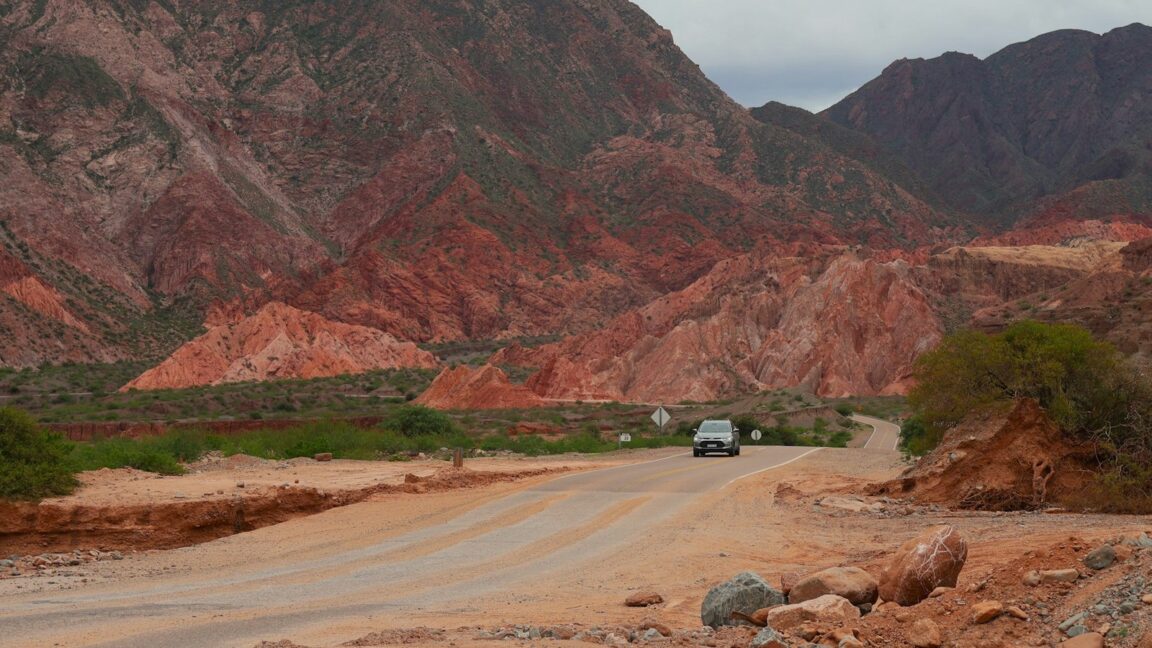
The road to Cafayate, National Route 68, runs south from Salta through the Quebrada de las Conchas, also called the Quebrada de Cafayate, a canyon cut through red sandstone inside the Calchaqui Valleys. The formations have names because each one earns it: the Garganta del Diablo, a great cleft in the rock that visitors can walk into; the Anfiteatro, a natural amphitheatre with startling acoustics; Los Castillos, towers that read as castle walls; and a string of viewpoints where the strata tilt and fold in bands of red, ochre and grey green.
Allow a full day for the round trip. The distance is about 190 kilometres each way, but the stops are the point, and the light changes the canyon through the day. Travellers who drive themselves should start early, carry water, and expect the return to Salta after dark if Cafayate’s bodegas get a proper visit. Organised day tours run the same circuit and handle the driving, which matters on a road where the driver also wants to look at the walls.
What makes Cafayate wine country different?
Cafayate is a small, relaxed wine town at about 1,683 metres, and its vineyards are among the highest in the world. Around the town, vines grow at roughly 1,750 metres and higher, and in the wider Calchaqui Valleys plantings climb far beyond that: Bodega Colome, founded in 1831 and among Argentina’s oldest working wineries, farms vineyards between 1,700 and 3,111 metres, the top site known as Altura Maxima. Intense sun, dry air and a large swing between daytime heat and night cold are the standard explanation for the wines’ concentration, and local sources repeat the same trio of factors.
The grape to taste first is Torrontes, Argentina’s signature aromatic white, floral and crisp, which has its strongest association with Cafayate and the north. High altitude Malbec is the red counterpart, darker and more structured than many drinkers expect from the variety. Many bodegas sit within walking or cycling distance of Cafayate’s plaza, which makes a night in town more rewarding than a rushed tasting on a day tour: stay over, taste in the late afternoon, and drive the canyon again the next morning in the opposite light.
Is the Tren a las Nubes worth a day?
The Tren a las Nubes, the Train to the Clouds, is one of the great railway excursions of the Americas, and it needs honest framing. Since the service was rebuilt after 2014, the day no longer runs by train from Salta. Passengers travel from Salta by coach up National Route 51 through the Quebrada del Toro to San Antonio de los Cobres, a mining town at 3,774 metres, board the train there around midday, and ride to the La Polvorilla viaduct and back. The viaduct is a curved steel trestle 224 metres long and 64 metres high, at 4,220 metres above sea level, on the C-14 branch built under engineer Richard Maury from 1921 and completed in 1948.
The altitude is the real planning issue, not the timetable. The day climbs from about 1,200 metres to 4,220 metres in a morning, which is fast by any standard. The operator treats the trip as a high mountain excursion, advises eating lightly and skipping alcohol, and can cancel departures for weather. Book through the official Tren a las Nubes site, check the current season’s departure days there, and keep the day after flexible if the mountains are the heart of the trip. Travellers who love railways rate the day highly; travellers short on time usually get more from the Cafayate circuit.
How many nights, and how should you order them?
A workable pattern is two nights in Salta on arrival, a night or two in Cafayate, then a final night back in Salta before flying out, which breaks the canyon drive into two one way journeys in different light. With five or six nights, add the Tren a las Nubes as a full day from Salta and keep one city day unplanned for MAAM, the market streets and a slow plaza evening. Altitude argues for this order too: sleep first at Salta’s moderate height, take Cafayate next, and leave the 4,220 metre train day for when the body has had a few days to adjust.
Frequently Asked Questions
How do you get to Salta?
Most visitors fly. Salta’s airport receives domestic flights, including from Buenos Aires in about two hours. Long distance buses connect Salta with Buenos Aires and other Argentine cities, but journeys are very long compared with flying.
When is the best time to visit Salta and Cafayate?
The dry season, roughly April to November, brings the clearest skies and the most reliable mountain roads. The summer months, December to March, are warmer and wetter, and heavy rain can affect rural roads in the northwest.
Do you need a car for the Quebrada de las Conchas?
No. A car gives the most freedom for stops and light, but organised day tours from Salta run the Cafayate circuit daily in season and remove the need to drive back through the canyon at the end of a tasting day.
How high is the Tren a las Nubes, and does altitude matter?
The train reaches the La Polvorilla viaduct at 4,220 metres, and passengers sleep the night before at about 1,200 metres in Salta. That rapid gain is why the operator advises a light breakfast, no alcohol and a gentle pace, and why travellers with altitude concerns should take medical advice before booking.
What wine should you taste in Cafayate?
Start with Torrontes, the aromatic white most closely associated with Cafayate, then compare a high altitude Malbec. Tasting rooms cluster near the town plaza, and current opening arrangements are best confirmed with each bodega.
Is one night in Salta enough?
For the city alone, two nights is more realistic once MAAM, Cerro San Bernardo and an evening pena are included. For the region, treat Salta as a base of several nights and add Cafayate as an overnight rather than a dash.
Featured image: Red sandstone cliffs in the Quebrada de las Conchas, Salta Province. Photo on Unsplash, Unsplash License (Unsplash photo file photo-1789231957394, published with this caption on Next Stop Anywhere’s Salta and Jujuy guide, which credits its photography to its named Unsplash contributors collectively; full record in the article JSON). Facts checked 14 November 2026 against operator, museum and regional sources linked in the text.