 Jonas Lindqvist
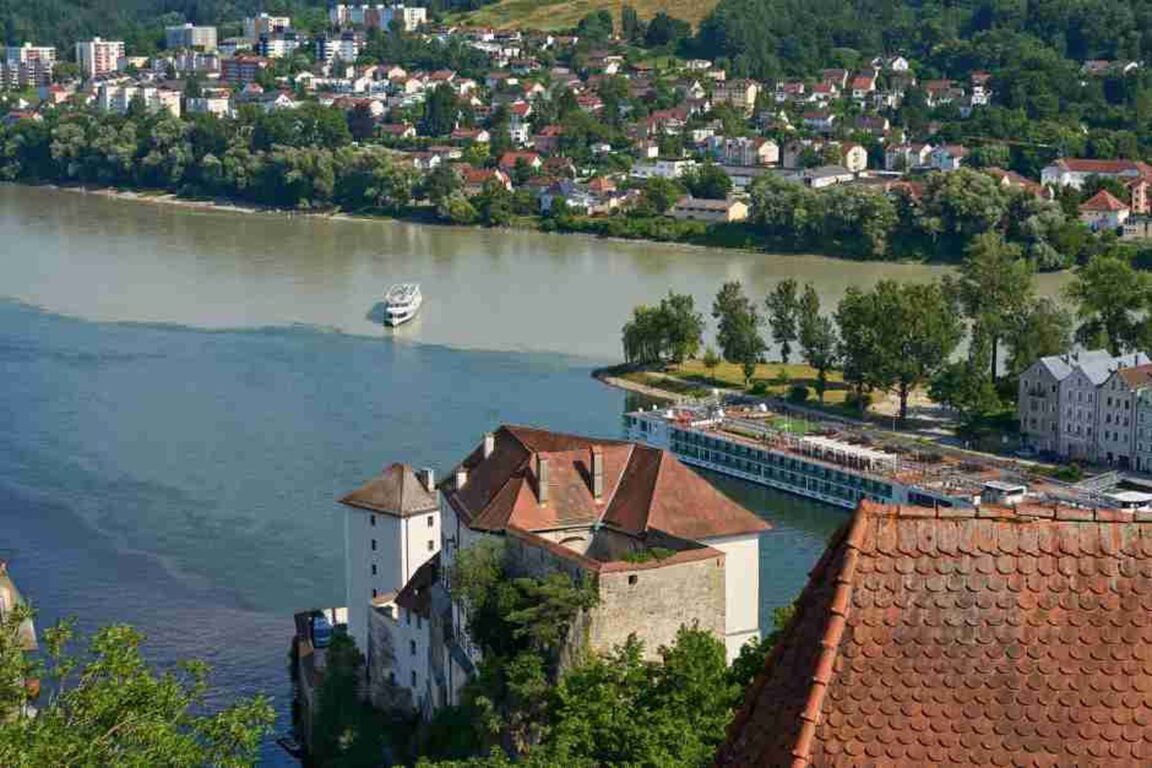
Walk to the very tip of the old town first, and stand at the railing where the three rivers meet, then climb to the Veste Oberhaus fortress and read the same view from above: that ground level, then panorama order is the right first morning in Passau. At the Dreiflusseeck, the point the Germans also call the Ortsspitze, the green Inn slides in from the south, the blue brown Danube arrives from the west and the small dark Ilz drops down from the Bavarian Forest in the north, and on a clear day after rain you can watch the three colours run side by side before they mix. Everything else in this guide, the cathedral, the lanes and the Ilz walks, hangs off those two views.
Quick Facts
- Location: Passau, Lower Bavaria, Germany, on the Austrian border, where the Danube, Inn and Ilz converge.
- The point: The Dreiflusseeck, or Three Rivers Corner, at the eastern tip of the old town peninsula, open at all hours and free.
- The panorama: Veste Oberhaus, the fortress founded in 1219 by the prince bishops of Passau on the hill across the Danube.
- Fortress museum: Open in season, mid March to mid November, Monday to Friday 9:00 to 17:00 and weekends 10:00 to 18:00; adult entry is listed between 5 and 7 euros across current sources, so confirm at the gate or the museum site before a special trip.
- The climb: About 15 to 20 minutes on foot up a switchback path from the old town, or the seasonal shuttle bus from Rathausplatz during museum hours.
- The cathedral: St Stephen Cathedral holds the largest cathedral organ in the world, with 17,974 pipes; midday organ concerts run in season, listed at 5 euros, with evening concerts at 10 euros.
- Getting there: Passau is the last major German rail stop before Austria, about two and a half hours by direct train from Munich and about 90 minutes from Regensburg.
What should a first timer do first at the three rivers point?
Go to the point itself, on foot, through the old town. The peninsula is barely a kilometre long, so the walk from the cathedral ridge east to the tip takes minutes, and it teaches you the city geography better than any map: Danube on your left, Inn on your right, lanes dropping steeply between them. At the railing at the very tip you are standing inside the phenomenon rather than looking at it. The Inn, remarkably, often looks the larger river, greener and faster; the Danube is deeper and carries the name away east toward Austria. A memorial at the point remembers those lost to the rivers, a sober footnote in a flood city: the old town hall nearby carries flood marks up its tower, the highest from the great flood of 2013.
Do not rush away. The colours are the exhibit, and they change with weather and season: clearest after rain has fed the Ilz with dark forest water, softest in flat winter light. Photographers should treat the point as the close up and save the wide shot for the fortress, which is the next move. If a sightseeing boat is boarding at the Danube promenade, the short Three Rivers cruise is the third angle, from the water itself; in the shoulder season the published afternoon departures end earlier in the day, around 15:00 from October in current timetables, so book it in the morning rather than leaving it to chance.
How does the Veste Oberhaus complete the picture?
Cross the Danube and climb. The Veste Oberhaus has watched this confluence since 1219, built by the prince bishops who ruled Passau and taxed its river trade, and rebuilt across the centuries into the Gothic, Renaissance and Baroque complex that stands today, its facade still carrying the painted date 1499 from one of those rebuildings. The walk up takes 15 to 20 minutes on a switchback path; the museum shuttle from Rathausplatz runs in season for anyone whose legs are done. From the walls and the observation tower the whole system resolves at once: the old town peninsula below, the Inn arriving from Austria, the Ilz cutting down from the forest, and the merged Danube leaving east. It is one of the finest river panoramas in southern Germany.
Inside, the Oberhausmuseum covers the history of Passau and its region, and the fortress also houses a youth hostel, which makes it the best value bed in town for travellers who prize a view over a lobby. Practical honesty matters here: the museum keeps a season, roughly mid March to mid November, with limited Christmas openings, and the courtyard surfaces are uneven and parts of the exhibition and tower are not step free, so visitors with limited mobility should confirm the accessible viewpoint route with the museum before climbing. In deep winter, swap the fortress interior for the Glass Museum in the old town and keep the outdoor point and riverside walks, which never close. Travellers following the Danube upstream should compare our Durnstein where to stay guide for the Austrian stretch of the same river.
What fills the rest of a first day: cathedral, lanes and the Ilz?
Give the late morning to St Stephen Cathedral, the great Baroque church rebuilt after the city fire of 1662, whose organ of 17,974 pipes across 233 registers is the largest cathedral organ in the world. The midday concert in season is the efficient way to hear it: short, seated and timed so the afternoon stays free. Below the cathedral, the Hollgasse artists lane and the painted old town streets reward an unplanned hour, with the caveat that the cobbles turn slippery in rain.
Save the Ilz for the afternoon walk. The smallest and darkest of the three rivers is the local one: its valley path runs north from near the fortress side into quiet, wooded water, a complete change of register from the shipping scale Danube, and the campsite and bathing spots along it show you the Passau residents actually use. Walk out as far as energy allows and turn back on the same path; the Ilz rewards the first hour most. Finish back at the point near dusk if the day allows, when the cruise boats have gone and the three colours flatten into one dark sheet heading for Austria. For the other end of this river system in Austria, our Hallstatt Dachstein road guide covers the Salzkammergut country the Danube traffic feeds into.
Where should you stay, and how long should you give Passau?
Stay in the old town if you can. The peninsula hotels put the point, the cathedral and the fortress climb inside a ten minute walk in three different directions, and the evening, when the cruise groups have reboarded and the lanes empty, is when the city is at its best. The fortress youth hostel is the budget outlier with the panorama built in, and the streets across the Inn in the Innstadt district give a quieter, more residential base with the classic postcard view back across the water to the old town facades. Drivers should note that old town parking is in garages at the edges of the peninsula, one more reason this is a walking city from the moment you arrive.
One full day is the minimum that does the place justice: the point and the fortress in the morning order this guide sets out, the cathedral concert at midday, the lanes and the Ilz in the afternoon. A second day opens up the Danube properly, with a longer boat run toward Linz or the cycle path east into Austria, and walkers can add the Mariahilf pilgrimage church above the Inn, reached by its long covered stairway, for the third great viewpoint of the trip. Passau also works as the hinge of a longer route: Regensburg upstream, Linz and the Wachau downstream, and the Bavarian Forest behind the Ilz valley, all from one base.
Frequently asked questions
Where exactly is the Dreiflusseeck?
At the Ortsspitze, the easternmost tip of Passau old town peninsula, where the Inn and the Ilz join the Danube. It is reached on foot through the old town, is open at all hours and costs nothing.
Which viewpoint is better, the point or the fortress?
They do different jobs. The point puts you at water level inside the confluence, where the three colours run side by side. The Veste Oberhaus gives the panorama that explains the geography. A first visit should do both, point first, fortress second.
How long does the climb to Veste Oberhaus take?
About 15 to 20 minutes on foot up a switchback path from the old town. A shuttle bus runs from Rathausplatz during museum hours in season.
When is the Oberhausmuseum open?
In season, roughly mid March to mid November, Monday to Friday 9:00 to 17:00 and weekends 10:00 to 18:00, with limited openings around Christmas. The point and the riverside walks are outdoors and always open.
How do you reach Passau without a car?
By train. Passau sits on the Munich to Vienna main line, about two and a half hours from Munich and about 90 minutes from Regensburg, and the old town, the point and the fortress climb are all walkable from the station side of town.
Featured image: The confluence at Passau, where the waters of the Inn and Danube meet below the old town, photographed from the Oberhaus side. Photo by Lukas Seitz on Unsplash, via the captioned hosted copy at TravelWorldOnline. Unsplash License. Facts checked 16 November 2026.