 Thandiwe Nkosi
The honest headline is this: the Dachstein side of Hallstatt is spectacular but only partly step free. The cable cars from Obertraun can carry most visitors up the mountain, and the Hallstatt salt mine funicular is being rebuilt as a fully accessible lift, but the famous Five Fingers platform sits at the end of a 20 to 30 minute walk over gravel and stony ground, and the ice caves involve climbs that rule them out for many travellers with limited mobility. This guide separates what is genuinely barrier free from what is merely possible, so you can plan a Dachstein day around the parts that will actually work for you.
Quick Facts
- Mountain access: The Dachstein Krippenstein cable car rises from Obertraun, on the shore of Lake Hallstatt a short drive or bus ride from Hallstatt village, in two sections via the Schonbergalm middle station.
- Five Fingers platform: Five steel fingers extend over a drop of about 400 metres at the Krippenstein summit area; one finger has a glass floor and another frames Hallstatt in a picture frame. No separate admission beyond the cable car ticket.
- The catch: Five Fingers is reached by a 20 to 30 minute walk from the top station over gravel, forest road and natural ground with steeper, stony sections, and the return is continuously uphill. It is not a step free route.
- The caves: The Giant Ice Cave and Mammoth Cave start with a 15 to 20 minute uphill walk climbing about 70 metres from the middle station, followed by steps and uneven cave paths. The operator and regional guides rate them unsuitable for visitors with limited mobility.
- Salt mine works: Salzwelten Hallstatt closed its funicular and mine for reconstruction from September 2025, with reopening announced for late August 2026; the new funicular is described by the operator as fully accessible, while the underground mine tour itself is not step free. Always check the operator before travelling.
- Village reality: Hallstatt village centre is largely car free but steep and stepped away from the lakeside; the flattest ground is the lake promenade and the Echerntal valley floor.
How do you get up the Dachstein from Hallstatt?
Start in Obertraun, not in Hallstatt itself. The Dachstein Krippenstein cable car base station sits at Winkl 34 in Obertraun, the village at the southern end of Lake Hallstatt, reached from Hallstatt by road around the lake or by bus and train combinations via the Hallstatt station ferry and Obertraun station. Section one climbs to the Schonbergalm middle station, the trailhead level for the Giant Ice Cave and Mammoth Cave. Section two continues to the Krippenstein top station, the starting point for Five Fingers and the Welterbespirale spiral viewpoint. In the main summer season the system runs daily, with the caves and platforms open across the long season from spring to the start of November; exact first and last cabins and any weather closures are set by the operator each year.
The cable cars themselves are the most accessible part of the whole mountain. Gondola cabins on modern Austrian systems of this type are boarded at platform level, and staff are used to helping wheelchair users and families with pushchairs onto section one and two. That accessibility, however, ends at the top station doors, which is why the honest planning question is never can I get up, but what can I do once I am up there.
Is Five Fingers step free? The honest answer
No, and it is better to know that before you buy a ticket than at the top station. From the Krippenstein station, the path to Five Fingers takes about 20 to 30 minutes each way across a mix of asphalt, gravel, forest road and natural ground. Regional accessibility assessments describe stony and steeper sections on the way out and a continuously uphill return, at an altitude where the air is thinner and the weather turns fast. The platform itself, five cantilevered fingers about 4 metres long over a roughly 400 metre drop, includes one finger floored entirely in glass, which is a problem of confidence rather than mobility for some visitors, and a picture frame finger that lines up Hallstatt and the lake below.
So who should attempt it? Fit walkers with ordinary footwear, including many older visitors who are comfortable on uneven uphill paths, manage Five Fingers routinely, and the operator rates the walk as an easy hike. Wheelchair users and anyone who cannot manage sustained uneven ground should treat it as out of reach in its current form and look at the alternatives below instead. Pushchairs only make sense with large wheels and a willingness to push uphill on gravel. If vertigo is the issue rather than mobility, the glass finger can simply be skipped; the other fingers and the frame give you the same panorama.
What are the step free and lower effort alternatives?
The Welterbespirale, the World Heritage Spiral near the top station, is the calmer summit experience: a spiral viewing construction with wide lake and Dachstein views that avoids the exposed finger platforms and the longest walk. The terrace and restaurant level at the Krippenstein station itself deliver a genuine high mountain panorama with no trail at all, which on a clear day is most of what many visitors came for. At the middle station, the Schonbergalm area offers shorter, gentler paths and alpine meadow views without committing to the caves.
Back in Hallstatt, the salt mine story has an accessibility twist worth planning around. Salzwelten closed the Salzbergbahn funicular and the mine in September 2025 for a full rebuild, announcing reopening for late August 2026, and describes the new funicular as fully accessible, with the Skywalk viewing platform above the village reachable from the panoramic lift. The underground tour, with its slides, stairs and uneven salt galleries, remains a physical tour that the operator does not present as accessible. In plain terms, after the rebuild a step free visitor can ride up, take the Skywalk view over the village and lake, and use the visitor facilities, while the mine interior stays off the list. Verify the reopening date and the exact accessible route on the Salzwelten site before you build a trip around it, because construction timelines move.
For more Austrian and Albanian old town planning in this series, see our guides to Ostuni, the white city and Gjirokaster Old Town, both of which deal honestly with hills and cobbles.
What about Hallstatt village itself for limited mobility?
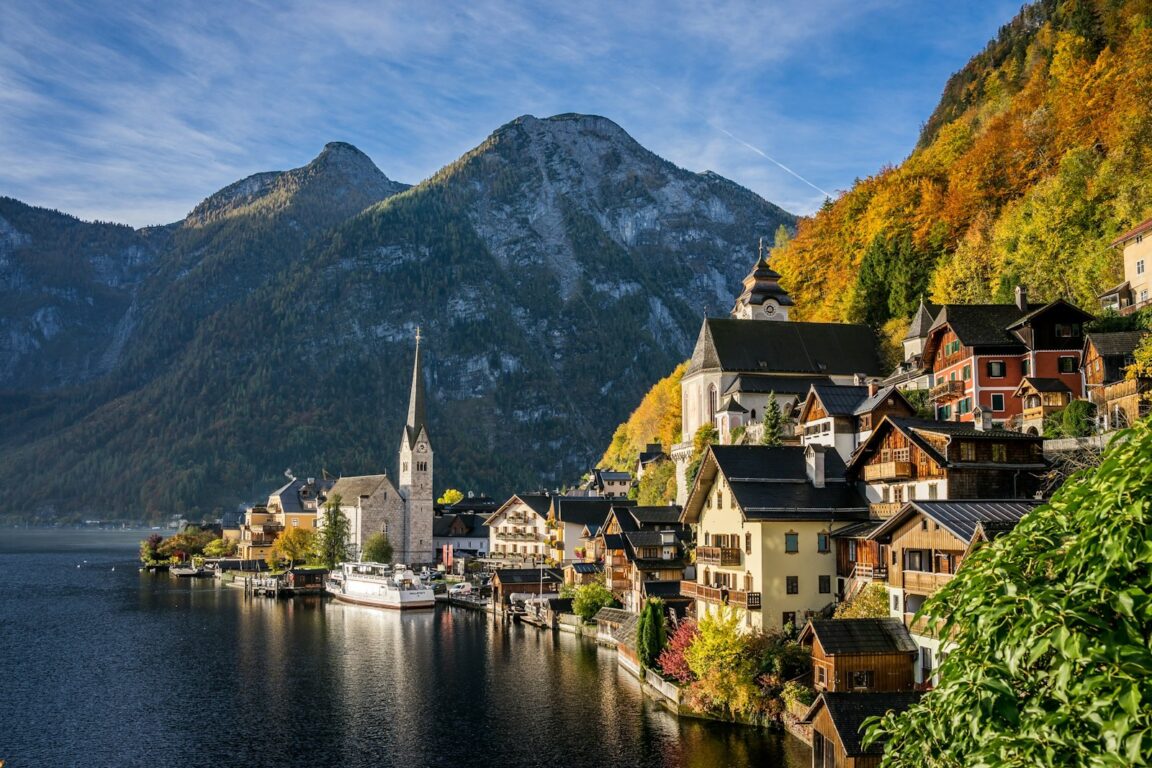
Hallstatt is a village built on a shelf between a steep mountain and a lake, and its geography sets the limits. The lakeside promenade and market square area are the flattest, most manageable ground, with the classic postcard view available from the northern viewpoint path without climbing into the lanes. Away from the water, lanes climb quickly and steps are common, including on routes to the Catholic church and the small charnel house. Cars are kept out of the centre and visitor parking sits in car parks at the village edges, so expect a walk in from your vehicle or bus whatever your mobility.
Arriving by train deserves a specific warning: Hallstatt station is across the lake from the village, and the connection is a ferry that meets trains and docks in the village centre. The ferry is part of the charm and is manageable for many travellers, but it is a boat boarding, not a level platform, so anyone for whom that transfer is a problem should arrive by road to the Obertraun or Hallstatt car parks instead. In winter, ice on the lanes and the closure of the cable car system between seasons narrow the options further, and the village in fresh snow is beautiful precisely because it is a mountain village, with a mountain village surface underfoot.
How should you pace a Dachstein day?
Go up early, decide your summit goal before you ride, and keep the caves and Five Fingers as alternatives rather than a stack. A realistic accessible leaning day looks like this: cable car to the top station for the terrace panorama and the Welterbespirale, down to Schonbergalm for a meadow walk and lunch, then back to the lake for the flat Hallstatt promenade in the afternoon. A realistic fit walker day adds Five Fingers at the summit and one cave from the middle station, accepting the uphill cave approach path as the price. Temperatures at the Krippenstein can run around ten degrees cooler than the lakeshore with strong wind, so the layer you need is a windproof one, and the platform in cloud is an expensive white void: check the summit webcam on the operator site before you pay.
Frequently asked questions
Is the Five Fingers platform wheelchair accessible?
No. The cable cars can take you to the Krippenstein top station, but the 20 to 30 minute path to Five Fingers crosses gravel and stony, steeper ground with an uphill return, so the platform itself is not step free. The top station terrace and the Welterbespirale are the practical summit alternatives.
Are the Dachstein ice caves suitable for limited mobility?
No. Reaching the Giant Ice Cave and Mammoth Cave involves a 15 to 20 minute uphill walk climbing about 70 metres from the middle station, then steps and uneven paths underground. They are rated unsuitable for visitors with limited mobility, balance problems or serious knee issues.
When is the Hallstatt salt mine funicular reopening?
Salzwelten closed the funicular and mine for reconstruction from September 2025 and has announced reopening for late August 2026, with the new funicular described as fully accessible and the Skywalk reachable by panoramic lift. The mine tour itself is not step free. Check the operator site for the confirmed date before travelling.
What is the flattest part of Hallstatt village?
The lakeside promenade and market square area, plus the classic viewpoint at the northern end of the village. The lanes climbing toward the churches are steep and stepped, and visitor parking is at the village edges.
How do you reach the Dachstein cable car from Hallstatt?
The base station is in Obertraun, at the southern end of Lake Hallstatt. Travel around the lake by road or bus, or combine the Hallstatt station ferry and local trains via Obertraun. The cable car then runs in two sections, via Schonbergalm for the caves, to the Krippenstein for Five Fingers.
Featured image: Hallstatt village on Lake Hallstatt, with its church spires and the Dachstein mountains behind. Photo by Leonhard Niederwimmer on Unsplash, via the captioned hosted copy at Honge. Unsplash License.