 Rafael Santos
Eating well in Trebinje means following the wine first. This small city in far southern Bosnia and Herzegovina, set on the Trebisnjica river at the foot of Mount Leotar, is the centre of Herzegovinian wine country, and its defining food stop is not a restaurant at all: it is the stone wine cellar of Tvrdos Monastery, about 5 kilometres west of the old town, where monks make Vranac reds and Zilavka whites in a cellar tradition that reaches back to the 15th century. Build the day around that tasting, eat in the plane tree shade of the old town before or after, walk the Trebisnjica bridges between courses, and treat Dubrovnik, roughly 30 kilometres away by road in Croatia, as a day trip in the opposite direction to the one most people make. Trebinje is cheaper, quieter and slower than the coast, and its food makes far more sense as a base than as a rushed stop.
Quick Facts
- Where: Trebinje, the southernmost city in Bosnia and Herzegovina, on the Trebisnjica river in East Herzegovina
- Signature stop: Tvrdos Monastery, a 15th century Serbian Orthodox monastery about 5 km west of town, renowned for wine production from the local Vranac and Zilavka grapes, with a wine cellar dating to the 15th century
- Wines to know: Zilavka, the fuller bodied local white, and Vranac, the local red whose name evokes a black stallion
- Setting: An 18th century Ottoman old town, plane tree lined riverbanks and the Arslanagic Bridge, built in 1574 and later moved stone by stone into the centre of town
- Dubrovnik logic: About 30 km by road, so Trebinje works as a lower cost base for a Dubrovnik day trip, and Dubrovnik visitors can reverse the trip for a wine day
- River: The Trebisnjica is one of the longest sinking rivers in the world, about 96.5 km above ground and roughly another 90 km below the surface
- Best food season: Spring to autumn, with September and October adding the wine harvest to mild weather
Why does the Tvrdos cellar come first?
Tvrdos is the stop that organises everything else, because it is both a monastery visit and the region in a glass. The monastery was established at the end of the 15th or in the early 16th century on the site of an earlier church, and today it is renowned for its wine production, in particular from the local Vranac and Zilavka grape varieties, and for wine cellars that are a popular visitor attraction in their own right. One cellar dates to the 15th century, where Vranac matures in old oak barrels, while a newer cellar near the Trebisnjica uses modern equipment a few metres away. The contrast is the point: the same monastery works both ends of a 500 year winemaking habit.
The scale is larger than the quiet courtyard suggests. Reporting on the Herzegovina Wine Route describes about 70 hectares of monastery vineyard near Trebinje and in Popovo Polje, the great karst field that runs west from the city, with the monks still involved in picking, cellar work and selling the wines. Sequence the visit properly: see the frescoed church and courtyard first, in dress that respects an active Orthodox monastery, then do the cellar and tasting, then buy at the monastery shop if a bottle is coming home. Allow one to two hours in total. Go earlier in the day in high summer, before tour groups moving between Dubrovnik and Mostar reach the valley, and never treat the tasting as a reason to rush the church.
What should you eat in the old town itself?
Back in Trebinje, the old town, known as Kastel, is a compact 18th century Ottoman quarter of stone houses and small squares on the river. This is where the everyday eating happens: bakeries and grills for a working lunch, cafes under the famous plane trees for the long pause the city is known for, and family restaurants serving Herzegovinian cooking built around grilled meats, river valley produce and the local wines by the glass. The honest way to order here is to let the wine lead. A glass of Zilavka with grilled fish or lighter dishes, a Vranac with roasted meat, and whatever the kitchen says is seasonal from Popovo Polje is a more reliable strategy than hunting for a single famous dish.
The city market is the other food stop worth building in. Trebinje sells itself, accurately, as a city of sun and plane trees, and the market is where that sunshine shows up as produce: valley vegetables, cheese, honey and preserves from the surrounding villages, and wine country fruit in season. Visit in the morning, eat breakfast beforehand in the old town, and use the market to understand what the restaurants will be cooking that night. Travellers who enjoyed the bridge town food further north in our guide to Mostar, Bosnia and Herzegovina will find Trebinje a calmer version of the same Herzegovinian table, with wine in place of Mostar’s coffee led rhythm.
How do the Trebisnjica bridges fit a food day?
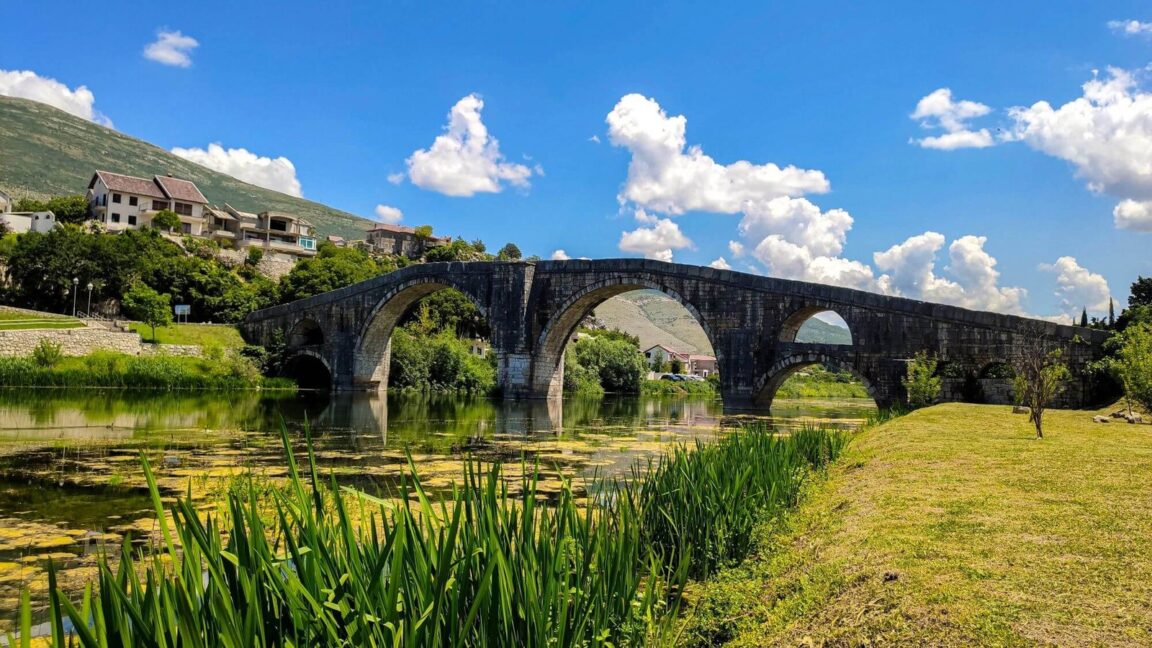
Trebinje is a walking city, and the bridges are the digestion between meals. The Arslanagic Bridge, also called the Perovic Bridge, was originally built in 1574 under the patronage of Mehmed Pasa Sokolovic, several kilometres from its current site. When a hydroelectric dam project threatened it in the twentieth century, the bridge was dismantled and reconstructed in the centre of Trebinje, where it now spans the Trebisnjica between the Gradina and Police banks at about 92 metres long. It has kept its authentic Ottoman architecture, and crossing it on foot, then following the tree lined banks, is the natural walk between a market morning and a Tvrdos afternoon.
Above the old town stands Hercegovacka Gracanica, the monastery church completed in 2000 as a replica of the Gracanica Monastery in Kosovo, on a hill with the clearest view back over the red roofs, the river bends and Leotar behind. It is a viewpoint stop, not a food stop, but it earns its place in the sequence because it explains the geography you have been eating in: a sunlit karst valley, a sinking river, and vineyards on every workable slope. Do it in the late afternoon light, after the cellar, before dinner.
Does Trebinje work as a base for Dubrovnik, or the other way round?
Both, and the logic is worth spelling out because it decides where you sleep. Trebinje lies about 30 kilometres by road from Dubrovnik, with the border crossing on the route between them, so a day trip in either direction is straightforward driving. Sleeping in Trebinje and day tripping to Dubrovnik puts the expensive, crowded city into a single planned day and keeps your evenings in a cheaper, quieter wine town with better value dinners. Sleeping in Dubrovnik and day tripping to Trebinje reverses the benefit: the coast keeps your beach time, and Trebinje becomes a dedicated wine and old town excursion, with Tvrdos as the anchor.
Two cautions keep the logic honest. First, this is an international border, and Bosnia and Herzegovina sits outside the European Union and the Schengen area, so carry passports, allow time for the crossing at busy hours, and check the entry rules for your nationality for both countries before building the trip around the hop. Second, do not stack the day trip and the cellar tasting into a drinking and driving problem: whoever drives tastes last, tastes least, or does not taste at all, and a hired driver or a Dubrovnik based tour that includes Tvrdos is the sensible upgrade for a group. The same border aware planning applies all along this coast, as our first timer guide to Kotor, Montenegro shows for the next bay south.
When is the best time to come hungry?
April to October is the reliable window, when the riverbanks, the market and the monastery are all working at full stretch and the plane trees do their job. September and October are the connoisseur’s pick, adding harvest activity in the vineyards and milder temperatures for the bridge walks. High summer brings the fullest restaurant season and the longest evenings, at the cost of heat in the karst valley at midday, which is another reason to put Tvrdos in the morning and the old town dinner late. Winter is quiet and the cellar still pours, but the city gives up much of the outdoor cafe life that makes its food culture distinctive, so a winter visit should be a deliberate, wine led short break rather than a substitute for the full season.
Frequently Asked Questions
What wine is Trebinje known for?
Two local grapes define it. Zilavka is the fuller bodied white and Vranac the principal red, and both are made at Tvrdos Monastery, whose wine production from these varieties, and its 15th century cellar, are the region’s signature tasting experience.
How far is Tvrdos Monastery from Trebinje old town?
About 5 kilometres west of the town, a short drive or taxi ride. Allow one to two hours for the church, courtyard, cellar and tasting together, and dress for an active monastery, with shoulders and knees covered.
Can you day trip between Trebinje and Dubrovnik?
Yes. The cities are about 30 kilometres apart by road, so each works as a day trip from the other. It is an international border crossing between Bosnia and Herzegovina and Croatia, so carry your passport, allow time at busy hours and check entry rules for your nationality in advance.
What is the Arslanagic Bridge and why was it moved?
It is a 16th century Ottoman stone bridge, built in 1574 under Mehmed Pasa Sokolovic. A twentieth century hydroelectric dam project would have flooded its original site, so it was dismantled and reconstructed in the centre of Trebinje, where it now crosses the Trebisnjica.
Is Trebinje worth a night, or only a stop?
A night, at minimum. The food case for Trebinje is a sequence, market in the morning, Tvrdos cellar, bridge walks, a viewpoint at Hercegovacka Gracanica and a late old town dinner, and that sequence collapses if the town is treated as a photo stop between Dubrovnik and Mostar.
What should you buy to take home?
Wine, bought at the monastery or from the town’s wine shops, is the obvious answer, with Zilavka and Vranac both travelling well. Market honey and preserves are the lighter alternative. Check your onward country’s alcohol import limits before loading the car.
Photo: The Arslanagic Bridge over the Trebisnjica river in Trebinje. Photo by Mujo Hasanovic on Unsplash, Unsplash License. Facts checked 16 November 2026 against monastery, wine route and city sources; confirm cellar opening arrangements locally before visiting, as monastery schedules change.