 LeVar Thomas
Start at someone table. In Mai Chau the food trip is a homestay dinner first, a jar of ruou can shared through long straws second, and a market morning for sticky rice third, because this valley in northern Vietnam cooks as a community and the visitor eats as a guest. Mai Chau is a White Thai valley west of Hanoi, a floor of rice fields ringed by limestone hills, where villages such as Ban Lac and Pom Coong sleep in wooden stilt houses and feed travellers the food of the house: com lam, sticky rice cooked in bamboo, grilled hill chicken and stream fish, bamboo shoots, and rice wine poured for the whole table at once. Two days here is not a restaurant crawl. It is an invitation, repeated at every meal.
Quick Facts
- Where: Mai Chau valley, northern Vietnam, west of Hanoi, in the White Thai villages of Ban Lac, also written Lac Village, and Pom Coong, with Mai Chau town as the market centre
- The base: A family homestay in a traditional stilt house in Ban Lac or Pom Coong, where meals are cooked by the house and eaten together. Ban Lac is a centuries old White Thai village with around 20 stilt house homestays in local listings
- The signature: Com lam, sticky rice steamed inside a bamboo tube, split open at the table and eaten with sesame salt, grilled meats and greens
- The drink: Ruou can, rice wine fermented in a large jar and drunk communally through long bamboo straws, offered at homestay dinners and festivals. Drink as a guest, in turn, and do not rush the jar
- Also order: Pa pinh top, grilled fermented fish; grilled chicken with mac mat leaves; steamed stream fish; canh hen, clam soup; sour bamboo shoot dishes; and stir fried bees with sour bamboo shoots, the dish Mai Chau Ecolodge own food writing calls a classic for locals and an experiment for foreigners
- The lodge alternative: Mai Chau Ecolodge, on Pom Pu Hill near town, whose own site describes meals of locally grown produce, authentic Vietnamese and Thai tribal food, and homestay evenings with local dishes, homemade rice wine and a village dance show
- Market rule: Mai Chau town market in the morning for sticky rice, grilled meats, banh cuon and produce. Homestay meals are arranged with the house, usually the day before or on arrival, not ordered from a menu at the door
What is a homestay dinner in Mai Chau actually like?
It starts on the floor of a stilt house, on mats, with the family food arriving as a set rather than as courses. The Mai Chau Ecolodge, describing the homestay experience it arranges in White Thai homes, puts the elements plainly: dinner with delicious local dishes, homemade rice wine, and then music and dance performed by villagers. In the houses of Ban Lac the same pattern holds at family scale. A tray or a spread of small dishes, rice at the centre, the host deciding the order, and no menu anywhere in the building, because the kitchen cooked what the garden, the stream and the market gave it that day. Travellers who need to choose every dish will struggle here for one evening and then, usually, relax. Being fed is the experience.
The dishes repeat across houses with small variations, and the repetition is the point: this is a cuisine, not a tasting menu. Com lam comes first among equals, sticky rice packed into a bamboo section with water and cooked until the bamboo chars and the rice takes its scent, then split and peeled at the table so the rice stands in a pale cylinder, eaten in pieces with sesame salt. Grilled meats follow, hill chicken and pork from animals raised around the village, and fish from the streams, steamed or grilled with herbs. Bamboo shoots appear sour, stir fried and in soup, mountain greens are gathered rather than farmed, and a clam soup, canh hen, shows up in the village listings as a quiet signature. Portions are communal, refills appear without ceremony, and the correct response to a dish you love is to say so. The cook is usually within earshot and it is her review that matters.
How does ruou can work, and how should a guest behave?
Ruou can is rice wine with a ritual. The wine ferments in a large earthenware jar, water is added, and the table drinks through long bamboo straws set into the jar, in turn, together. It is offered at celebrations, at festivals and at homestay dinners as a welcome, and the Ecolodge account of a village evening ends the same way, with guests invited to drink from the shared jar after the dancing. The wine is mild, sweet and easy to underestimate, because the straw reaches the stronger wine at the bottom and the jar is topped up as the level falls.
The etiquette is simple and worth following exactly. Wait to be invited, drink when your turn comes, do not refuse the first straw outright, and do not treat the jar as a drinking contest. A guest who sips, thanks the host and passes the turn has understood the drink. It is a bond, not a beverage, the valley way of putting a stranger inside the circle of the house, and in Ban Lac, a village that has hosted travellers for decades while keeping its White Thai culture at the centre, the offer is genuine. Accept it in that spirit and the rest of the evening, the brocade weaving, the stories, the dance team if the village performs that night, opens up around it.
What do market mornings add?
Sticky rice, in every sense. Mai Chau town market is the valley larder, and a morning there shows the homestay kitchen its raw materials: bamboo sections and sticky rice for com lam, live chickens, stream fish, bamboo shoots in piles, herbs and greens gathered from the hills, and stalls selling ready food to the valley itself, banh cuon steamed rice rolls, grilled meats, fruit and snacks. Travellers staying in the villages cycle or walk in, eat breakfast at a stall, and ride home past the rice fields with the day supplies of half the valley moving in the same direction. Buy small things and eat them on the spot. Brocade from the weaving villages is the durable souvenir, sold by the women who weave it in Ban Lac and Pom Coong, but the market food is the souvenir of the morning itself.
Breakfast at the homestay deserves its own note, because it reverses the dinner. Where dinner is a set feast, breakfast is plain and early: sticky rice again, or noodles, eggs, fruit and tea or coffee, eaten before the valley heats up and the cycling and trekking start. Eat it. The Mai Chau day is built for movement between meals, bicycles on the flat valley lanes from village to village, and a traveller who skips breakfast meets the midday heat on an empty stomach an hour from the nearest kitchen.
A two day eating plan for Mai Chau
Day one: arrive hungry, eat with the house
Arrive by early afternoon, settle into a stilt house in Ban Lac or Pom Coong, and confirm dinner with your hosts on arrival, including any dishes you cannot eat. Walk or cycle the village lanes before the meal, look at the looms and the rice fields, and then sit down to the full homestay spread: com lam split at the table, grilled chicken and pork, stream fish, bamboo shoots, greens and soup, with the ruou can jar when it is offered and the village dance if it runs that night. Sleep in the stilt house with the valley sounds coming through the bamboo. This evening is the reason the trip exists.
Day two: market morning, lodge lunch, one more dinner
Breakfast at the house, then the Mai Chau town market for banh cuon, grilled snacks and sticky rice to carry, and a slow cycle back through Pom Coong. Take lunch at Mai Chau Ecolodge for the valley other register, a restaurant table overlooking the paddies serving the same Thai tribal food with a wider menu, as its own site describes, then return to the village for a second homestay dinner and order, by asking your hosts the day before, for the dishes day one missed: pa pinh top if fish is running, the sour bamboo shoot dishes, and com lam again, because once is not enough. Travellers continuing north can pair this guide with our Hanoi food guide for the capital end of the road, and with our three days in Da Lat for the highlands at the other end of the country.
FAQ
Do I choose my homestay dishes?
Mostly no, and that is the arrangement to accept before you book. Homestay kitchens cook a set family meal from what is available. Tell your hosts on arrival about allergies and foods you cannot eat, and ask the day before if there is a dish you hope for, but expect the house to lead. The food is home cooking at its source.
Is ruou can strong, and can I refuse it?
It is a mild, sweet rice wine drunk through long straws from a shared jar, stronger at the bottom and topped up as it falls, so pace yourself. Refusing the first offer entirely is poor form. Take a turn, sip, thank your host, and drink water alongside. Hosts understand a guest who tastes and stops far better than one who never starts.
What is com lam?
Sticky rice cooked inside a bamboo tube until the bamboo chars and scents the rice. At the table the tube is split and the rice peeled out in a firm cylinder, then eaten in pieces with sesame salt, grilled meats and greens. It is the Mai Chau signature and appears at homestay meals and market stalls alike.
Ban Lac or Pom Coong, which village for food?
Both are White Thai stilt house villages a short cycle apart, and both feed guests from family kitchens. Ban Lac is the larger and longer established homestay village, Pom Coong the quieter. Choose by the house, not the village, and eat at least one dinner wherever you sleep.
When is the best season to eat in Mai Chau?
The dry, cooler months and the rice seasons are the valley at its best, spring green and the golden weeks before the autumn harvest, when the fields that feed the kitchens are the view from the table. Homestay dinners run year round, but cycling between villages and market mornings are pleasanter outside the heaviest rain.
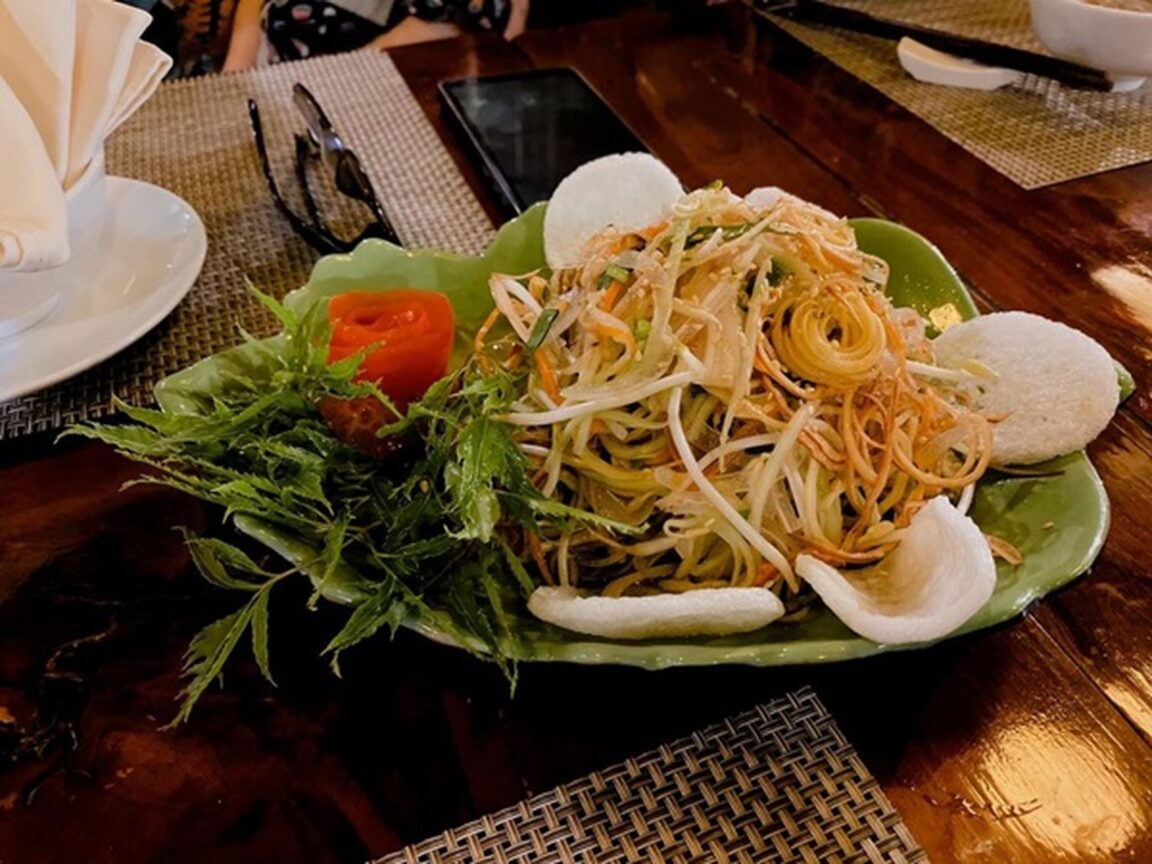
Photo: A Thai tribal dish served at Mai Chau Ecolodge, Mai Chau. Photo via Mai Chau Ecolodge, maichau.ecolodge.asia, the subject official site.