 Maya Chen
Inhotim needs two days, and the reason is simple arithmetic: the visiting area covers about 140 hectares of gardens, lakes and forest in Brumadinho, Minas Gerais, with contemporary art installed in purpose built galleries and across the landscape itself, and no single day at walking pace does it justice. Give it two days, split the coloured routes between them, book tickets in advance through the official channel, and use the free Wednesday or the free last Sunday of the month only if the crowds that come with free entry are a fair trade for the saving. One rushed day at Inhotim produces tired feet and half remembered pavilions. Two days produce one of the great art trips in the Americas.
Quick Facts
- Where: Instituto Inhotim, Rua B, 20, Brumadinho, Minas Gerais, Brazil, about 60 kilometres from Belo Horizonte
- Hours: Wednesday to Friday 9:30am to 4:30pm, Saturdays, Sundays and holidays 9:30am to 5:30pm, per Inhotim’s official visitor information. Closed Mondays and Tuesdays outside the January and July periods, when Tuesday opening is added
- Tickets: Buy in advance through the official site, inhotim.org.br, which sells through Sympla. Current full and half prices are set on that page and change, so check the live figure rather than any printed guide
- Free entry: Every Wednesday is free, and the last Sunday of the month is free, under the Inhotim Gratuito programme described on the official site. Free days still require a ticket obtained in advance and they are the busiest days
- Scale: About 140 hectares open to visitors, with galleries dedicated to single artists, dozens of outdoor works, and themed botanical gardens, per the institute’s own descriptions
- Facts checked: 18 November 2026, against inhotim.org.br. Some galleries and works are always closed for maintenance on rotation; the official tickets page lists the current closures
What exactly is Inhotim?
Inhotim began as the private collection of Minas Gerais businessman Bernardo de Mello Paz, was founded as an institute in 2004 and opened to the public shortly after. What makes it unlike any conventional museum is the commissioning model. Artists were not simply hung on walls. They were given land, budget and time to build permanent pavilions and landscape works at full scale, so the collection reads as a sequence of one artist worlds set inside a botanical garden. The official gallery list runs from Adriana Varejao, Cildo Meireles and Claudia Andujar to Doug Aitken, Olafur Eliasson, Matthew Barney and Yayoi Kusama, whose Narcissus Garden of mirrored spheres floats on a lake near the reception area. The gardens are a collection in their own right, with themed plantings that include a desert garden, an orchid largo and a garden of the senses, and the institute’s botany programme treats the landscape as seriously as the art.
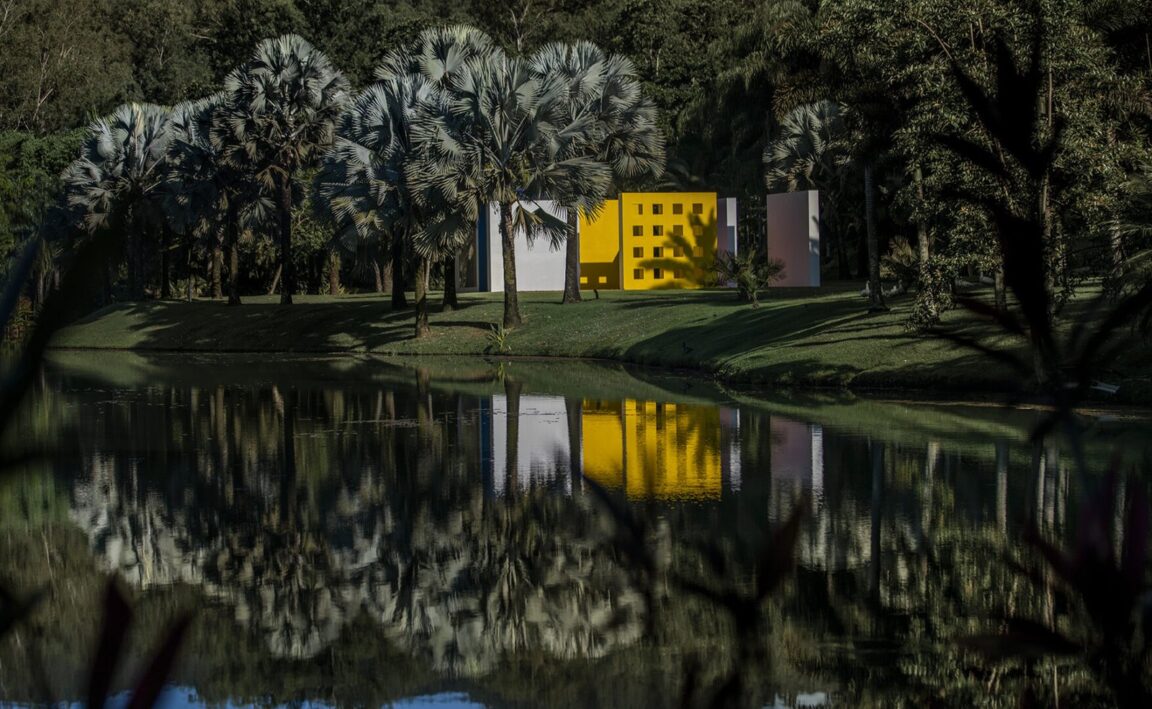
The featured photograph on this article, from the institute’s own site, shows the logic in one frame: Helio Oiticica’s Invention of Colour, Penetrable Magic Square No. 5, a walk in structure of coloured walls, reflected in one of the lakes among the Bismarck palms. At Inhotim the artwork, the planting and the water are one composition, and that is why the visit cannot be hurried.
How should the two days be split?
Inhotim organises its paths into colour coded routes, listed on the official site as the Yellow, Orange and Pink routes, and the natural two day split follows them. Day one belongs to the routes nearest reception: the lakes, the Kusama spheres, the galleries around the central gardens, and one or two of the big single artist pavilions taken slowly. Day two takes the farther route, where the distances grow, the crowds thin, and the landscape scale of the place lands properly.
Day one: the centre and the icons
Arrive at the 9:30am opening, because the last entry rhythm and the 4:30pm weekday close make Inhotim a shorter day than visitors expect. Start with the works that define the place while legs and attention are fresh: the Magic Square by the lake, the Narcissus Garden, and the Galeria Adriana Varejao, whose tiled, water filled pavilion is one of the most photographed interiors in Brazilian art. Eat a proper lunch at one of the institute’s restaurants rather than snacking, because the afternoon galleries reward a reset. The Doug Aitken pavilion, Sonic Pavilion, where microphones carry the sound of the earth from deep in a borehole into a glass room, is the quiet masterpiece of the central area and is best late in the day when the room empties.
Day two: the far route and the slow works
The second day is for distance. Chris Burden’s Beam Drop, a field of steel beams dropped from a crane into concrete, sits at the far edge of the park and explains itself only in person. The Cildo Meireles gallery, with the red saturated rooms of Desvio para o Vermelho, and the Cosmococa gallery of Helio Oiticica and Neville D’Almeida, where some rooms are entered barefoot or by hammock, both need unhurried time. Build the day around two or three such anchors and let the gardens fill the gaps. The internal electric cart transport, sold separately from admission, is worth buying on day two if anyone in the group is flagging; the official transport and ticket options are set out on the official tickets page.
How do you get to Brumadinho, and where do you sleep?
Brumadinho is a small mining region town, and almost every international visitor routes through Belo Horizonte, about 60 kilometres away, roughly an hour and a half by road depending on traffic. The institute publishes its own transfer information, including Belo Horizonte coach options with set pickup points, on its visitor pages, and those official transfers are the simplest route for a first visit because they are timed to the opening hours. Driving gives flexibility for a two day visit and for staying in Brumadinho itself, where a small stock of pousadas serves the institute. Sleeping in Brumadinho rather than commuting twice from Belo Horizonte is the single best structural decision on a two day trip: it turns the second morning into a relaxed 9:30am start instead of a second dawn departure. Travellers combining Inhotim with a wider Brazil trip should read the Always Packed explainer on Brazil’s e-Visa for US, Canadian and Australian travellers before booking, and the Salento and Cocora Valley guide covers the natural pairing for a longer South America art and landscape itinerary.
When is the best time of year, and the best day of the week?
The dry season, roughly May to September, brings cooler, sunnier walking weather to Minas Gerais and is the comfortable window for two full days outdoors. The wet summer months are lusher and greener, and the gardens are arguably at their most dramatic, but paths and lawns take rain and the heat builds by midday. On the week, Thursday and Friday are the connoisseur days: paid entry, full hours and the thinnest crowds. Free Wednesdays are a genuine gift and a real saving, especially for families, but they draw school groups and local visitors in numbers, and the last free Sunday of the month is the busiest day in the calendar. Book free day tickets the moment they are released through the official channel, because capacity is limited and free does not mean walk in.
What do people get wrong on a first visit?
Four mistakes repeat. First, allowing one day, which turns a contemplative place into an endurance event. Second, arriving late: with a 9:30am open and a 4:30pm weekday close, a noon arrival halves the visit. Third, skipping the maintenance list: the institute always has a gallery or two closed for conservation, and the official page names them, so plan anchors around the closures rather than discovering them at a locked door. Fourth, underestimating the walking. Distances between pavilions are garden distances, measured in hundreds of metres of path, so real shoes, water and sun protection matter more here than in any city museum.
Frequently Asked Questions
Is Inhotim really free on Wednesdays?
Yes. The institute’s own visitor information states that all Wednesdays are free under the Inhotim Gratuito programme, and the last Sunday of the month is also free. Free entry still requires an advance ticket through the official Sympla channel, and free days are the busiest, so book early and arrive at opening.
How much are Inhotim tickets on a paid day?
The institute sets full and half prices on its official tickets page and revises them, and recent published prices in other guides disagree with each other, which is exactly why this guide does not print a figure. Check the live price at inhotim.org.br when booking. Half price categories and under five exemptions are defined on that page.
Can Inhotim be done in one day?
The highlights can, at a brisk pace, in good weather, with the cart transport helping. The place cannot. About 140 hectares, dozens of galleries and outdoor works, and gardens that deserve time of their own make two days the honest recommendation, and the institute sells multi day passes for that reason.
What are Inhotim’s opening hours and closed days?
Wednesday to Friday 9:30am to 4:30pm, and Saturdays, Sundays and holidays 9:30am to 5:30pm. The institute is closed on Mondays and Tuesdays for most of the year, with Tuesday opening added in January and July. Confirm the calendar for your exact dates on the official site.
How far is Inhotim from Belo Horizonte?
About 60 kilometres, roughly an hour and a half by road. Official transfers run from set Belo Horizonte pickup points, and staying overnight in Brumadinho is the comfortable base for a two day visit.
Hours, free entry programme and gallery closure practice checked 18 November 2026 against inhotim.org.br. Ticket prices are deliberately not printed here because the institute revises them; the official tickets page carries the live figure.