 Sofia Rossi
Jacks Camp is worth its rate if you want the safari that does not exist anywhere else: nine vast vintage styled tents on the edge of Botswanas Makgadikgadi Salt Pans, mornings with habituated meerkats, dry season quad bike crossings of a white salt crust, and dinners at a 36 seat table inside a mess tent that doubles as a natural history museum. Natural Selection, the operator, does not publish a simple nightly tariff on the camp page. You enquire with dates and a safari consultant replies, which the camp says happens within 24 hours, so judge the camp on fit first and price second. Fit is easy to test. If you want dense game viewing every hour, go to the Okavango. If you want space, desert species, style and strangeness, this is the camp.
Quick Facts
- Location: Edge of the Makgadikgadi Salt Pans, Botswana, the remains of an ancient super lake that once covered most of southern Africa
- Operator: Natural Selection, reservations@naturalselection.travel, +27 21 001 1574
- Tents: 9 guest tents, 7 twin tents with two extra length queen beds and 2 double tents with one extra length king bed
- Tent size: 270 square metres each, split evenly between 135 square metres indoors and 135 square metres outdoors
- Private space: Expansive deck with private plunge pool and swing beds, en suite bathroom with indoor and outdoor showers, over bed cooling system
- Mess tent: Natural History Museum, library, vintage 36 seater dining table from an 1820s officers mess, drinks cabinet and antique pool table
- Also in camp: Swimming pool pavilion, described by the operator as the only one of its kind in Africa, a Persian tea tent and a shop
- Seasons: Open year round, dry season April to October, green season from November to mid April
- Included practicalities: Wi-Fi in camp, 24 hour electricity, hairdryers, complimentary laundry, solar powered operation
- Rates: Not published as a fixed tariff on the camp page, quoted on enquiry by date and season
- Facts checked: 18 November 2026, against the Natural Selection Jacks Camp page
What are the tents actually like, tent by tent?
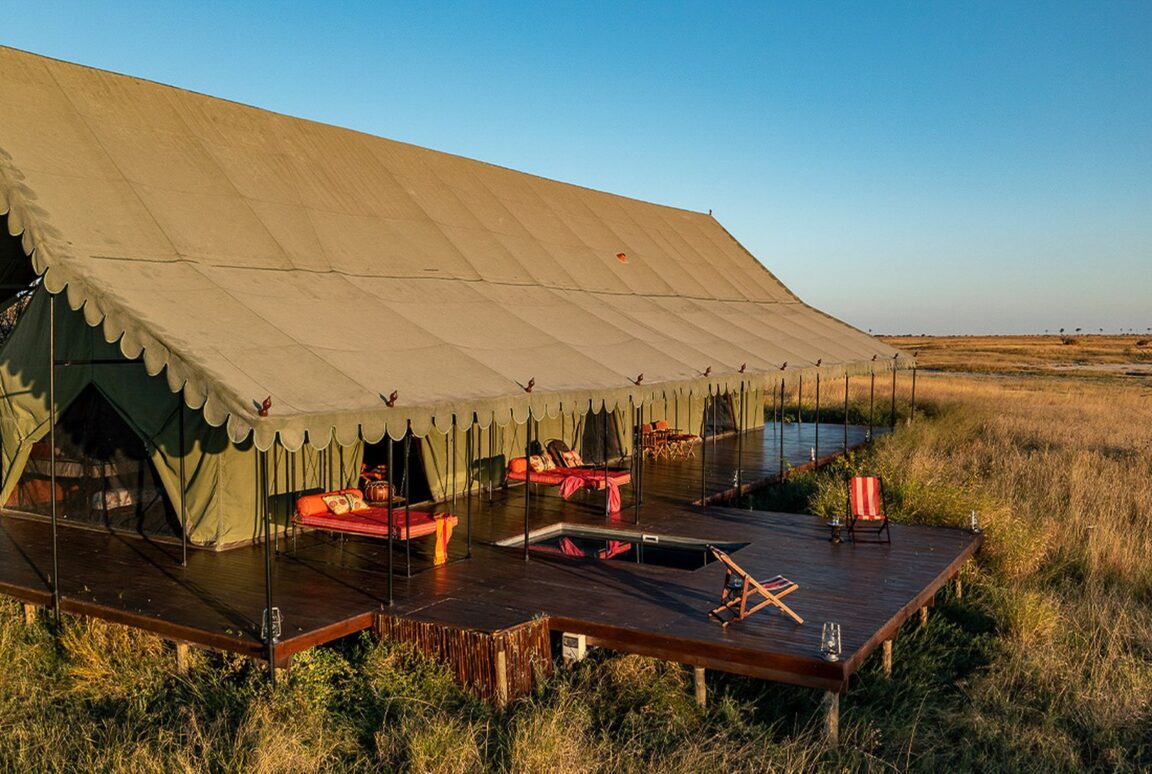
There are only nine of them, and size is the first surprise. Each guest tent is 270 square metres, half indoors and half outdoors, which makes the private deck as much a room as the tent itself. On that deck sits a private plunge pool and swing beds facing the pans. Inside, the style is 1940s campaign safari done at full commitment: green canvas and muslin draped walls, Persian and North African rugs, paraffin lamps, brass fittings, mahogany campaign furniture, hand carved beds and rich textiles from around the world. The living area has a sofa and a day bed, the en suite bathroom has both an indoor and an outdoor shower, and an over bed cooling system handles the desert heat. Each tent also holds Natural History Museum cabinets curated by Ralph Bousfield himself, so the museum idea is not confined to the mess tent.
The twin and double split matters for booking. Seven twin tents carry two extra length queen beds each, and two double tents carry one extra length king bed, so couples who want the king should say so early, because there are only two chances in camp. Spa treatments are available at additional cost. The camp runs sustainably on solar power with careful waste management, offers 24 hour electricity in the tents and includes a complimentary laundry service, which on a desert itinerary with strict luggage thinking is worth more than it sounds.
Why does the mess tent house a natural history museum?
Because the Bousfield family story is the camp. Jack Bousfield, a crocodile catcher and adventurer, set up the first simple camp on this spot in the 1960s after a trapping expedition in the pans. After his death in 1992, his son Ralph established the company behind todays camp and rebuilt it in the nostalgic 1940s style under the promise of real adventure in unreal style. The large mess tent is where that history is kept: the renowned Natural History Museum, the library, cabinets of curiosities, framed Peter Beard pictures, original posters from the French taxidermist Deyrolle and Bousfield family photographs, all arranged around a vintage 36 seater dining table that served as an officers mess table in the 1820s.
Communal dining at that table is a feature, not a compromise. The operator notes it creates a convivial atmosphere that is particularly welcoming for solo travellers, and in a nine tent camp it means dinner is a shared debrief on hyenas, meerkats and pan crossings rather than a private performance. The Persian tea tent supplies afternoon sweet treats, the pool table and drinks cabinet fill the hot middle of the day, and the swimming pool pavilion, still described as the only one of its kind in Africa, is the place to hide from the heat.
How do the meerkat mornings work?
They are the camps signature encounter, and they are built on science rather than feeding. Natural Selection says it has been pioneering a meerkat habituation project with some of the worlds pre eminent researchers. The meerkats remain very wild, but they are used to people at close range and, in the operators words, enjoy coming to say hello. In practice that means an early morning spent on foot near the colony as the animals emerge, forage and take turns on sentry duty, with guests sitting quietly at their level rather than watching from a vehicle. It is a morning activity, it depends on the colony routine rather than a timetable, and it is the encounter most guests rank first when they leave. It also sets the tone for the guiding here: most of the wildlife at Jacks is small, elusive and desert adapted, and the pleasure is in understanding it rather than counting it.
When can you cross the pans by quad bike, and what else fills a day?
Quad biking is a dry season activity, and the camp is explicit about why. From April to October the pans are a shimmering white crust, and that is the time for crossing them by quad bike, sleeping under the stars and seeing the Makgadikgadi in its most iconic state. All pan activity is weather permitting, so a wet spell can close the crust even inside the season. The rest of the programme runs across the year: game drives and night drives for desert species, a cultural experience with the Zu/hoasi Bushmen who live at the camp, a visit connected to the famous Chapmans Baobab story, cycling excursions, sundowners on the pan and time at the camp waterhole, where a high definition live stream camera runs 24 hours a day.
The wildlife list is a desert list, and it should be read that way. Brown hyena is the emblem species, with the operator putting the global population at only 8,000. Around it sit aardwolves, bat eared foxes, honey badgers, black maned Kalahari lions, aardvark, gemsbok, springbok and black backed jackals, with the occasional elephant. Nobody should book Jacks expecting Okavango density. Book it for animals you are unlikely to see anywhere else, found by guides working a huge, empty landscape. Travellers pairing the pans with a greener, water based stay may also like our look at La Residence in Franschhoek for the South African end of a longer itinerary, and our explainer on South Africas remote work visa if the trip is being stretched into a longer stay in the region.
Dry season or green season: which version of Jacks should you choose?
The camp is open year round, and the two seasons could hardly differ more. Choose April to October for the classic desert: white pans, quad bikes, star beds under clear skies, nomadic herds in the distance and the landscape at its most lunar. Choose November to mid April for the transformation. The rains turn the salt flats into grasslands, migratory birds arrive, flamingos gather in pink clouds, and the pans host Africas second largest mammal migration of wildebeest and zebra. The green season is also Botswanas quieter tourism period, and the operator notes it can be a more affordable time to visit. The honest trade is simple: dry season gives you the pans themselves, green season gives you the animals in number. A three night stay is the sensible minimum either way, because the meerkat morning, a pan activity and a Bushmen experience each deserve their own day part, and desert weather can reshuffle any single day.
Who suits Jacks Camp, and who should book somewhere else?
It suits safari travellers on a second or third Botswana trip, design lovers who care how a camp feels, solo travellers who will enjoy the communal table, and anyone who would trade a checklist of big cats for meerkats on their boots and silence on a salt pan. It is less suited to a first time safari traveller whose one trip must deliver the classic big game circuit, to travellers who dislike communal dining, or to anyone visiting in the green season specifically for quad bikes, because the crust decides that, not the camp. On value, the judgement is about uniqueness. There are cheaper ways to see Botswana, but there is no substitute camp that combines this museum, this meerkat project and this pan. If those three things excite you, the rate is buying something scarce. If they do not, it is an expensive tent in a desert.
Frequently Asked Questions
How many tents does Jacks Camp have?
Nine guest tents: seven twin tents with two extra length queen beds and two double tents with one extra length king bed. Each tent is 270 square metres including its deck and private plunge pool.
Is Jacks Camp open all year?
Yes, the camp is listed as open year round. The dry season runs from April to October and the green season from November to mid April, and the activities and wildlife differ sharply between them.
Can you quad bike on the pans at any time of year?
No. Quad biking is a dry season activity on the crusted pans, and all pan activity is weather permitting. In the green season the pans turn to grassland and the focus shifts to the zebra and wildebeest migration and flamingos.
How do you get a price for Jacks Camp?
Rates are quoted on enquiry rather than published as a fixed tariff on the camp page. Send your dates to reservations@naturalselection.travel or call +27 21 001 1574, and the camp says a safari consultant will reply within 24 hours.
What is special about the meerkat experience?
The camp runs a habituation project with leading researchers, so a wild colony tolerates people at close range on foot. Guests spend a morning at the colonys level as the meerkats forage and stand sentry, rather than viewing them from a vehicle.
Is Jacks Camp good for solo travellers?
The operator specifically highlights communal dining at the 36 seater mess tent table as welcoming for solo travellers, and with only nine tents the camp has a house party scale rather than a hotel atmosphere.