 Thandiwe Nkosi
Pack for two climates in one bag. June in Namibia is dry winter: official tourism guidance puts winter daytime temperatures at roughly 18 to 22 degrees Celsius nationally, with inland nights that can fall below freezing, and regional guides for June put Etosha days around 25 to 29 degrees against Sossusvlei dawns of 2 to 7 degrees. The bag that survives that swing is a soft duffel, not a suitcase, because if any leg of the trip uses a light aircraft in Namibia, Wilderness Air and FlyNamibia Safari both publish the same rule: 20 kilograms per person in total, camera gear and hand luggage included, in a soft duffel with no frame, no rigid structure and no wheels. Build the whole list around that duffel and the dawn game drive, and June becomes the easiest safari month of the year to pack for.
Quick Facts
- Season: June is dry winter and the start of peak safari season, with effectively no rain on most routes
- Temperature swing: Around 20 degrees inside a single day is normal. Windhoek runs roughly 7 degrees at dawn to 22 degrees by mid afternoon in June guides, and desert dawns run colder
- Etosha in June: Warm days, roughly 25 to 29 degrees, with nights around 9 to 13 degrees
- Sossusvlei in June: Days roughly 22 to 26 degrees, dawns roughly 2 to 7 degrees, with sub zero starts possible
- The bag: One soft duffel, no frame, no wheels, no rigid base, sized to about 70 cm long, 35 cm high and 30 cm wide if flying
- Light aircraft limit: 20 kg per person all in on a seat rate basis with Wilderness Air in Namibia, including hand luggage and camera equipment. FlyNamibia Safari publishes the same 20 kg figure
- Self drive note: If no flight is involved, the same duffel still wins. It fits lodge rooms, roof boxes and hire car boots better than a hard case
- Entry check: Namibia changed its visa rules in April 2025. Confirm your own position before departure rather than packing on an old assumption
Why does June punish the wrong layers?
The cold in Namibia does not arrive the way winter cold arrives in a city. It arrives at 5:30 in the morning, in an open game drive vehicle, moving at speed across the Etosha pan, with no doors and no heating. A dawn drive in June asks for a proper insulated jacket, a warm hat, gloves and a fleece, worn all at once, over a base layer. By 11 am the same traveller is in a T shirt, applying sunscreen, watching animals at a waterhole in warm, still air. By sunset the temperature falls off a cliff again, and dinner outside needs most of the morning kit back on.
That daily arc, not the average temperature, is what to pack for. The system is three layers that combine in every order. A merino or synthetic base layer that can be worn two or three days running. A fleece or light insulated mid layer that works alone in the evening. And a windproof insulated outer jacket that blocks the game drive wind, which is the single item that decides whether dawn drives are a pleasure or an endurance test. Add a warm hat and gloves that live permanently in the jacket pockets, so they are never in the wrong bag at 5 am.
For the desert leg the pattern repeats with one addition. Sossusvlei at dawn in June can start near freezing at the Sesriem gate, and the walk up a dune warms you fast, so the same peelable layers work, with closed shoes that shed sand and a buff or scarf that keeps fine sand and cold air off your face on the drive in.
What goes in the duffel, item by item?
Work to a simple count and the 20 kg ceiling stops being a threat. Two pairs of long trousers in neutral colours, one worn to travel. Three long sleeve shirts or tops that layer, at least one with sun protection for midday. Two short sleeve tops for the warm middle of the day. One fleece. One insulated windproof jacket. A warm hat, gloves and a buff. Sleepwear that doubles as a base layer on the coldest mornings. Underwear and socks for five days, washed through on rotation, because most safari lodges offer laundry and June air dries clothes fast. A swimsuit only if your lodges have pools you will actually use at midday, which in June many travellers skip.
Footwear is where weight hides. One pair of closed walking shoes or light boots, worn in transit, covers game walks, dune climbs and lodge paths. One pair of light sandals or camp shoes covers everything else. Heavy hiking boots earn their place only if your itinerary includes serious guided walking. For most June itineraries they are dead weight in a 20 kg allowance.
Colours matter for a practical reason, not a fashion one. Neutrals in khaki, stone, olive and brown do not show the dust, do not alarm animals on walks, and can be mixed freely, which is what makes five days of clothing look like ten. White shows every kilometre of gravel road. Black absorbs midday heat and shows dust just as fast.
How do you sand proof a bag for Sossusvlei?
Namib sand is fine enough to find every zip, seal and lens thread. The defence is cheap and unglamorous. Pack each clothing group in its own dry bag or zip sealed bag inside the duffel, so sand that enters the outer bag never reaches clean clothes. Keep camera bodies and lenses in sealed bags whenever they are not in your hands, and change lenses inside the vehicle or inside a bag, never standing on a dune in moving air. A simple rocket blower, a lens cloth in a sealed pouch, and a spare cloth that you accept will become the sandy one will carry a camera kit through a week of dunes.
Shoes get the same treatment in reverse. Shake them out every single time before bringing them into a tent or room, and keep a small brush or an old sock by the door of your bag for the job. Sunglasses on a cord, a hat with a chin strap for open vehicles, and lip balm and sunscreen decanted into the day bag complete the desert kit. The sun at midday in June is strong even when the air feels cool, and the combination of altitude, dry air and wind burns skin faster than the temperature suggests. Travellers comparing a road based version of this list should also read our guide to packing for a Namibia self drive, which covers the vehicle side of dust and distance in more depth.
What are the soft bag rules, exactly?
This is the part of a Namibia packing list that gets repeated wrong most often, so here is the version published by the operators themselves. Wilderness Air, which flies seat rate safaris in Namibia, allows 20 kg per person on a seat rate basis, and that figure includes carry on hand luggage and camera equipment. In Namibia specifically it accepts only soft duffel bags, with no frames or rigid structures, up to maximum dimensions of 30 cm wide, 35 cm high and 70 cm long. The reason is physical, not bureaucratic. The bags are loaded into a small cargo pod or hold, and a framed or wheeled bag simply does not deform to fit.
FlyNamibia Safari publishes the same 20 kg limit and the same insistence on a bag with no internal or external structure, no retractable handle and no wheels. Both operators also publish a way out for travellers who genuinely cannot travel that light. An additional seat can be booked for luggage, which is the honest solution for a photographer carrying a long lens, and it must be arranged in advance, not negotiated at the airstrip.
Two warnings follow from that. First, a duffel with a rigid base plate or a trolley handle is not a soft bag, however soft its sides feel, and it can be refused. Second, the limit that matters is the one on your own booking. Charter and sole use flights work to different figures, and operators update their terms, so confirm the allowance in writing when you book and weigh the finished duffel at home. A bag that weighs 19 kg on your bathroom scale leaves room for the scale to be wrong. Before you fly, also check the entry position in our explainer on Namibia’s visa change for US and other visitors, because the April 2025 rules caught many travellers out.
What belongs in the day bag, not the duffel?
On game drive days the duffel stays at the lodge and a small day bag does all the work. In it go the warm hat and gloves for the first hour, sunglasses and sunscreen for the third hour, a full water bottle, lip balm, binoculars if you carry them, and the camera kit in its sealed bags. Layers come off into the day bag as the morning warms, which is why it needs spare volume even though it starts nearly empty.
Documents, medication, a change of base layer and anything irreplaceable travel in that same small bag on flight days, inside the 20 kg total, never in a separate personal item you assume will not be weighed. Light aircraft allowances are all in by design. Travellers who plan around that from the start never have the airstrip conversation that starts with a bag being opened on the tarmac.
Frequently Asked Questions
How cold does Namibia actually get in June?
Cold enough to need a proper jacket at dawn. Official tourism guidance describes winter days at roughly 18 to 22 degrees with inland nights that can drop below freezing, and June regional guides put Sossusvlei dawns at 2 to 7 degrees and Etosha nights at 9 to 13 degrees. Pack for near freezing starts and warm afternoons in the same day.
Can I take a wheeled suitcase on a Namibia fly in safari?
No, if the flight is with an operator applying the standard Namibia rule. Wilderness Air accepts only soft duffel bags in Namibia, with no frames or rigid structures, and FlyNamibia Safari excludes wheels and retractable handles as well. A wheeled bag can be refused at check in for the flight.
Does the 20 kg limit include my camera gear?
Yes. Wilderness Air states that its 20 kg per person seat rate allowance includes hand luggage and camera equipment. Photographers who cannot meet it should book an additional luggage seat in advance through the operator rather than arriving overweight.
Do I need malaria precautions for a June trip?
June is the dry season, when risk is at its lowest, but parts of northern Namibia, including the Etosha area, are treated as seasonal risk areas in the wet months. This guide does not give medical advice. Ask your own clinician or travel health service about your specific route and dates well before departure.
What should I wear on an Etosha dawn game drive?
Everything warm you packed, all at once. Base layer, fleece, insulated windproof jacket, warm hat, gloves and a buff, with sunglasses ready for when the sun clears the pan. You will remove most of it by mid morning, which is the point of packing layers instead of one heavy coat.
Is one bag really enough for a week in Namibia?
Yes, in June more easily than in any other month. There is no rain to pack for, lodge laundry and fast drying air support a five day clothing rotation, and the whole list in this guide fits a standard soft duffel with room to spare inside 20 kg, provided footwear stays at two pairs.
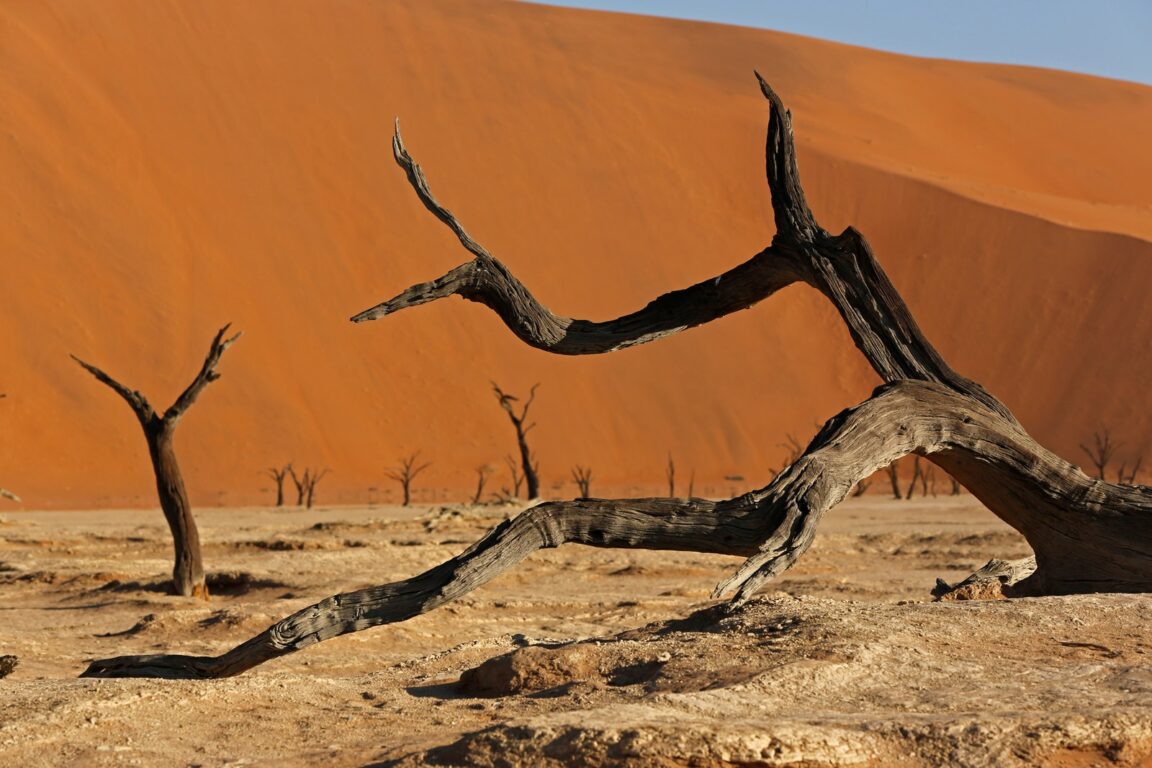
Image: Dead camelthorn trees on the Deadvlei pan against a red dune at Sossusvlei, Namib Naukluft Park, Namibia. Photo from Visit Namibia, the Namibia Tourism Board’s official website, visitnamibia.com.na.