 Aiko Tanaka
Do the Villa Romana del Casale slowly, in room order, and give it a full morning: this late Roman villa outside Piazza Armerina holds about 3,500 square metres of mosaic floors still in the rooms they were made for, including the famous Room of the Ten Maidens, nicknamed the Bikini Girls, and a roughly 60 metre Great Hunt corridor. Tickets are bought at the site ticket office, the park lists the villa as open every day from 9am to 7pm with last admission at 6pm, and the visit pairs naturally with the Archaeological Museum of Aidone and the Morgantina site on the park combined ticket. Arrive at opening, walk the raised walkways in the signed order, and save the Bikini Girls and the triclinium for when you have the context of everything before them.
Quick Facts
- What it is: A late Roman villa, built in the first quarter of the 4th century AD, inscribed on the UNESCO World Heritage List in 1997.
- Where: Contrada Casale, off provincial road SP90, about 3 to 5 km from Piazza Armerina in central Sicily.
- Mosaics: About 3,500 square metres across more than 40 rooms, described by UNESCO as the finest mosaics in situ anywhere in the Roman world.
- Hours listed by the park: Open every day, 9am to 7pm, last admission 6pm. Hours can change by season and for site notices, so check the official site before travelling.
- Tickets: Full ticket 14 euros, reduced ticket 7 euros for ages 18 to 24, free for under 18s, per the park ticket page checked on 17 November 2026. A park combined ticket covering the villa, Morgantina and the Aidone museum is also sold; confirm the current combined price at the ticket office, as published figures have changed.
- Booking: Ordinary admission does not require advance booking; tickets are sold at the ticket office on site.
- Time needed: Allow 2 to 3 hours for the villa alone, and a full day if you add Morgantina and Aidone.
- Access: Visitors view the floors from raised walkways and cannot walk on the mosaics. Accessibility information is limited, so contact the site in advance if step free access matters to your visit.
What are the Bikini Girls, really?
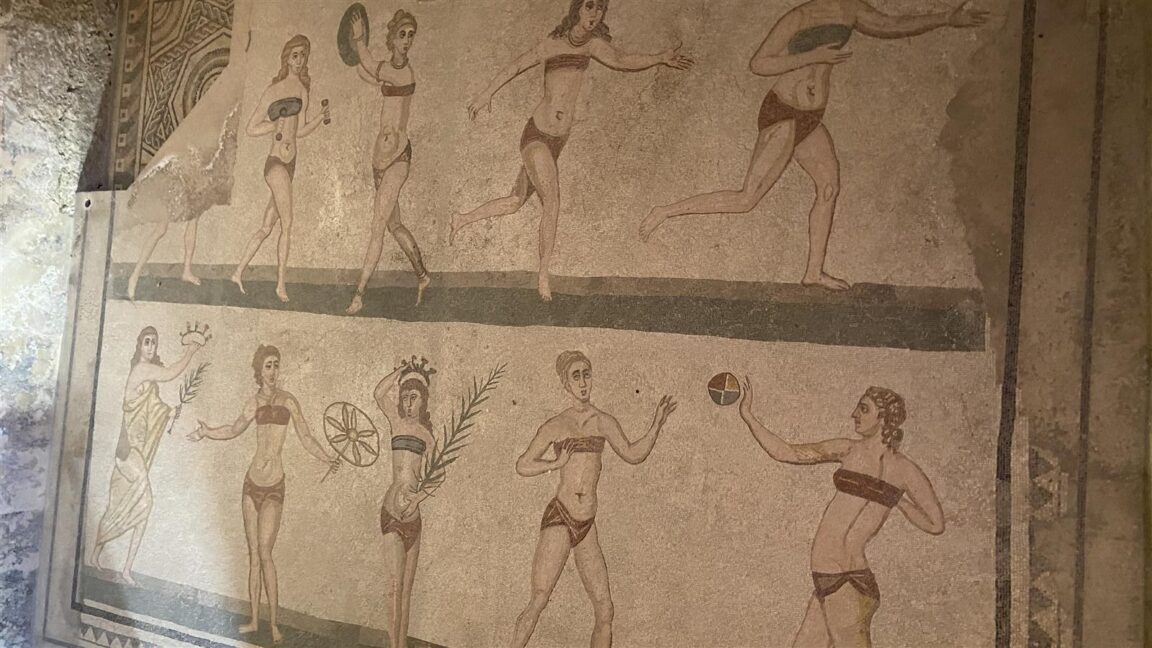
The room everyone photographs is formally the Room of the Ten Maidens. Ten young women are shown in two registers, exercising and competing in two piece garments that look strikingly like modern bikinis, which is how the nickname stuck. Look closer and the scene is about sport, not swimwear. One figure lifts hand weights, another prepares to throw a discus, another runs, and another plays with a ball. At the edge, a figure in a long dress holds out a crown and a palm branch, the prizes, while one athlete crowns herself as the winner.
The detail rewards a slow look. The garments are the strophium and subligaculum worn for athletics, the ball game is a real Roman pastime, and the composition puts the prize giving on the same level as the contests themselves. It is one of the very few surviving Roman images of women in organised athletic competition, which is why art historians rate this small room so highly. Do not treat it as a quick photo stop. Stand at the walkway rail, work left to right across both registers, and pick out each event before you move on.
How should you time the visit?
Timing is the difference between reading the floors and shuffling past them. The single best decision is to be at the ticket office close to the 9am opening. Tour groups from the coast tend to arrive later in the morning, and the walkways above the most famous rooms are narrow, so an early start means standing at the rail of the Great Hunt corridor and the Ten Maidens room without a crowd at your back.
Build the visit in this order. Start with the entrance area and the baths, where smaller geometric and figurative floors teach you how to read the workshop style. Continue into the quadrangular peristyle, the colonnaded courtyard whose floor carries animal heads framed by laurel wreaths around a central fountain. Then take the Small Hunt room, a compact hunting cycle in a private apartment, before the corridor. That sequence means the Great Hunt, when you reach it, lands as the set piece it was designed to be rather than as one more mosaic among many.
Leave the oval portico and the triclinium, the great dining hall with the Labours of Hercules, for the end of the circuit. The Hercules cycle is dense and violent, and it reads best once your eye is tuned. If you are pairing the villa with Aidone the same day, keep the villa to the morning and drive to Aidone after lunch, because the museum holds the finds, including the Goddess of Morgantina material, that explain the older Greek city whose ruins you can also walk at Morgantina.
What should you look for in the Great Hunt corridor?
The Great Hunt corridor, the Ambulacro della Grande Caccia, runs for roughly 60 metres and shows the capture and transport of wild animals for the arena games of Rome. Work along it slowly, panel by panel. Hunters net and cage animals in Africa and the East, beasts are loaded onto ships, and the geography itself is part of the story, with personifications and landmarks marking where each animal comes from. Elephants, big cats, antelope, ostriches and a rhinoceros all appear, handled with a level of observed detail that suggests the North African workshops the park credits with the floors knew these animals at first hand.
Two habits help. First, look at the edges, where small scenes of handlers, carts and cages carry the logistics that the big captures depend on. Second, step back as well as in. The corridor was a processional space between the peristyle and the great reception hall, and its scale only makes sense when you take in the full run of it. Visitors who sprint the corridor in two minutes miss almost everything it contains.
How do tickets and the Aidone pairing actually work?
Buy your ticket at the villa ticket office on arrival. The park ticket page lists a full ticket at 14 euros and a reduced ticket at 7 euros for visitors aged 18 to 24, with under 18s admitted free, and free entry schemes apply on the first Sunday of the month under the national museum programme. Because combined ticket prices for the park have been published at different levels in recent seasons, ask at the office for the current combined ticket covering the villa, the Morgantina archaeological area and the Archaeological Museum of Aidone, and do the arithmetic against single tickets before you pay.
The pairing is worth it. Morgantina is the ancient city site in the hills near Aidone, with an agora, theatre and houses that give you the urban Greek and Roman world the villa belonged to. The Aidone museum, housed in a former Capuchin convent, displays the objects excavated there, most famously the Goddess of Morgantina, the acrolith statue returned to Sicily after years in the Getty Museum, along with a Hellenistic silver treasure. Seeing the floors at the villa in the morning and the statue and silver at Aidone later the same day turns two good visits into one coherent story about wealth, art and return.
Piazza Armerina itself deserves an hour if you have it, for its cathedral and old town lanes, and it is the practical base for the night. If you are building a wider Sicily route, the same slow, timed approach works for the island other great floor and palace visits; our guide to Matera and its cave city covers a very different kind of historic interior, and our explainer on visiting the Alhambra shows how timed entry shapes a visit to a comparable must see monument.
What mistakes do first time visitors make?
The commonest mistake is arriving in the middle of the day in summer, when the covered walkways are at their busiest and the light and heat make lingering hard. The second is treating the villa as a single room attraction, hurrying to the Bikini Girls and leaving. The floors are a programme, and the minor rooms, the baths, the latrine with its own small mosaics, the children hunting and fishing scenes in the private apartments, are what make the famous rooms legible.
A third mistake is skipping the context panels and the site plan at the entrance. The villa is a terraced complex built over several levels on the slope, and the plan explains why rooms sit at different heights and how a guest in the 4th century would have moved from entrance to baths to peristyle to reception hall. Five minutes with the plan at the start saves confusion at every junction later.
Finally, do not assume you can walk on or lean over the floors. The mosaics are viewed from elevated walkways throughout, photography is at the discretion of the site rules on the day, and tripods and flash are not the way to behave around fragile tesserae. Comfortable shoes for standing, water in summer, and a phone charged for the site official pages are the practical kit.
Frequently asked questions
Do you need to book Villa Romana del Casale tickets in advance?
No. Ordinary admission is sold at the ticket office on site and does not require a reservation. Arriving near the 9am opening is the simplest way to avoid queues at peak times.
How much does entry cost?
The park ticket page checked on 17 November 2026 lists a full ticket at 14 euros, a reduced ticket at 7 euros for ages 18 to 24, and free entry for under 18s. A combined ticket for the villa, Morgantina and the Aidone museum is also available; confirm its current price at the ticket office.
How long does a visit take?
Allow 2 to 3 hours to walk the full circuit at a reading pace. A rushed visit can be done in 90 minutes, but the Great Hunt corridor and the Ten Maidens room both reward unhurried time.
Why are the Bikini Girls famous?
The Room of the Ten Maidens shows ten young women competing in athletics in two piece garments, with a prize giving scene at the side. It is a rare and detailed Roman depiction of female sport, and one of the most reproduced images from the ancient world.
Can you combine the villa with Aidone in one day?
Yes, and it is the recommended pairing. Visit the villa in the morning, then the Archaeological Museum of Aidone and, if time allows, the Morgantina site, which the park combined ticket is designed to cover.
When is the best time of day to visit?
At opening. The walkways over the famous rooms are narrow, groups build up from mid morning, and an early start gives you clear views at the rails of the Great Hunt corridor and the Ten Maidens room.
Facts checked on 17 November 2026 against the official Villa Romana del Casale site, the Sicilian regional archaeological park ticket and hours pages, and UNESCO. Hours and prices can change; recheck the official site before travelling. Featured image: the Bikini Girls mosaic, the Room of the Ten Maidens, from the official Villa Romana del Casale website.