 Wei Chen
A Simien Mountains trek is decided in Debark, not on the trail. Every visitor must register at the Ethiopian Wildlife Conservation Authority park office in Debark, pay the entry fee there, and take on a park scout, because a scout is compulsory for every group entering Simien Mountains National Park. Only after that paperwork is done does the classic camp order make sense: drive in to Buyit Ras, walk to Sankaber at about 3,250 metres, continue to Geech (also spelled Gich) at about 3,600 metres, and only then push on towards Chennek and the high viewpoints. Pace the altitude in that order and the trek is demanding but manageable. Rush it, or arrive in Debark too late in the day to sort the permit properly, and the mountains will punish the shortcut. One honest warning belongs at the top: access to northern Ethiopia has been disrupted in recent years, so check your government travel advice and confirm the current situation with the park office before you commit money to this trip.
Quick Facts
- The permit point: Park headquarters and the EWCA office in Debark, about 100 km north of Gondar on a surfaced road. Tickets are bought here, not at the park gate
- Entry fee: 90 Ethiopian birr for a foreign tourist aged 12 and above, plus a small vehicle fee (20 birr for a vehicle with up to 12 seats for foreign tourists), per the park fee schedule republished by Simien Lodge in July 2026. Guide, scout, cook and mule fees are extra and are arranged at the park office
- The non negotiable: A park scout must accompany every group. A licensed guide is technically optional but is now customary, and park officials generally ask you to take one
- Park hours: 6 am to 6 pm. Arrive before dark, because staff can refuse entry after nightfall and payments are not refunded
- The camp order: Buyit Ras trailhead, then Sankaber (about 3,250 m), then Geech or Gich (about 3,600 m), then Chennek (about 3,620 m)
- Stage times: About 5 hours from Buyit Ras to Sankaber, about 6 hours from Sankaber to Geech, and about 7 hours from Geech to Chennek on the leisurely three day pattern published by Simien Lodge
- The park: 412 square kilometres, inscribed as a UNESCO Natural World Heritage Site in 1978. Ras Dejen, also spelled Ras Dashen, is Ethiopia’s highest mountain at 4,543 metres on the official Visit Ethiopia listing
- Signature wildlife: Gelada troops, walia ibex, a small population of Ethiopian wolves, and the lammergeier or bearded vulture. Visit Ethiopia lists 180 bird species for the park
- Best season: The dry season runs roughly from October to May. December and January are the coldest months, with nights falling below freezing at Geech and above
- Access check: Confirm current security advice and park access before booking. Conditions in northern Ethiopia have changed repeatedly in recent years
Why does everything start at the Debark park office?
Because Debark is where the park is administered, and the system is deliberately centralised. The entrance gate at Buyit Ras sits about 14 km east of town, but no ticket is sold there. You register at the park office in Debark, pay the entry and vehicle fees, and engage your scout there, with guides, cooks, mules and mule handlers allocated through the park office and the guides association rota. Simien Lodge, which sits inside the park about 22 km from Debark, is blunt about the method: only sign contracts at the park office in Debark, and do not be talked into equipment or package deals in Gondar or elsewhere.
The timing matters as much as the place. The park is open from 6 am to 6 pm, driving between sunset and sunrise is not allowed inside the park, and late arrivals can be turned away even with a lodge reservation, with no refund. Build your travel day around that. Gondar to Debark is about 100 km and can take up to two hours, so a morning flight into Gondar followed by a relaxed drive up is the sensible pattern. An afternoon arrival that leaves you negotiating scout rotas at dusk is how treks lose their first day.
One fee trap catches people out. Guide and scout charges may be counted to include your departure day, so a trek that starts on Monday morning and ends on Wednesday morning can be charged as three full days. If you want your guide and scout to stay with you until the final morning, say so explicitly when you buy the ticket, or they may reasonably consider their work finished the previous evening and head home.
What is the right camp order, and why does it matter?
The standard northern escarpment route climbs in steps, and each step has a job to do. Sankaber, at about 3,250 metres, is the acclimatisation camp: high enough to start the adaptation, low enough to sleep reasonably on a first night at altitude. Geech, at about 3,600 metres, is the plateau camp, set in open Afroalpine grassland with giant lobelias, and it is the base for the walk out to Imet Gogo, the viewpoint most trekkers rate as the finest in the park. Chennek, at about 3,620 metres, barely higher than Geech, is the wildlife camp, the best base for walia ibex on the cliffs below Bwahit and for gelada troops on the surrounding slopes.
Visit Ethiopia, the official tourism site, recommends the three day trail connecting Sankaber, Geech, Imet Gogo and Ayna Meda for travellers whose main interest is endemic wildlife, and that recommendation lines up with how the camps work in practice. Trying to sleep at Geech on night one saves a day on paper and costs far more in headaches, nausea and broken sleep. The escarpment is not going anywhere. Climb it in the order the camps were placed.
From Chennek, strong and acclimatised parties continue towards Ras Dejen. Visit Ethiopia notes the summit can be undertaken as a three day hike from Chennek, which tells you plainly that the highest mountain in Ethiopia is an expedition add on, not a casual extension of the Sankaber to Geech walk. Treat it as its own plan, with its own extra days, rather than a decision you make at Chennek over dinner. Readers weighing up other hut and permit systems will find the same staged logic in our guide to how New Zealand’s Great Walks booking system works.
How should you pace the altitude, day by day?
The pacing rule for the Simiens is simple: sleep low relative to where you walked, gain height in the Sankaber, Geech, Chennek steps, and never stack a summit day on top of a travel day. Simien Lodge, at 3,260 metres, advises visitors to acclimatise for several days in Ethiopia above 2,000 metres before coming up, to drink plenty of water, and to treat descent to Debark and a low night’s sleep as the remedy if altitude sickness takes hold. That advice is worth following literally. A night or two in Gondar or Addis Ababa at altitude before Debark is not dead time; it is the cheapest insurance on the trip.
A workable pattern looks like this. Day one, drive from Debark through Buyit Ras and walk the roughly five hour stage to Sankaber, then stop, however fresh you feel. Day two, walk the roughly six hours to Geech, passing the Jinbar waterfall area, and use the afternoon gently on the plateau rather than charging straight at Imet Gogo. Day three, make the Imet Gogo viewpoint walk from Geech in the morning when the air is clearest, and either hold a second night at Geech or continue to Chennek. Day four, walk Geech to Chennek, the longest stage at about seven hours, and finish the trek with a vehicle pickup from Chennek rather than retracing the whole escarpment on foot.
Cold is the other pacing factor, and it surprises people who file Ethiopia under hot countries. Daytime sun at altitude is powerful, and a hat is essential kit, but temperatures fall sharply the moment the sun drops, and at Geech and above, nights in December and January fall below freezing. Hypothermia is a real risk for under equipped trekkers. If you hire tents and sleeping bags locally, inspect them before you leave Debark, because hired kit varies and thin sleeping bags are a known problem. Warm layers, a waterproof shell even in the dry season, and a sleeping system honestly rated for frost are not optional extras on this trek.
What will you actually see on the escarpment?
The wildlife is the reason the pacing is worth it. Geladas, the grass eating primates found only in the Ethiopian highlands, live in large troops on the plateau grasslands and sleep on the cliff faces at night. Males carry a flowing lion like mane and a bare red chest patch, and troops graze calmly around Sankaber and Geech, often close to the trail. They are monkeys, not baboons, despite the common nickname. Keep a respectful distance, do not feed them, and approach quietly and from the side rather than walking straight at a troop or staring a big male in the eye, which geladas read as a threat.
The walia ibex is the park’s rarest prize, a heavy horned wild goat found only in these mountains, most often picked out on the cliffs around Chennek and below Bwahit. Visit Ethiopia calls the park the last remaining stronghold of the species. The Ethiopian wolf, the rarest canid in the world, survives here in a population of around 50 animals on the official listing, a distant second to the Bale Mountains population, so a sighting is a genuine privilege rather than an expectation. Overhead, look for the lammergeier, the bearded vulture with a wingspan of about two metres that specialises in dropping bones to crack them for marrow. Add klipspringer on the rocks, Menelik’s bushbuck in the forest patches, and giant lobelias standing up to 10 metres tall above 3,700 metres, and the walking days fill themselves.
What fitness does this trek honestly require?
You do not need mountaineering skills, technical climbing ability or expedition experience. You do need hill fitness: the ability to walk for five to seven hours a day on consecutive days, on rough paths, while breathing air at 3,250 to 3,620 metres that holds noticeably less oxygen than the air at sea level. The stages are long rather than steep, and mules can carry your main bag, which changes the equation considerably. What defeats people here is rarely the walking. It is the combination of a long stage, a cold night, poor sleep at altitude and a second long stage the next morning.
Train for it with back to back weekend hill days in the two months before you go, and be honest about the altitude question if you are flying in from sea level with no time to spare. If your schedule only allows three days total in the mountains, cut the route, not the acclimatisation: a Sankaber and Geech loop with Imet Gogo, done slowly, is a better trek than a forced march to Chennek that leaves you ill. Packing discipline helps too, and the soft bag, layer first approach in our Kenya safari packing guide translates well to mule supported trekking here.
Frequently Asked Questions
Do I really need a scout to trek in the Simien Mountains?
Yes. Park policy requires a scout to accompany every group into Simien Mountains National Park, and scouts are engaged at the park office in Debark when you pay your entrance fee. Scouts are local men who know the ground and the camps. They traditionally carry a rifle, a legacy of early park practice. If that makes you uncomfortable, you can ask your scout to keep a discreet distance, but you cannot trek without one.
Is a guide compulsory as well?
Not formally, but in practice almost everyone takes one, park officials generally ask you to, and the trek is far more informative with one. Guides are allocated by rota through the guides association at the park office, speak English, and carry the knowledge of flora, fauna and route finding that turns a walk along an escarpment into an understanding of it. Budget for both a guide and a scout, and clarify at purchase whether your final departure morning is included in their days.
How much is the park entry fee?
On the park fee schedule republished in July 2026, a foreign tourist aged 12 and above pays 90 Ethiopian birr for entry, with a vehicle fee of 20 birr for a vehicle with up to 12 seats. Those headline fees are small. The real cost of a trek is the team around you: guide, scout, cook, mules and handlers, plus food, equipment hire and transport from Gondar or Debark. Fees are set by the park authority and can change, so confirm the current schedule at the Debark office when you register.
When is the best time to trek the Simiens?
The dry season runs roughly from October to May, and it is the sensible window for firm trails and clear escarpment views. December and January bring the clearest night skies and the coldest nights, with frost at Geech and above. The main rainy season is July and August. Whenever you go, carry a waterproof layer and warm clothing, because mountain weather here turns quickly even in the dry months.
How do I get to Debark?
Fly to Gondar, which has daily Ethiopian Airlines connections from Addis Ababa and other northern cities, then drive about 100 km north to Debark, a journey of up to two hours on a surfaced road. Debark is also 830 km from Addis Ababa by road, which is a multi day overland commitment rather than a transfer. Arrange park transport, whether a 4×4 into the park or a pickup from Chennek at the end of your trek, through the park office or a reputable Gondar operator.
Is it safe to travel to the Simien Mountains right now?
That is a question to answer with current official advice, not with this guide. Northern Ethiopia has seen conflict and access disruption in recent years, and operators have paused trips when conditions deteriorated. Before booking, check your own government’s travel advice for the Amhara region, confirm with the park office in Debark that the park is open and operating normally, and make sure your insurance covers the trip as planned. If the advice says do not go, do not go. The mountains will keep.
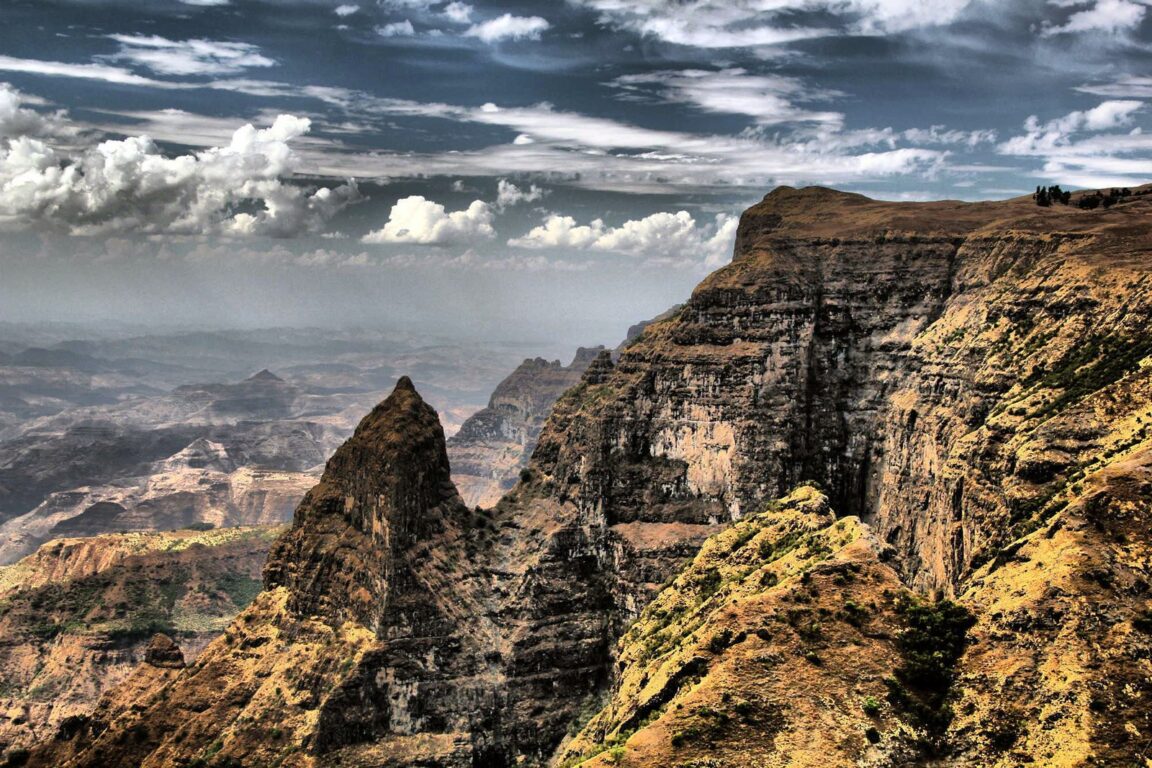
Image: Simien Mountains escarpment pinnacles and cliffs, Ethiopia. Photo: Visit Ethiopia, via visitethiopia.et, the official tourism website.