 Elena Vasquez
Quinta da Regaleira rewards the visitor who arrives late in the day or heads straight uphill on entry: book a timed ticket on the official Blueticket portal, go to the Initiation Well before anything else, then work downhill through the tunnels, grottoes and palace as the midday queues thin. The estate is a four hectare garden palace on the edge of Sintra’s historic centre, built for Antonio Augusto Carvalho Monteiro to designs by the Italian architect and stage designer Luigi Manini, and it is run by the Cultursintra Foundation, not by Parques de Sintra. That single fact explains the separate ticket, the separate booking and why no Pena Palace combination ticket will ever cover it.
Quick Facts
- Address: Quinta da Regaleira 9, 2710-567 Sintra, a short uphill walk from Sintra’s historic centre and station buses
- Tickets in 2026: Adult 18 to 64 pays 20 euros; youth 6 to 17 and seniors 65 and over pay 15 euros; a family of two adults and two youths pays 60 euros; children up to 5 enter free but still need a ticket
- Where to buy: Only through the foundation’s official online ticket office at regaleira.byblueticket.pt, or at the ticket office on site; the foundation takes no responsibility for tickets bought elsewhere
- Entry system: Dated tickets with entry slots every 30 minutes and up to one hour of grace after the slot time; last entry is 17:30 all year
- Hours: Gardens open at 10:00 and close at 18:30 from October to March, and open at 09:00 and close at 19:30 from April to September; the palace, chapel and exhibition rooms close 30 minutes before the gardens
- Closed: 1 January and 24, 25 and 31 December
- Time to allow: Two to three hours for the well, tunnels, grottoes, palace and chapel without rushing
- Audio guide: 5 euros, available at the ticket office only
Why does Regaleira feel so different from Pena Palace?
Pena is a palace that looks outward, all colour and view. Regaleira looks inward and downward. Monteiro, a wealthy collector with deep interests in symbolism, commissioned Manini to build an estate that reads like a staged journey: a Manueline style palace and chapel at the bottom of the hill, then a climbing garden of terraces, towers, lakes and grottoes threaded by underground passages. Almost everything decorative carries a second meaning, from carved stonework linked in popular accounts to alchemy, the Knights Templar and Masonic ritual, to the garden’s deliberate movement between light and darkness. Visitors do not need to decode any of it to enjoy the place, but knowing the estate was designed as a sequence rather than a collection explains why the route order matters so much here. Walk it in the intended direction and the garden builds; wander at random and it can feel like a set of disconnected curiosities.
The estate also sits inside the Cultural Landscape of Sintra, inscribed by UNESCO in 1995, alongside Pena, the Moorish Castle and the town’s other Romantic era estates. If you are building a Sintra day from Lisbon, our 3 days in Lisbon itinerary shows where a Sintra day trip fits, and it pairs naturally with Regaleira as the garden half of the day against Pena’s palace half.
What is the Initiation Well, and how should you walk it?
The Poco Iniciatico, the Initiation Well, is the reason most people come. It is not a well that ever held water for drawing. It is an inverted tower sunk about 27 metres into the hill, lined with a spiral staircase that descends past nine landings. The number nine is usually linked to Dante’s nine circles, and at the bottom a compass rose is set into the floor. You enter at the top through an opening disguised in the rock, descend in one direction only, and leave at the bottom through a tunnel rather than climbing back up. The flow is one way and descending only, which keeps the staircase moving but also means there is no second chance: if you want photographs looking down the shaft, take them on the way.
Practical details matter more than symbolism here. The steps are worn and can be damp, the light drops quickly, and the queue to enter forms at the top from late morning in the busy months. That is why the route advice is so consistent: on entry, walk straight uphill to the well first, before the palace, before the chapel, before coffee. Visitors on the last entry slots of the day often find the well at its quietest, because day trip groups have already left for the station, and the low light in the garden gives the grottoes and lakes a very different character from the flat midday glare.
Where do the tunnels actually take you?
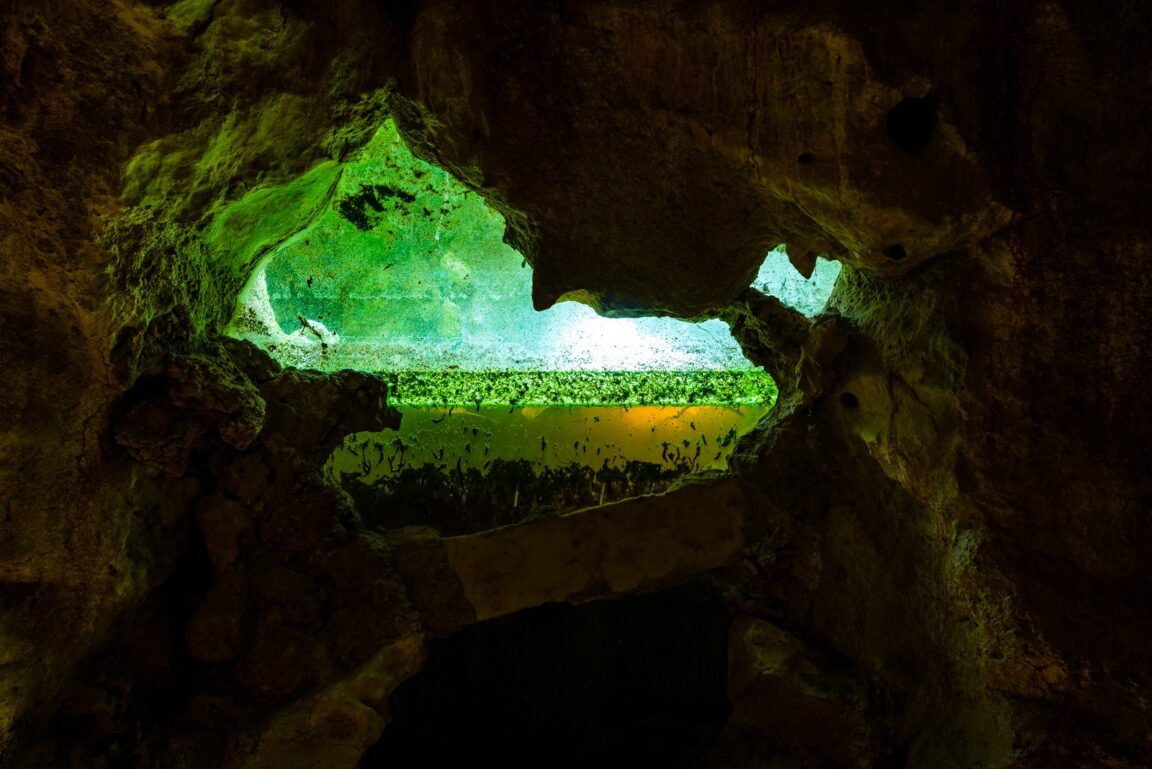
At the bottom of the well, the tunnel system carries you through the hill to the estate’s grottoes, emerging near the lake and its waterfall grotto, where stepping stones cross the water in front of the cascade. The effect is deliberate theatre: darkness, then daylight on water. Other passages link the grottoes, the chapel area and the garden’s upper terraces, and part of the pleasure is losing the sense of where you are on the surface. Allow time for this section rather than treating it as an exit corridor. Surfaces underground are uneven and can be wet, so shoes with grip beat smooth soles, and phone torches help in the darker stretches even though the main routes are passable without one. Note that individual features can close for conservation or safety; recent official notices have listed areas such as the aquarium and waterfall path as closed at times, so check the foundation’s current notices before promising children a specific grotto.
What should you see after the well and tunnels?
Work back downhill. The palace is smaller inside than its facade suggests, with carved fireplaces, decorative ceilings and exhibition rooms that give context to Monteiro and Manini; it closes 30 minutes before the gardens, so do not save it for the very end of a late visit. The chapel, facing the palace, packs Gothic and Manueline carving into a tiny space and repays five quiet minutes. In the garden, look for the upper terrace viewpoints toward the Moorish Castle, the towers and the lake system, and the long decorative bench and loggia structures that frame views back to the palace. Because the garden climbs, a downhill finish is kinder on legs: well and upper garden first, palace and chapel last, exit at the bottom of the hill.
How do you time a late entry visit?
The late entry strategy rests on three facts. Entry is by dated 30 minute slot with up to an hour of grace, so a mid afternoon slot is a real booking, not a hope. Last entry is 17:30, but the gardens stay open to 18:30 in the October to March season and 19:30 from April to September, so a 16:00 or 16:30 arrival still leaves around two to three hours inside in summer. And the crowds run the other way: most Sintra day trippers arrive mid morning, queue for the well around midday and leave by late afternoon. Book the slot, arrive within your grace hour, go straight to the well, then slow down. The trade off is the palace and chapel closing 30 minutes before the gardens, so put the interiors in the middle of a late visit, not at its end. If you are extending a Portugal trip beyond Lisbon, the slower wine and cork country in our Alentejo travel guide makes a good contrast to Sintra’s intensity.
Frequently Asked Questions
How much does Quinta da Regaleira cost in 2026?
Adults aged 18 to 64 pay 20 euros. Youths aged 6 to 17 and seniors aged 65 and over pay 15 euros, a family ticket for two adults and two youths costs 60 euros, a visitor with a disability and one companion pay 12 euros each with proof, and children up to 5 are free but need a ticket. An audio guide costs 5 euros at the ticket office.
Where is the only official place to buy tickets online?
The foundation’s own Blueticket portal, regaleira.byblueticket.pt. The foundation states it is the only authorised online ticket office and that it is not responsible for problems with tickets bought on other websites. You can also buy at the ticket office on site, subject to slot availability.
Is Regaleira included in a Pena Palace or Parques de Sintra ticket?
No. Regaleira is managed by the Cultursintra Foundation, separately from Parques de Sintra, so it is never part of a Pena Palace, Moorish Castle or combined Parques ticket, and the Lisboa Card does not cover it either. Budget for it as its own booking.
What happens if I arrive after my entry slot?
Tickets allow up to one hour of grace after the slot time, but nobody enters after the 17:30 last entry, so a late afternoon slot has less slack than a morning one. Arrive inside that window or the ticket is effectively lost.
How long does a visit take?
Two to three hours covers the Initiation Well, the tunnels and grottoes, the palace and the chapel at a comfortable pace. Visitors who only want the well can move faster, but the one way route and the garden’s size make under an hour a squeeze.
When is the Initiation Well quietest?
At the first entry of the day if you go straight uphill, and again in the last part of the afternoon when day groups have left. The longest queues build from late morning through mid afternoon in the busy season.
Facts checked 22 November 2026 against the Cultursintra Foundation’s published 2026 prices, hours and ticketing rules for Quinta da Regaleira.