 River Callahan
The first thing a traveller booking a Biscayne night snorkel needs to know is how the booking actually works, because it is not a nightly scheduled product: Biscayne National Park is 95 percent water, its official concessioner, the Biscayne National Park Institute, runs its snorkel calendar by day, out to the coral reefs and the shipwrecks of the Maritime Heritage Trail, and dedicated after dark snorkelling runs only on occasional scheduled dates and by private charter through the park’s authorised operators. That is not a reason to drop the idea. It is a reason to plan it properly. The reef genuinely changes shift at night: the day’s grazers shelter, and octopus, spiny lobster, squid and hunting eels come out onto the coral. This guide sets out how to check the concession calendar, what a night trip requires, what the reef shows after dark, and how the boat ride back across a black bay becomes part of the experience rather than an afterthought.
Quick Facts
- Park: Biscayne National Park, Florida; over 95 percent of the park is water, protecting the northernmost living coral reefs in the United States
- Concessioner: Biscayne National Park Institute, the park’s official non profit operator, based at the Dante Fascell Visitor Center, Homestead, and Dinner Key Marina, Coconut Grove
- Day snorkelling: Institute trips run to patch reefs, mangroves and Maritime Heritage Trail shipwrecks; advance reservations advised
- Night snorkelling: Not a daily scheduled trip; check the Institute’s calendar for special evening dates, or book a private charter with an NPS authorised operator
- Booking line: The National Park Service lists Institute bookings by phone at 786-335-3644 and through its website
- Park hours: Park waters open 24 hours; the Dante Fascell Visitor Center is open 9 am to 5 pm daily
- Facts checked: November 24, 2026, against National Park Service and Biscayne National Park Institute sources
How night snorkelling actually books
Start with the Institute’s calendar, because it is the park’s own operator and its trips directly benefit the park. Its standard snorkel programme is a daytime one, running from both the Dante Fascell Visitor Center at Convoy Point in Homestead and Dinner Key Marina in Coconut Grove, to sites chosen by the day’s conditions: a patch reef, the mangrove fringe, or a wreck of the Maritime Heritage Trail, the park’s underwater trail of shipwrecks spanning nearly a century of maritime history. Alongside the day trips, the Institute schedules evening and sunset programmes on selected dates, and it is on that part of the calendar that night water time appears. If no Institute night date fits, the National Park Service’s guided tours page lists the other operators authorised to run snorkel and dive charters in the park, several of which run night programmes and private charters; a private charter is how most night snorkels in Biscayne actually happen, with the date set by your group, the moon and the weather rather than by a timetable. Either way, book ahead, confirm the trip is a snorkel and not a night dive, and confirm lights are provided, because on a reef at night your torch is not optional equipment.
What the reef shows after dark
A coral reef runs two shifts. By day it is a grazing city of parrotfish, surgeonfish and turtles over the coral heads. At night the grazers wedge themselves into the reef to sleep, some in mucus cocoons, and the hunters and scavengers take over: octopus flowing over the coral in search of crabs, spiny lobsters marching in the open they avoid by day, squid hanging in the torch beam, moray eels out of their holes and swimming, and the whole water column lit, when conditions stir it, with bioluminescent plankton. The Maritime Heritage Trail wrecks add their own night character, encrusted structure holding exactly the crevice life that emerges after dark. None of this can be promised on a given night, and a good operator will not promise it; what can be said is that the night reef is not a dimmer version of the day reef but a different place, quieter, slower and stranger, and that the snorkeller’s technique changes with it: slower finning, a torch played across the coral rather than waved, and a buddy kept close.
Gear, rules and who should not go
Operators supply or rent the standard kit, mask, snorkel, fins and flotation, with wetsuits available and genuinely useful after dark even in Florida, when an hour’s still floating chills anyone. The night specific kit is the light: a primary torch per snorkeller, supplied by the operator on organised trips, and it is worth asking at booking whether a backup light and a glow marker for the boat are included. The park’s rules travel with you at night: no touching or standing on coral, no collecting anything, reef safe sun protection for the daylight hours, and the operator’s word is final on whether conditions allow the trip at all. Night snorkelling is not a first snorkel. It suits confident swimmers who have snorkelled by day, are comfortable in open water in the dark, and can manage a boat ladder in a swell. Anyone prone to disorientation should take the Institute’s sunset cruise instead and keep the reef for daylight; there is no shame in it, and the park rewards both choices.
The boat ride back
Every Biscayne trip is framed by its boat rides, and the night ride back is the one travellers describe years later. The reef sites lie offshore of the park’s barrier islands, Elliott Key and Boca Chita Key among them, and the run home crosses open bay under a sky that, this close to Miami’s glow, still darkens enough for stars once the boat is away from shore. Practicalities matter: bring the dry layer for the ride, because a wet snorkeller in a moving boat at night gets cold in any month; keep cameras and phones secured, as spray finds everything; and listen to the captain’s briefing on where to sit and stow gear before departure, not after. On shore, the evening ends at one of two very different trailheads, the visitor centre’s quiet Convoy Point grounds in Homestead or Dinner Key Marina in Coconut Grove with Miami’s restaurants a short walk away, a choice worth making deliberately when you book. The night snorkel, honestly booked and properly run, is among the finest things the national park system offers this close to a great city: a wild reef, working the night shift, an hour from downtown Miami.
Frequently Asked Questions
Can you book a night snorkel in Biscayne National Park?
Yes, but not as a nightly scheduled trip. The Biscayne National Park Institute, the park concessioner, runs its snorkel programme mainly by day and schedules evening programmes on selected dates; beyond those, night snorkelling is arranged as a private charter through operators the National Park Service authorises to work in the park. Check the Institute’s calendar first, then the NPS guided tours page.
What will you see on the reef at night?
The reef’s night shift: octopus, spiny lobster, squid, free swimming moray eels and sleeping day fish in the coral, with bioluminescence possible when the plankton is stirred. Sightings are never guaranteed, and any operator who guarantees them is overselling.
Where do Biscayne snorkel trips leave from?
The Institute departs from the Dante Fascell Visitor Center at Convoy Point, 9700 SW 328th Street, Homestead, and from Dinner Key Marina in Coconut Grove, Miami. The park itself is over 95 percent water, so every reef trip is a boat trip.
What gear is required for night snorkelling?
Mask, snorkel, fins and flotation as standard, a wetsuit for warmth on longer floats, and a proper underwater torch, which organised trips supply. Confirm lights and rentals are included when you book, and bring a dry layer for the boat ride back.
Is night snorkelling suitable for beginners?
No. It is for confident swimmers who have already snorkelled by day. Beginners should take the Institute’s daytime snorkel trips, including its beginner programme in the calm bay, and graduate to the reef at night on a later visit.
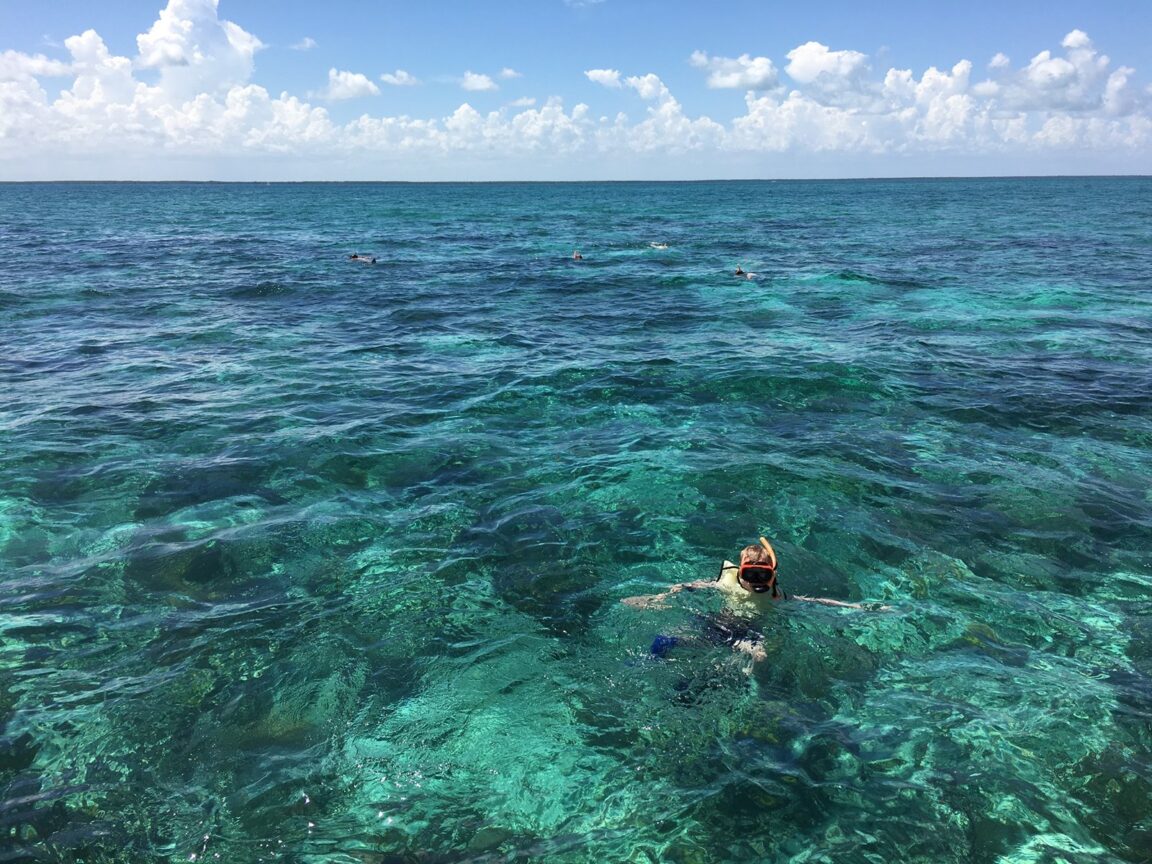
Image: Snorkellers over the reef at Anniversary Reef, Biscayne National Park. Photo: Matt Johnson, National Park Service, via nps.gov.