 Aiko Tanaka
If your suitcase measures more than 160 cm when its length, width and height are added together, you cannot simply board a Tokaido Shinkansen and put it behind any seat. On the Tokaido, Sanyo, Kyushu and Nishi-Kyushu Shinkansen, a bag with total dimensions between 161 and 250 cm counts as oversized baggage, and it may only travel in the baggage space behind a reserved seat with an oversized baggage area. The reservation itself costs nothing extra. Board without one and the conductor charges a 1,000 yen carry-on oversized baggage fee, including tax, and decides where the bag goes. Anything over 250 cm in total cannot be brought on board at all. Those are the rules as published by Central Japan Railway Company (JR Central), checked on 24 November 2026, and they are now being enforced at the gate and on board rather than treated as a polite request.
Quick Facts
The threshold: total dimensions (length + width + height) over 160 cm make a bag oversized
The ceiling: bags over 250 cm in total dimensions cannot be carried on board
The seat: reserve a seat with an oversized baggage area, usually the last row of the car
The cost of reserving: nothing extra, the seat costs the same as any reserved seat
The cost of not reserving: 1,000 yen, including tax, collected on board
Where the rule applies: Tokaido, Sanyo, Kyushu and Nishi-Kyushu Shinkansen only
Weight and pieces: up to two pieces, each 30 kg or less, maximum length 200 cm
How do you measure a bag for the Shinkansen rule?
Measure the outside of the case, not the packing space inside it. Add the longest side, the width and the depth, including wheels, handles and anything rigid that sticks out. JR Central puts bags at 160 cm or less in the ordinary category: they go on the overhead rack, at your feet, or in the deck baggage storage areas, with no reservation needed. Between 161 and 250 cm the bag is oversized and the reservation rule applies. The operators note that the 160 cm line is roughly the size at which international airlines start charging oversized baggage fees, which is why so many travellers are caught out: a case that flew to Japan as ordinary checked baggage can still be oversized on the train. If you are shopping for a case for a Japan rail trip, measuring before you buy is the single easiest way to make this entire rule disappear. Our guide to packing for a Japan rail trip, with luggage forwarding and coin lockers explained, works through the case sizes that keep a whole trip simple.
Which trains and routes does the rule cover?
The reservation requirement applies on the four connected Shinkansen networks run by JR Central, JR West and JR Kyushu: the Tokaido line from Tokyo to Shin-Osaka, the Sanyo line onward to Hakata, the Kyushu line to Kagoshima-Chuo, and the Nishi-Kyushu line to Nagasaki. A Tokyo to Kyoto or Tokyo to Hiroshima journey sits squarely inside the rule. JR Central states plainly that advance reservations are not required for oversized baggage on conventional line trains, and the Tohoku, Joetsu, Hokuriku and Hokkaido Shinkansen, run by JR East and JR Hokkaido, operate under their own guidance rather than this reservation system. The practical point for itinerary planning is that a mixed trip can change rules halfway: the same case can be unregulated on a northern route and reservation-only the moment the journey joins the Tokaido line at Tokyo.
Where does an oversized bag actually go on the train?
It goes in the space behind the last row of seats in designated reserved cars. When you reserve a seat with an oversized baggage area, that space behind your seat row is yours to use, and JR Central asks passengers to share it considerately, because the area behind a five-seat row serves the passengers who reserved those five seats. On the Tokaido Shinkansen, which runs 16-car sets, JR Central publishes the supply, and it is tighter than most travellers expect: a Nozomi service has 57 seats with a baggage area, a Hikari has 42, and a Kodama has just 17, split between ordinary cars and Green cars. Some Tokaido and Sanyo cars also offer lockable oversized baggage compartments on the deck, booked with specific seats and limited to bags within set dimensions, 80 by 60 by 50 cm for an upper compartment and 80 by 60 by 40 cm for a lower one. One trap deserves emphasis: the deck storage areas labelled for large baggage are for bags of 160 cm or less. An oversized bag may not be left there instead of reserving, and oversized baggage cannot be brought into non-reserved cars at all.
How do you reserve a seat with an oversized baggage area?
You book it exactly as you book any reserved seat, and the fare is the same as an ordinary or Green car reserved seat. JR Central lists the routes: at a station ticket office, tell the staff member you want a seat with an oversized baggage area; at a reserved-seat ticket machine, select that seat type; online, choose the seat marked with an oversized baggage area through the Tokaido Sanyo Kyushu Shinkansen online reservation service, JR West or JR Kyushu reservation systems. Japan Rail Pass holders can make the same reservation, including through the pass reservation service at a station ticket office. Because the seat counts per train are small, reserving early matters most on Nozomi services at holiday peaks and on the last trains of the day, when a missed reservation can mean waiting for a later departure rather than squeezing in. Anyone may reserve these seats, even without a large bag, but JR asks travellers who do not need the space to leave the seats for those who do.
What happens at the gate and on board without a reservation?
This is the enforcement part of the headline, and it is mechanical rather than discretionary. If you board with oversized baggage and no reservation, JR Central states that you will be charged a carry-on oversized baggage fee of 1,000 yen, including tax, and the crew will direct the bag to a space the operator designates, which may not be near your seat. You also cannot fix the problem by moving to a non-reserved car, because oversized baggage is barred from those cars entirely. The fee is small; the real cost is friction at the busiest moment of the journey, a bag stored away from you, and the possibility on a full train that there is simply no good place for an unreserved case. Travellers connecting straight from an airport should treat the reservation as part of the ticket purchase, not as an optional extra to sort out on the platform.
What about strollers, instruments and sports equipment?
JR Central carves these out of the oversized baggage definition. Strollers, musical instruments and sports equipment such as bicycles and skis may be carried without being treated as oversized baggage, and can use the baggage racks and deck storage areas. The catch is the last-row space: if you want to use an oversized baggage area or a lockable compartment for a stroller, instrument case or sports bag, you still need to reserve the corresponding seat. Families and musicians who specifically want that space should book it in the same way as a passenger with a giant suitcase. For everyone else, the honest summary is simple: measure the case, and if the three sides add up past 160 cm, reserve the seat. It costs nothing, and it converts the strictest baggage rule in Japanese rail travel into a non-event. Travellers building a wider Japan trip around the trains can also read our explainer on Japan’s dual pricing debate for major attractions, which covers another rule change that now greets foreign visitors at the ticket desk.
Frequently Asked Questions
Is the oversized baggage reservation free on the Shinkansen?
Yes. JR Central states that tickets for seats with an oversized baggage area cost the same as ordinary reserved seats in ordinary and Green cars. The only charge in the system is the 1,000 yen fee, including tax, collected when a passenger brings oversized baggage on board without a reservation.
What size suitcase needs a reservation on the Tokaido Shinkansen?
Any single bag whose length, width and height add up to between 161 and 250 cm. Bags at 160 cm or less need no reservation, and bags over 250 cm in total cannot be brought on board at all.
Can I take an oversized bag in a non-reserved car?
No. JR Central states that passengers may not bring oversized baggage into unreserved cars, or into reserved cars that have no oversized baggage area. The bag has to travel with a reserved seat that carries the baggage space.
Does the rule apply on every Shinkansen line?
No. The reservation system applies on the Tokaido, Sanyo, Kyushu and Nishi-Kyushu Shinkansen. JR Central confirms it does not apply on conventional line trains, and the northern Shinkansen lines run by other JR companies follow their own guidance.
How many oversized baggage seats does a train have?
On the Tokaido Shinkansen, JR Central publishes 57 such seats on a Nozomi, 42 on a Hikari and 17 on a Kodama, across ordinary and Green cars, plus a small number of seats with lockable baggage compartments. Supply is limited, so book early at busy times.
What if my bag is over 250 cm in total?
It cannot be carried on the train. JR Central’s alternative is a delivery service: its luggage information page points travellers to hands-free delivery options that move bags between hotels and stations, which is also the standard fix for travellers whose cases beat the limit by a few centimetres.
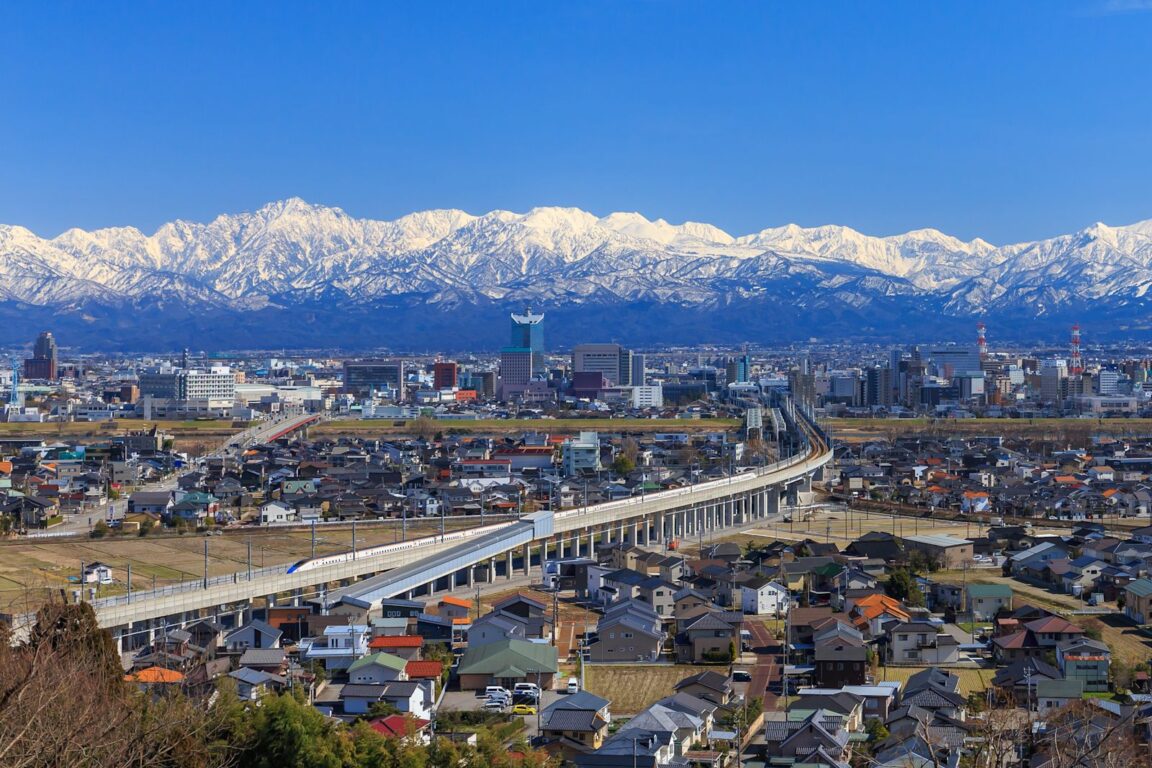
Photo: A Hokuriku Shinkansen train crossing Toyama beneath the Tateyama range. Photo by East Japan Railway Company, via the Japan National Tourism Organization (japan.travel), used with credit.