 Maya Chen
In Penang, you do not choose a hawker centre and then decide what to eat. You choose the dish and go to the centre that owns it. Char kway teow belongs to the charcoal woks of Siam Road and New Lane, Hokkien mee to the prawn stock pots of the morning markets and New Lane again, assam laksa to Air Itam under Kek Lok Si, and the all-in-one first night grazing session to the big seafront sheds of Gurney Drive. Match dish to centre in that order and Penang’s famous food stops being a blur of good stalls and becomes a plan. A plate typically costs between RM 6 and RM 12, the ordering system is the same everywhere once you learn it, and cash still rules most stalls.
Quick Facts
- The system: Claim a table first, order and pay at each stall, give your table number, and order drinks separately from the drinks stall
- Typical price: About RM 6 to RM 12 a plate at the classic centres; carry small notes, as many stalls are cash only
- Char kway teow: Siam Road for the charcoal fired benchmark, New Lane and Chulia Street for evening alternatives
- Hokkien mee: New Lane in the evening, morning markets for the breakfast version
- Assam laksa: Air Itam Market, in the shadow of Kek Lok Si temple, a morning and lunch dish
- First night all-rounder: Gurney Drive Hawker Centre, evenings from about 5 to 6 pm, the widest spread under one roof
- Local evening street: New Lane (Lorong Baru), stalls from about 4 to 5 pm; some stalls rest on certain weeknights
Where does char kway teow reach its peak?
Char kway teow is flat rice noodles fried hard and fast in pork lard with prawns, cockles, bean sprouts, chives, egg and Chinese sausage, and the great versions are defined by wok hei, the smoky breath that only a fierce charcoal fire gives. The benchmark plate is the Siam Road stall, a charcoal fired operation recognised in the Michelin Guide’s Penang coverage, where the queue is part of the ritual and a wait at busy times is normal. This is the plate worth organising an afternoon around: smoky, just greasy enough, the noodles charred at the edges. In the evening, the char kway teow stalls of New Lane, the hawker street off Macalister Road where George Town locals eat, run it closest, and Chulia Street’s night stalls carry the dish into the late hours inside the heritage core. Order it as the locals do, and be ready to say whether you want cockles and how much chilli, because the cook will ask and the answer changes the plate.
Which centre owns which dish?
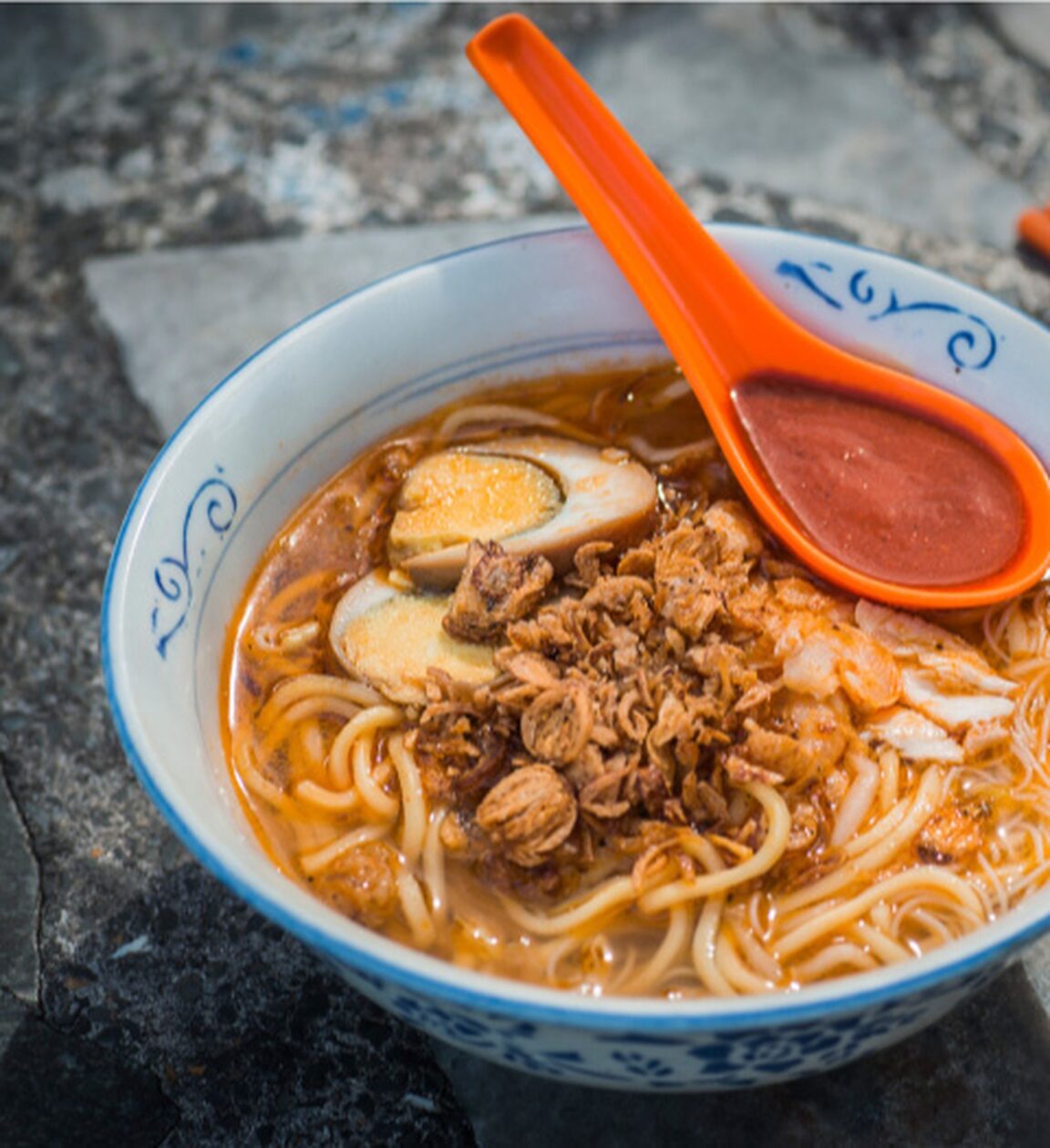
Work through the canon dish by dish. Hokkien mee, the prawn and pork stock noodle soup topped with egg, prawns and fried shallots, is a morning dish at the markets and an evening one at New Lane, where the broth pots have been going all day. Assam laksa, the sour tamarind fish noodle soup with pineapple, mint and shrimp paste, belongs to Air Itam: the market stalls below Kek Lok Si serve the version pilgrims cross the island for, and it sells through by early afternoon, so go in the morning and pair it with the temple. Oh chien, the oyster omelette with its crisped rice flour edges, is a New Lane and Chulia Street evening plate. Pasembur, the Indian Muslim salad of fritters, potato, egg and cuttlefish under a sweet peanut sauce, and rojak, the fruit and fritter salad in dark prawn paste, are Gurney Drive strengths, where the big centre’s range is the point. For dessert, cendol and ais kacang, shaved ice with red beans, palm sugar and coconut, close any session; the Penang Road cendol stalls are the famous standalone stop. Our George Town heritage guide covers the clan jetties and mansion hours that fill the hours before the evening stalls open, and our Melaka in two days piece continues the same Straits food story south.
How do you actually eat at a hawker centre?
The etiquette is a system, and learning it takes one meal. Find and claim a table first; a bag or a companion left at the table marks it as taken, and table hunting after ordering is the beginner’s error. Walk the stalls, order at each one, and give your table number, because the food is cooked to order and carried to you. Pay at the stall or on delivery as that stall prefers, and keep small notes ready. Drinks are a separate business entirely: a drinks stall holder will come to your table or you order at the drinks counter, and the traditional move is to order once for the table, a barley, a chrysanthemum tea or a fresh coconut, rather than per dish. One more rule saves embarrassment: stalls specialise, so never ask the char kway teow man for a soup noodle, and never rush a cook working a charcoal wok in a queue of twenty. The queue is the quality signal. If a stall has no line at peak hour, there is usually a reason.
Gurney Drive or New Lane: which evening should you choose?
Both, in that order. Gurney Drive Hawker Centre, the large covered complex on the seafront by Gurney Plaza, is the orientation night: the widest variety in one place, the easiest seating, sea air, and strong versions of rojak, pasembur, char kway teow and grilled seafood, busy from early evening and at its peak after dark. It is visitor friendly in the best sense, a training ground where a first timer can taste six dishes in an hour. New Lane is the second night and the locals’ room: a street of stalls with plastic tables in the roadway, less signage, shorter tempers and, dish for dish, the more serious cooking, above all the char kway teow, Hokkien mee and oh chien. Go to Gurney to learn the repertoire and to New Lane to judge it. Padang Brown, the local lunch ground known for popiah, apom and cendol, is the daytime alternative when the evening centres are shut.
How much cash does a grazing night take?
Less than you fear. With plates mostly between RM 6 and RM 12, a determined grazer eating four dishes with drinks spends roughly the cost of one modest restaurant main course in a Western capital. The constraint is not money but capacity, which is why Penang regulars eat in small groups and share every plate, ordering one dish per stall for the table rather than one per person. Some stalls now take DuitNow QR payments, but the famous older stalls are frequently cash only, and the correct preparation is a pocket of small ringgit notes before you arrive, not a card and a hope.
Frequently Asked Questions
What is the one dish I must eat in Penang?
Char kway teow, ideally the charcoal fired version at Siam Road. It is the dish Penang cooks argue about, the one with the clearest benchmark, and the plate that explains wok hei better than any description.
How much does a hawker meal cost in Penang?
Most classic plates run about RM 6 to RM 12. A full grazing session of several shared dishes and drinks usually lands well under RM 50 per person.
Do Penang hawker stalls take cards?
Mostly no. Cash is the reliable currency at the famous stalls, though some now accept DuitNow QR. Carry small notes.
When do the hawker centres open?
Morning markets run from about 6 am to late morning. The evening centres and streets, Gurney Drive, New Lane and Chulia Street, build from about 4 to 6 pm and run to midnight or later. Individual stalls rest on different days, so a favourite stall can be dark on any given night.
Are Penang hawker centres halal?
They are mixed. Malay and Indian Muslim stalls are halal, while classic Chinese char kway teow is fried in pork lard and is not. Centres signpost the split, and dedicated halal food courts exist in the malls.
Centre profiles, dish assignments, prices and ordering etiquette checked against Penang’s official tourism sources and the Michelin Guide’s Penang coverage on November 24, 2026. Stall rest days rotate; expect one favourite to be closed and have a second choice ready.
Photo: Penang Global Tourism, via mypenang.gov.my, Penang’s official tourism website, used with credit. A bowl of Penang Hokkien mee, served hawker style with egg, fried shallots and a spoon of sambal.