 Thandiwe Nkosi
Franschhoek rewards the traveller who walks away from the tram queue. The Wine Tram is a fine way to drink, but the village it loops around is older, stranger and more interesting than a tasting circuit: a French refugee settlement planted in 1688 at the end of a mountain valley, remembered in a museum and monument at the top of the main street, and still best read on foot, in the order this guide walks it. Start at the Huguenot Memorial Museum in the morning, when its genealogies and ship models have the rooms to themselves. Stand under the monument’s arches and understand what the figure on top is holding. Then drive, carefully and only after checking the day’s road position, up the Franschhoek Pass for the view the settlers never had of their own valley, and come back down to the main street for the galleries, bakeries and long lunch that are the village’s modern liturgy. The tram can have the afternoon. The morning belongs to the French Corner itself.
Quick Facts
The village: Franschhoek, meaning French Corner, in the Cape Winelands about 80 kilometres from Cape Town, settled by French Huguenot refugees from 1688
The museum: The Huguenot Memorial Museum on Lambrechts Road, beside the monument, open daily 9am to 5pm with last entry at 4:15pm on current listings, closed on New Year’s Day, Good Friday and Christmas Day
The monument: The Huguenot Monument, built in the 1940s and inaugurated on 17 April 1948, marking 250 years since the settlers’ arrival. Its central figure holds a Bible and a broken chain, for faith and freedom from persecution
The history in one line: After Louis XIV revoked the Edict of Nantes in 1685, Huguenot families reached the Cape in 1688 and were granted land in this valley by the Dutch East India Company
The drive: The Franschhoek Pass on the R45 climbs above the village with valley viewpoints. The pass has suffered storm damage closures in recent seasons, so check the road’s status on the day before building a route on it
The other museum: The Franschhoek Motor Museum at L’Ormarins on the R45, open weekdays 10am to 5pm and weekends 10am to 4pm on current listings
Facts checked: 24 November 2026, against museum and Franschhoek visitor listings
What does the Huguenot Museum actually explain?
Most wine country museums are about wine. This one is about exile, and it is better for it. The museum, in a building modelled on an eighteenth century Cape house beside the monument grounds, tells the story in the order it happened: the Huguenots in France, the revocation that made Protestants outlaws in their own country, the flight, the ships, and then the harder, quieter story of arrival, land grants in a valley already known to the Khoekhoe, and the slow building of farms, families and a wine industry. The exhibits run from ship models and household objects to religious artefacts, family portraits and the genealogies that South Africans with surnames like Joubert, du Toit, de Villiers and Malan still trace back to named passengers.
Give it the morning and give it time. The annex continues the displays, and the museum’s themes reach beyond genealogy into fynbos, architecture and the valley’s first inhabitants, which keeps the story honest: the French Corner was made by refugees, on land with a history before them. Visitors who want the farm scale version of the same heritage should read our guide to Babylonstoren, the Franschhoek farm hotel built on a 1692 land grant landscape, and then come back to the village for the human scale.
How should you read the monument?
The monument stands at the top end of the main street, where the village gives up and the mountains begin, and it is designed to be read like a sentence. Three tall arches, for the Holy Trinity, frame a central female figure standing on a globe. In one hand she holds a Bible; in the other, a broken chain. At her feet and around the base, the symbolism stacks the settlers’ whole argument: the sun of righteousness above, and the flight from persecution rendered as a woman stepping forward out of bondage into a new country. It was built through the 1940s and inaugurated on 17 April 1948, two and a half centuries after the first families landed, which makes it as much a statement about the South Africa of 1948 as about the refugees of 1688, and reading it with both dates in mind is the grown up way to see it.
Practically, the monument grounds are the village’s best free viewpoint and its natural turning point. Walk up Huguenot Road in the morning, do the museum, circle the monument, and then walk back down the same street as a different person: the one who now knows why the street names, the estate names and half the surnames in the valley are French.
Is the Franschhoek Pass worth the drive?
Yes, with a condition that matters more every year. The R45 pass climbs the Franschhoek Mountains behind the village, through hairpins and cuttings, to viewpoints that look back down the whole valley: the vineyard grid, the village, the monument’s white spike, and the road you came in on reduced to a line. It is the single best orientation device in the valley, the view that turns a list of estates into a map. The condition is the road itself. The pass has been closed by storm damage in recent seasons, at one point indefinitely while repairs were assessed, and its status is a same day question, not a guidebook fact. Check the Western Cape’s road information before you set out, treat a closure as final, and reroute via Stellenbosch without argument if the pass is shut. A closed pass is an inconvenience. A damaged one ignored is a risk.
Drivers with time for the valley’s second museum should continue the motoring theme at ground level: the Franschhoek Motor Museum at L’Ormarins displays a rotating selection from a collection of more than 220 vehicles, around 80 on show at a time, in four themed halls. It is the odd, delightful counterweight to the Huguenot story, proof that this valley collects beautiful machines as seriously as it collects grape varieties. Those staying over should compare the village’s grande dame in our guide to La Residence, Franschhoek’s vineyard hotel, before choosing where to sleep.
What is left on the main street itself?
Everything the morning was preparing you for. Huguenot Road is short, walkable end to end in about twenty minutes, and dense: galleries showing contemporary South African art, a Belgian style bakery culture that the French story makes feel inevitable, chocolate and coffee stops, and restaurants that have made this village of a few thousand people one of the most decorated eating addresses in Africa. Eat late and eat long; lunch is the main event here, and the estates can take the tastings before or after. Buy the museum ticket in the morning, the bread before it sells out, and leave the tram for the day you want the valley to come to you. Franschhoek beyond the Wine Tram is not a rejection of the tram. It is the village the tram is driving through, finally given its own day.
Frequently Asked Questions
What are the Huguenot Memorial Museum’s opening hours?
Current listings give daily opening from 9am to 5pm, with last entry at 4:15pm, closing only for New Year’s Day, Good Friday and Christmas Day. Confirm on the museum’s own channels in the week of a public holiday visit.
Why is Franschhoek called the French Corner?
Franschhoek means French Corner in Afrikaans. From 1688, French Huguenot refugees fleeing persecution after the revocation of the Edict of Nantes were granted farms in this valley, and their language, surnames, faith and winemaking shaped it permanently.
When was the Huguenot Monument built?
It was built during the 1940s and inaugurated on 17 April 1948, marking 250 years since the Huguenots’ arrival at the Cape. Its central figure holds a Bible and a broken chain, symbolising faith and freedom from religious persecution.
Is the Franschhoek Pass open?
Check on the day. The pass has suffered storm damage closures in recent seasons, including a period closed indefinitely, and its status changes with repairs and weather. If it is closed, route via Stellenbosch and save the pass for a confirmed open day.
How long do you need in Franschhoek beyond the Wine Tram?
A full day at minimum: a morning for the museum and monument, the pass drive if it is open, and a long main street lunch with the galleries. Staying overnight adds the valley at dawn and removes every reason to rush.
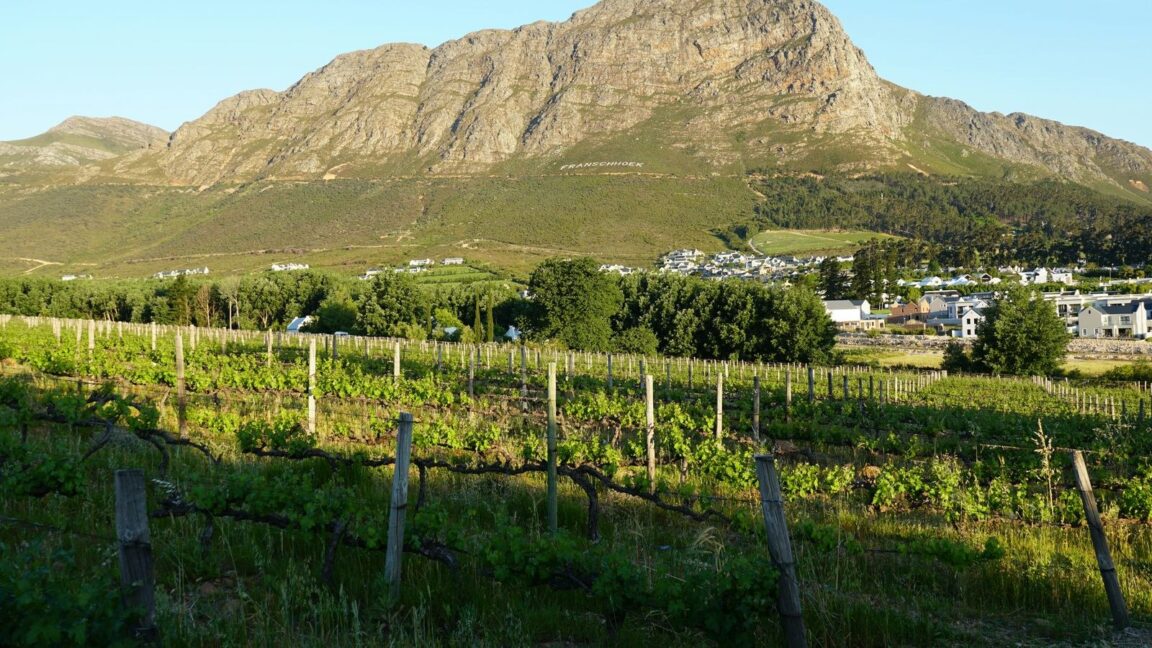
Photo: Vineyard rows in Franschhoek with the village and the Franschhoek Mountains behind, the name of the village lettered on the mountainside. Image: Sheila C, via Unsplash.