 Omar Haddad
Mostar deserves more than the bridge photograph, and the way to prove it is to sleep there. Spend the morning inside the Ottoman houses on the east bank, above all the Biscevica Corner house, cross Stari Most before the day trip coaches peak, and then leave town twice: southeast to the dervish house at the Buna spring in Blagaj, and southwest to the Kravica falls on the Trebizat river, early, before the tour buses. Staying overnight is what makes all three possible at the quiet ends of the day, and it turns Mostar from a stop into a small, complete trip.
Quick Facts
The bridge: Stari Most, the Old Bridge, was built in the Ottoman period in 1566, destroyed in 1993, and rebuilt and reopened in 2004. The Old Bridge area of the old city is a UNESCO World Heritage site.
The house: The Biscevica House, on Biscevica street at the corner known as Biscevica Cosak, is an Ottoman era residence of 1635, now a small museum house with a courtyard and rooms overlooking the Neretva.
Blagaj: The tekke, the dervish house at the source of the Buna river, stands about 12 kilometres southeast of Mostar under a limestone cliff. Dress modestly; wraps are provided at the entrance when needed.
Kravica: The waterfall park on the Trebizat river, about 40 kilometres southwest of Mostar. The park’s published adult entry is 20 KM, and the park opens daily from 7:00 a.m., closing at 17:00 in winter and as late as 22:00 in high summer.
Money: Carry convertible marks in cash. Small museums, houses, parking and many cafes in and around the old town are cash first.
Bases: Sleep in or beside the old town on the east bank for dawn and evening access to the bridge without the day trip crowds.
What is there to see in Mostar beyond the bridge?
Start with the houses, because they explain the town the bridge served. The Biscevica House is the essential one. Built in 1635, it stands at the corner where Biscevica street turns above the river, and it is arranged in the Ottoman manner: a stone walled courtyard at street level, shaded and quiet, and the living rooms above, including the divanhana, the raised sitting room whose windows and corner seat look straight down the Neretva toward the bridge. Inside are the furnishings of a wealthy Mostar family of the period, carpets, carved wood, copper and inlaid furniture, and a custodian who will walk you through the rooms and the family’s story. It is a small visit, half an hour to an hour, and it does the work a museum ten times its size often fails to do: after the house, the old town reads as a lived in Ottoman city, not a backdrop.
Pair it with the Muslibegovic House, a grander residence that doubles as a hotel, and with the Koski Mehmed Pasha Mosque, whose courtyard gives the classic postcard view back across the river to Stari Most and whose minaret, for a small fee, gives the best elevated photograph in town. Walk Kujundziluk, the coppersmiths’ street on the east bank, slowly and early, when the workshops are opening rather than performing, and cross the Crooked Bridge, Kriva Cuprija, the smaller and older single arch over the Radobolja stream, which predates its famous neighbour and gets a fraction of the attention. Our Mostar food guide plans the eating side of the same streets, cevapi on the river terraces and the bakeries locals use.
When should you cross Stari Most itself?
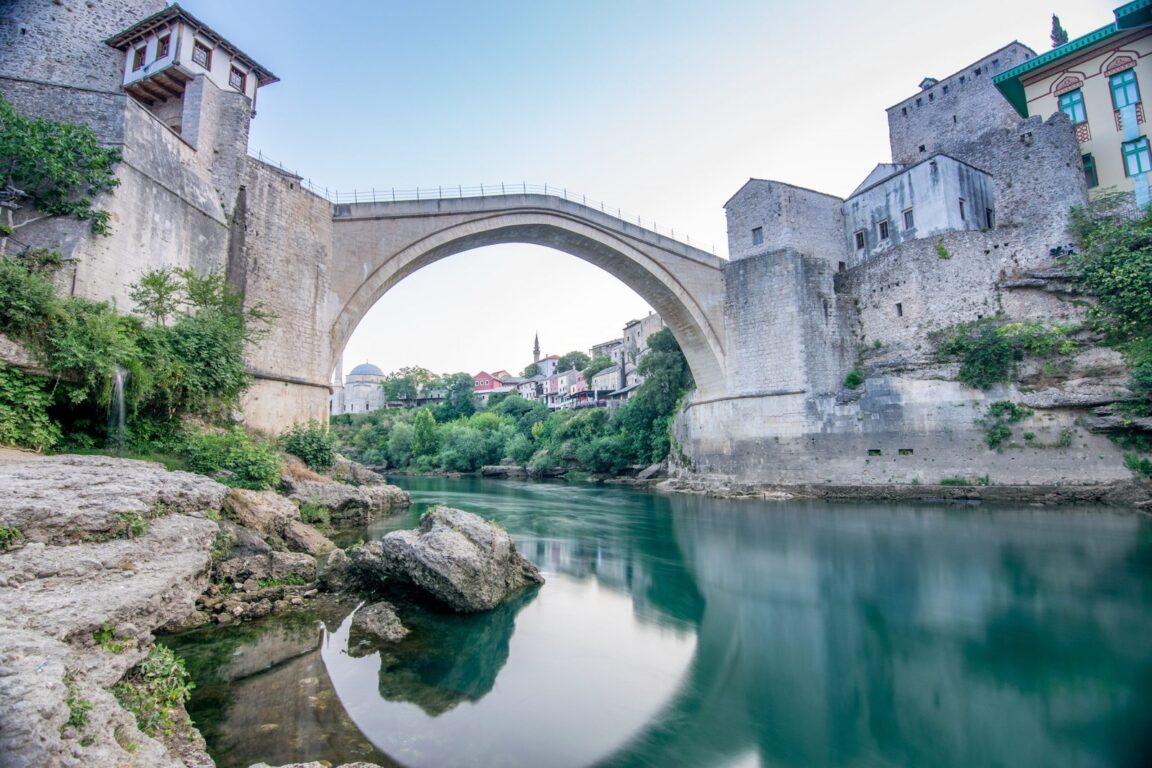
Twice, at the edges of the day. The bridge, a single pointed arch about 29 metres long spanning the green Neretva between two fortified towers, was built in 1566 by the Ottoman architect Mimar Hayruddin and stood for 427 years before it was destroyed in November 1993. The reconstruction, using stone from the original quarries and techniques matched to the old bridge, reopened in July 2004, and the old city around it joined the UNESCO World Heritage list in 2005. In the middle of a summer day the arch is a slow queue of day tours from the Croatian coast. Before 9 a.m. and after 6 p.m. it belongs to the town again: coffee on the terraces, swallows over the river, and in summer the members of the local diving club collecting for the traditional jump from the centre of the arch, a performance with centuries of practice behind it and not one to attempt yourself.
The Old Bridge Museum, in the tower complex on the east bank, fills in the engineering and the reconstruction story and is worth its small ticket on a first visit. Then give the west bank an hour: the newer, everyday Mostar of cafes and shops on the western side, a reminder that the city is a living, divided and recovering place, not only a heritage set.
How do you visit the Blagaj tekke properly?
Blagaj is a half day, not a photo stop. The village lies about 12 kilometres southeast of Mostar, and at its edge the Buna river emerges, full grown and startlingly clear, from a cave at the foot of a high limestone cliff. Built into the rock beside the spring in the Ottoman period, the tekke, a dervish house and lodge, is still a place of prayer and pilgrimage, which sets the terms of a visit: modest dress, with shoulders and knees covered and a headscarf for women inside, wraps available at the entrance, quiet behaviour, and a small entry fee paid in cash at the gate. Inside are the prayer room, the turbe, or tomb chamber, and rooms arranged around the sound of the spring itself.
Go in the morning. The light reaches the cliff face, the restaurant terraces along the Buna are still setting up, and the tour groups have not yet arrived from the coast. Eat grilled trout at one of the riverside restaurants afterwards, fish from the same cold spring water, and if you have energy left, look up at the fortress of Blagaj on the hill above, the medieval seat that guarded this valley long before the tekke was built. A local bus runs from Mostar to Blagaj, and taxis are simple to arrange; either way, confirm your return ride before you settle into lunch.
How should you time Kravica falls?
Early, and on a weekday if the trip allows. Kravica, often spelled Kravice, is a wide fan of waterfalls on the Trebizat river in western Herzegovina, where the river drops in a semicircle of cascades into a clear green pool. The park opens daily from 7:00 a.m.; in the winter months it closes at 17:00, while in high summer it stays open until 22:00. Adult entry on the park’s published tariff is 20 KM, with children under 7 free, and tickets can be bought online from the park as well as at the gate. Arrive near opening and the pool is a swim in cold, clean river water under the falls. Arrive at noon in August and it is a beach party with a queue, which some travellers love and others should simply plan around.
Kravica combines naturally with Blagaj on opposite ends of one long day only if you are driving; by bus and taxi, give each its own half day and keep Mostar’s evenings free, because the old town after the coaches leave is the reason you stayed. Our dedicated guide to Kravice waterfalls done properly covers swimming season rules, parking and the park in full detail.
Frequently Asked Questions
Is Mostar worth an overnight stay?
Yes. The bridge and old town are crowded with day tours between late morning and mid afternoon, and are at their best before 9 a.m. and in the evening. An overnight stay also makes the Blagaj tekke in the morning and an early start at Kravica possible without rushing either.
What is the Biscevica House?
It is an Ottoman era residence built in 1635 at the Biscevica Corner in Mostar’s old town, now a small museum house. Its courtyard and its divanhana, the raised sitting room overlooking the Neretva, show how a wealthy Mostar family lived in the Ottoman period. Allow half an hour to an hour, and carry cash for the entry.
How do you get from Mostar to Blagaj?
Blagaj is about 12 kilometres southeast of Mostar. Local buses run the route, taxis are easy to arrange in the old town, and drivers should confirm the return trip in advance. The tekke at the Buna spring asks for modest dress, and wraps are provided at the entrance.
How much does Kravica falls cost and when is it open?
The park’s published adult entry is 20 KM, with children under 7 free. The park opens daily from 7:00 a.m. and closes at 17:00 in winter, later in summer, up to 22:00 in the high season. Arrive near opening for the quietest swim.
Can you swim at Kravica?
Yes, the pool below the falls is a swimming spot in season, with the water cold even in summer. Follow the park’s signed swimming areas and rules on the day, and expect the pool to be busy by midday in July and August.
What currency do you need in Mostar?
The convertible mark, KM or BAM. Cards work in many restaurants and hotels, but small museums and houses, parking, market stalls and some cafes are cash first, so arrive with marks in small notes.
Featured image: Stari Most, the Old Bridge at Mostar, seen from the Neretva river with its towers and the old town rising behind. Photo by Faruk Kaymak via Unsplash (hosted copy via EEB), Unsplash License, used with credit.