 Hana Kim
The answer has not changed, but the clock has. South Korea’s Ministry of Justice has extended the temporary K-ETA exemption for nationals of 22 countries and regions for one more year, and it now runs to 31 December 2026, Korea time. If you hold one of those passports, including the United States, the United Kingdom, Canada, Australia, Japan and most of western Europe, you do not need a Korea Electronic Travel Authorization for a trip that falls inside 2026. You enter visa free as before, and the only formality left is the separate arrival card. Everyone else who travels visa free still needs an approved K-ETA before boarding, applied for only on the official site, k-eta.go.kr, or the official app, at a fee of 10,000 won. Nothing has been announced for 2027, so a trip that crosses the New Year needs a fresh check, not an assumption.
Quick Facts
The exemption: Temporary K-ETA exemption for 22 countries and regions, extended by the Ministry of Justice
End date: 31 December 2026, Korea time. No extension for 2027 had been announced when this was checked
The 22: Australia, Austria, Belgium, Canada, Denmark, Finland, France, Germany, Hong Kong, Italy, Japan, Macao, the Netherlands, New Zealand, Norway, Poland, Singapore, Spain, Sweden, Taiwan, the United Kingdom and the United States, including Guam
Who still applies: Visa free travellers from every other country, on k-eta.go.kr or the official K-ETA app only
The fee: 10,000 won per person on the official channel. Sites charging multiples of that are agencies, not the government
Still required for everyone: The arrival card formalities, which the exemption does not remove. Exempt travellers who voluntarily obtain a K-ETA are excused the arrival card
Facts checked: 24 November 2026, against the K-ETA notice reporting the extension and Ministry of Justice reporting
Which passports are on the exemption list?
The list is the same 22 as in the earlier rounds of the policy, and it helps to read it by region. In Asia it covers Hong Kong, Japan, Macao, Singapore and Taiwan. In the Americas, Canada and the United States, including Guam. In Europe, Austria, Belgium, Denmark, Finland, France, Germany, Italy, the Netherlands, Norway, Poland, Spain, Sweden and the United Kingdom. In Oceania, Australia and New Zealand. If your passport is not in that paragraph, the exemption is not yours, however visa free your entry otherwise is, and a K-ETA approval belongs on your pre-departure list alongside the flight booking.
Note what the exemption is not. It does not change anyone’s visa free eligibility or length of stay, which are set by separate agreements. It does not help a traveller who needs a visa, who belongs in the embassy process instead. And it is tied to the passport you actually travel on, which matters for dual nationals: the exemption follows the document presented at check-in and at the Korean border, not the other passport in your bag.
Why does the end date matter so much this time?
Because the pattern of extensions invites complacency. The exemption began in April 2023 as a tourism support measure, was extended through 2024, then through 2025, and now through 2026, each time by a notice close to the end of the year. A traveller booking a January 2027 trip today is booking into a gap: as of this check, no 2027 decision has been published. If no extension comes, the 22 exempt nationalities will need K-ETAs again from 1 January 2027, and the application, with processing that can run to 72 hours in busy periods, becomes a boarding requirement overnight.
The practical rule is simple. For travel ending inside 2026, exempt passport holders can relax. For travel in 2027, check the notices on k-eta.go.kr again before you fly, and if the requirement is back, apply with days to spare. Our earlier explainer on South Korea’s K-ETA exemption and who still skips the application walks through the application itself, and the companion piece on the Korea e-Arrival Card covers the form that replaced the paper card.
Should exempt travellers apply voluntarily anyway?
There is one genuine reason to consider it. A traveller holding an approved K-ETA is excused from submitting the arrival card, so a voluntary application trades 10,000 won and a few minutes online for a cleaner arrival. Against that, the application must be made on the official channel, the approval is tied to the passport used, and an exempt traveller who mistypes a passport number has created a problem they never needed to have. Most short trip travellers will simply keep the exemption and complete the arrival card. Travellers who cross into Korea repeatedly in a year, and value the faster lane, are the ones the voluntary route suits.
Whichever you choose, use only k-eta.go.kr or the official app. The Korean government has appointed no agents, and the copycat sites that dominate search results charge several times the official fee for the same form. If a site quotes you a price in dollars well above the won equivalent of 10,000, close it. Once you are through the formalities, the trip itself is the easy part; our three days in Busan itinerary is the natural second stop after a Seoul arrival.
How does the exemption interact with the arrival card?
Korea now runs two separate digital gates, and confusing them is the most common remaining error. The K-ETA, run by the Korea Immigration Service under the Ministry of Justice, is a pre travel authorisation: it is assessed before you fly, and the airline’s check is where an unapproved traveller is stopped. The arrival card is a landing formality, the digital successor to the paper card once handed out in the cabin, and it records where you are staying and how long you are staying for the officers who meet the flight. The exemption switches off the first gate for the 22 listed passports and leaves the second gate standing. That is why an exempt traveller can truthfully say they need no authorisation and still be handed a formality on arrival day, and why the voluntary K-ETA, which excuses its holder from the arrival card, appeals to frequent visitors: it collapses the two gates back into one approval held before departure. Keep the two ideas separate, complete whichever of them your passport and your choices leave standing, and the Korean arrival becomes what it should be, a passport stamp and a short walk to the train.
Frequently Asked Questions
Do Americans need a K-ETA for South Korea in 2026?
No. The United States, including Guam, is on the temporary exemption list until 31 December 2026, Korea time. Americans enter visa free with a valid passport and complete the arrival card formalities instead.
When does the K-ETA exemption end?
On 31 December 2026, Korea time. It has been extended year by year since 2023, but no extension for 2027 had been announced when this guide was checked on 24 November 2026.
How much does a K-ETA cost, and where do I apply?
10,000 won per person, only at k-eta.go.kr or in the official K-ETA mobile app. The government has appointed no agents, and third party sites charging more are adding their own fees.
Does the exemption remove the arrival card too?
No. The exemption removes only the K-ETA step. Travellers without a K-ETA still complete the arrival card process. Holding an approved K-ETA, including a voluntary one, is what excuses a traveller from the arrival card.
What if my trip starts in 2026 and ends in 2027?
Entry is judged on your arrival. An arrival inside 2026 falls under the exemption for listed passports. If you will enter Korea again in 2027, or your plans change to a 2027 arrival, recheck the K-ETA notices before flying, because the requirement may have returned.
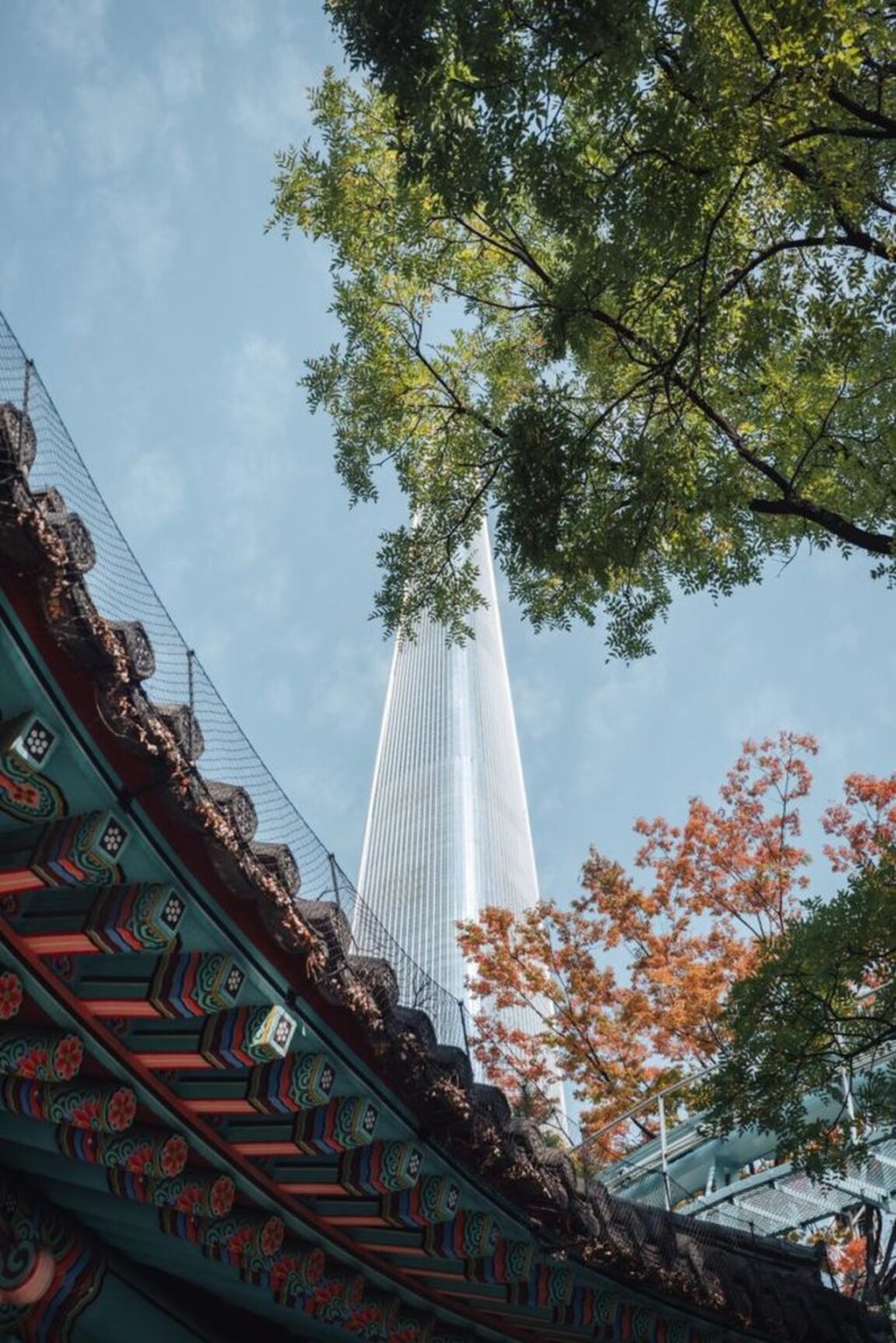
Photo: Lotte World Tower rising behind a traditional Korean temple roof in Seoul, South Korea. Image: Nikky W., via Unsplash.