 Hana Kim
South Korea has two colour seasons, and they are run by two different forecast systems that reward two different booking styles. Cherry blossom races up the country from Jeju in late March to Seoul in early April, peaks about a week after it opens in each city, and is gone in a fortnight. Autumn colour walks the other way, starting on Seoraksan in late September and peaking mountain by mountain through late October and early November, with the official Korea Forest Service map naming the day each famous peak should hit its best. Blossom is a gamble you hedge with flexible bookings. Autumn is a schedule you can plan a month out. This guide works through both, and through the holiday weeks that can price either trip out from under you.
Quick Facts
Blossom order: The bloom opens in the south and moves north. The Korea Tourism Organization’s 2026 forecast put first flowers on Jeju and in Busan on 25 March, Jeonju and Gyeongju on 28 March, Gangneung on 1 April, Seoul on 3 April and Incheon on 7 April, with full bloom about a week after opening in each place.
Autumn order: Colour starts in the north-east mountains and moves south. The Korea Forest Service’s 2026 peak map, published 22 September 2026, forecast peak colour on Seoraksan on 20 October, Songnisan on 28 October, Naejangsan on 4 November and Hallasan on 6 November, defining peak as the point when about half the trees have turned.
Species peaks: In the same 2026 forecast, ginkgo peaked nationally around 30 October and maples and oaks around 31 October.
The climate frame: Visit Korea gives Seoul a January average high of 2.1 degrees and an August high of 30 degrees, with April at 17.9 and October at 20.2 degrees, which is why spring and autumn are the walking seasons.
The crowd traps: Seollal (Lunar New Year) and Chuseok move with the lunar calendar and empty or fill the country depending on direction, and early May carries a run of public holidays. Both colour seasons sit clear of the worst of it, but blossom can collide with school spring breaks and autumn with Chuseok in late-September years.
Facts checked: 24 November 2026, against Korea Tourism Organization and Korea Forest Service published forecasts for 2026.
How does the blossom forecast actually work?
Korea treats cherry blossom as official business. The meteorological service observes standard trees in each city and declares opening when a set number of flowers bloom on the reference branches, a record kept in Seoul since 1922. The tourism authorities then publish a national forecast each February or March giving an opening date per city. Two facts about that forecast matter more than the dates themselves. First, opening is not peak: full bloom follows about a week later, and it is the peak week that fills the famous streets. Second, the forecast moves. In 2026 the bloom ran several days earlier than the long-term average, and Seoul’s standard tree in fact flowered ahead of the forecast window, which is why experienced blossom travellers book a span, not a day.
The geography is your hedge. Because the bloom climbs from Jeju to Seoul over roughly two weeks, a traveller based in the middle of the country can chase it in either direction by train. Jinhae, near Busan, holds the country’s biggest blossom festival around its naval port streets and streams. Gyeongju spreads its blossom around the lake and the tomb parks with more room to breathe. Our Gyeongju guide covers that city in detail, and it is at its most beautiful in the first week of April.
How is the autumn forecast different?
Autumn colour is forecast by the Korea Forest Service, working with the National Arboretum and regional arboretums, and it is published as a mountain-by-mountain peak map each September. The unit is not the city but the famous peak: Seoraksan first, then the central ranges, then Naejangsan, the country’s most celebrated maple mountain, and Hallasan on Jeju last. The spread in 2026 ran from 20 October to 6 November for those headline names, and the full map shows neighbouring mountains more than three weeks apart. There is no single Korean autumn week. There is a rolling front, and the skill is standing in front of the right mountain on its week.
The definitions differ between agencies, which explains duelling headlines. The Forest Service calls peak at about 50 percent of trees turned. The meteorological service reports first colour and peak by observation after the fact, at a higher threshold. Both are honest; they are simply measuring different moments. For booking purposes, the Forest Service map, published a month ahead, is the planning tool, and it has the great virtue of telling you in September where to be in late October. City colour follows the mountains by a week or so: Seoul’s palace gardens and the Secret Garden at Changdeokgung peak in late October and early November, which is also when our guide to Korea’s healing forests is at its most relevant.
Which season gives you the better trip?
Blossom is prettier in photographs and worse in every practical respect. It is shorter, more weather-fragile, since one rainy weekend can strip a city at its peak, and it concentrates demand into the same famous streets in the same ten days. Its great advantage is that it pairs with mild temperatures and the festival calendar, and that the south-to-north chase by rail is a lovely trip structure in itself.
Autumn is the planner’s season. The window is three to four weeks wide somewhere in the country, the mountain map is published in advance, October is statistically the driest, clearest month in Seoul, and the colour pairs with harvest food and cool hiking weather. Its traps are different: the famous mountains are extremely busy on the two weekends nearest their forecast peak, and Seoraksan’s upper trails close for forest-fire prevention in mid to late autumn, so a peak-weekend plan needs the trail notices checked as well as the colour map. On balance, first-time visitors with fixed dates should choose autumn, and blossom should be chosen by travellers who can flex by a week in either direction. If your trip starts with entry paperwork, our K-ETA exemption explainer sets out who currently skips the application.
What do the holidays do to both seasons?
Korea’s two great holiday migrations, Seollal in winter and Chuseok in autumn, move with the lunar calendar. Chuseok is the one that can reach into colour season: in years when it falls in late September or early October, the whole country travels at once, trains sell out, and mountain roads jam, just as the first colour appears in the north. Blossom season has its own softer pressure, school and university spring breaks in March, and the early-May holiday cluster that turns the tail of the season into a domestic travel peak in the south.
The working rule is to check the lunar calendar before the colour map. A blossom or autumn trip that avoids the holiday weeks keeps ordinary prices and bookable trains. One that lands inside them needs every ticket bought the day bookings open.
What about the islands at both ends of the calendar?
Jeju deserves a sentence of its own in both seasons. It blooms first, in late March, with the king cherry trees that are the island’s own variety, and it colours last, with Hallasan’s peak forecast on 6 November in 2026, weeks after the mainland’s northern mountains. That makes Jeju the traveller’s insurance policy in both directions: the place to start a blossom trip a few days early, or to finish an autumn trip a few days late, when the mainland has already turned. The island’s weather is its own, windier and wetter than the peninsula’s, so the insurance is about dates, not about skies.
Frequently asked questions
When is cherry blossom in Seoul? The forecast opening for Seoul in 2026 was 3 April, with full bloom about a week later. The long-term pattern is opening in late March to early April and peak roughly a week after opening, but the exact dates move by several days each year.
When does autumn colour peak in Korea? Mountain by mountain from mid October to mid November. The Korea Forest Service’s 2026 map put Seoraksan’s peak on 20 October, Songnisan on 28 October, Naejangsan on 4 November and Hallasan on 6 November.
Which is better, blossom or autumn? Autumn, for most travellers with fixed dates: a longer window, an official peak map published a month ahead, and the driest weather of the year. Blossom suits travellers who can shift their dates by a week.
Where is the best blossom outside Seoul? Jinhae for the festival scale, Gyeongju for blossom around lakes and tomb parks with more space, and Jeju for the earliest bloom of the year, from late March.
How far ahead should I book? For autumn, once the Forest Service map appears in September. For blossom, book refundable rooms in two candidate weeks as soon as the February to March forecast is published, then commit when the opening dates firm up.
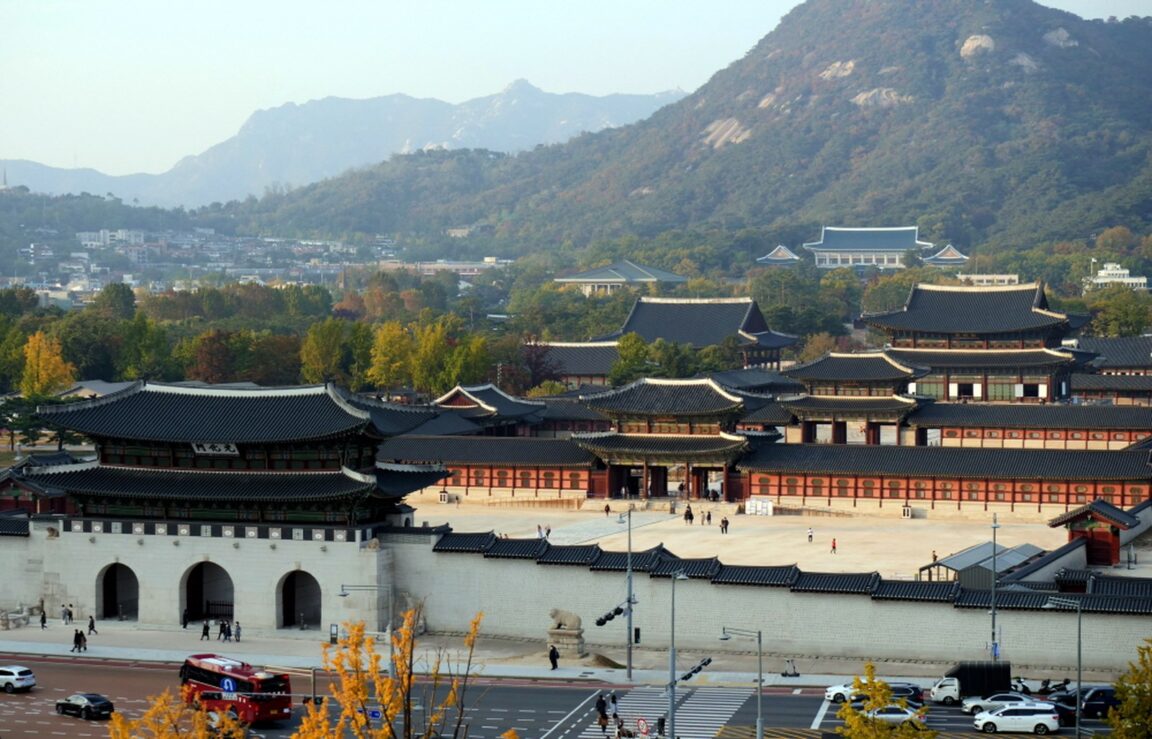
Featured image: Gyeongbokgung Palace from above in autumn, Gwanghwamun gate and the palace courtyards spread beneath Bugaksan, with ginkgo trees turning yellow in the foreground. Photo: Seoul Metropolitan Government, via english.seoul.go.kr, the city’s official website (handout photo, free for editorial use), used with credit.