 Hana Kim
South Korea’s healing forests are not a metaphor: they are a national, bookable system of forests managed for therapy, where a stressed visitor from Seoul can reserve a guided slow walk led by a certified forest healing instructor, have stress and blood pressure measured before and after, drink tea in a cypress grove and sleep in a forest lodge, often for the price of a city lunch. The two names to build a trip around are Jangseong, where a cypress forest planted by one man from 1956 has become the National Jangseong Healing Forest and a national forest activities centre, and the wider network booked through the Korea Forest Welfare Institute’s Sooperang portal and the national recreation forest system, which is how the Miryang area’s city run healing trips and dozens of other forests take reservations. Entry to the Jangseong healing forest itself is free and it opens daily from 9 a.m. to 6 p.m.; the guided programs are the part to book, at 10,000 won per person on the published Visit Korea listing checked on November 21, 2026.
Quick Facts
- System: Designated healing forests under South Korea’s forest welfare programme, run with the Korea Forest Service and the Korea Forest Welfare Institute
- Anchor site: National Jangseong Healing Forest, Chungnyeongsan National Forest, Jangseong, opened in 2011, seven themed hiking courses, entry free, open 9 a.m. to 6 p.m. all year
- The forest: Cypress and cryptomeria planted from 1956 by Im Jongguk, known as Chuam, now about 2.4 million square metres holding some 2.5 million trees
- Guided programs: Jangseong centre experience programs listed at 10,000 won individual and 8,000 won group per person, reservation required
- Booking: National centres through the Sooperang portal (sooperang.go.kr); recreation forest programs through foresttrip.go.kr; some sites by phone
- Staying over: Jangseong centre rooms listed from 64,000 won for a single storey room sleeping up to seven on off season weekdays
- Facts checked: November 21, 2026, against Visit Korea, the Korea Tourism Organization’s official site
What exactly is a Korean healing forest?
A healing forest, chiyuui sup in Korean, is a forest created or designated to use the documented ingredients of woodland, scent, light, sound, landscape and phytoncides, the antimicrobial compounds trees release, to support health and rest, and in Korea that idea was written into public policy rather than left to spas. The forests are staffed by forest healing instructors, a licensed profession, and the standard visit has a clinical frame that surprises first timers: at Jangseong’s Health Promotion Center, a booked program can begin with blood pressure, heart rate variability and an InBody measurement giving a stress index and vascular age, continues with tea therapy and safety briefing, and only then moves outdoors into guided walking, breathing and rest among the trees. The point is not hiking. Trails are graded gently, benches and wind bathing decks are built into the routes, and the instructor’s job is to slow the group down. Visitors who know the Japanese practice of shinrin yoku will recognise the family resemblance, and our Kyoto forest bathing guide covers that tradition; the Korean difference is scale and state organisation, a whole welfare institute running forests as public health infrastructure.
Why is Jangseong the forest to build the trip around?
Because its forest has an author. The cypress woods of Chungnyeongsan were planted from 1956 onward by Im Jongguk, pen name Chuam, who spent decades turning bare private land into what Visit Korea’s account of the National Center for Forest Activities, Jangseong describes as about 2.4 million square metres holding some 2.5 million trees, recognised among Korea’s beautiful forests to be preserved. Two institutions now share the mountain. The National Jangseong Healing Forest, opened in 2011 at 716 Chuam-ro, offers seven hiking courses of different themes and slopes, including the main Well-being Forest Path up to the Chungnyeongsan Observatory, with free entry and hours of 9 a.m. to 6 p.m. year round, per the Visit Korea listing for the healing forest. Beside it, the National Center for Forest Activities splits into a Forest Education Center on Bangjangsan and the Forest Healing Center in the cypress forest itself, where the booked programs, health checks and accommodation sit, and where the 0.6 kilometre Sumnurim Trail, built wide enough for wheelchairs and strollers, threads decks between trees it was designed not to harm. A memorial mural to Chuam at the healing centre entrance sets the tone: this is a planted forest with a biography, and the guides tell it that way.
How do the booked slow walks and programs actually reserve?
Through the same two doors as the rest of Korean forest welfare. National centres, Jangseong included, take program and accommodation reservations through Sooperang, the Korea Forest Welfare Institute’s booking portal, and the centre’s listing is explicit that reservations are required for its programs: the experience programs at the Forest Healing Center are listed at 10,000 won for individuals and 8,000 won for group participants, with accommodation in the same listing running from 64,000 won for a single storey room sleeping up to seven, off season weekday rate, to 100,000 won for a two storey room sleeping up to ten. Recreation forests and many local healing forests book instead through foresttrip.go.kr, the national recreation forest reservation site, or by phone: the Odosan Mountain Healing Forest in Hapcheon, a useful comparison in the same southern region, lists its forest healing program at 10,000 won for adults and 5,000 won for children and teenagers, with prior phone reservation required. Book Korean language first where the portals allow it and use the centres’ phone lines, Jangseong’s are published as +82-61-399-1800 for the centre and +82-61-399-1777 for the healing forest, for anything the portal will not complete in English. Weekends in spring and autumn are the contested slots; a weekday booking is a different, easier exercise.
What does a Miryang healing day add, and how is it different?
Miryang, in Gyeongsangnam-do within reach of Busan, runs the same idea at city scale rather than national centre scale. The city’s Saturday healing trip format strings a guided day together from the area’s own assets, forest and cliffside walking, the pond at Wiyangji ringed with trees and its pavilion, and food and craft experiences, sold as a single bookable day with places reserved in advance through the operating agency. It is a lighter instrument than Jangseong: no health measurements, no forest lodge, and the therapy is the walking, the water and the pace rather than a staffed centre. That contrast is genuinely useful for planning a Korea trip, because it maps onto the two ways visitors actually use the system: a dedicated overnight pilgrimage to a national forest, or a healing themed day folded into a wider southern itinerary. Travellers working the Busan coast into the same week can sequence the two with our 3 days in Busan itinerary, putting the Miryang day on the itinerary’s quiet middle rather than its arrival edge.
How should a Seoul visitor sequence a healing forest trip?
As a two day, one night unit, not a day trip, whichever forest is chosen. The national centres reward the overnight pattern their accommodation is built for: arrive by early afternoon, take the measured, guided program while the forest is quiet, sleep in the forest rooms, and walk one of the unguided themed courses the next morning before the day groups arrive. From Seoul both Jangseong in the southwest and the National Center for Forest Therapy at Yeongju, the system’s flagship therapy centre under Sobaeksan with some 50 kilometres of healing trails and its own bookable stays, are half day journeys, which is precisely why compressing them into a single day wastes the asset: the benefit these places are engineered to deliver is cumulative slowness. Pack for walking rather than hiking, soft shoes, layers for still air under trees, and nothing with a schedule attached to the hour after the program ends. Travellers should also hold the honest limit in view: these are wellness programs, not medical treatment, and the centres say so themselves; what they sell is rest, measured and guided, in forests that were planted and staffed for exactly that.
Frequently Asked Questions
How much does it cost to visit the Jangseong Healing Forest?
Entry to the National Jangseong Healing Forest itself is free, and it is open from 9 a.m. to 6 p.m. all year. The bookable extras are the guided programs at the neighbouring National Center for Forest Activities, listed at 10,000 won per person for individuals and 8,000 won for group participants, and the centre’s accommodation, listed from 64,000 won on off season weekdays.
Do healing forest programs need to be booked in advance?
Yes for the guided programs and the accommodation. National centres book through the Sooperang portal of the Korea Forest Welfare Institute, recreation forest programs through foresttrip.go.kr, and some sites by phone. The open forest trails, including Jangseong’s seven courses, can be walked without a program booking during opening hours.
What happens in a guided forest healing program?
At Jangseong the pattern is a health check first, blood pressure, heart rate variability and a stress index measurement, then tea therapy and a safety briefing indoors, then a slow guided walk with breathing, rest stops at wind bathing areas and benches, led by a forest healing instructor. Programs are graded for rest, not exertion.
What is the difference between Jangseong and the Miryang healing trips?
Jangseong is a national centre in a designated healing forest, with staff instructors, health measurements, bookable programs and forest accommodation. Miryang’s healing offer is a city run day format, guided walking and local experiences including the Wiyangji pond area, reserved as a day trip. Jangseong suits a dedicated overnight; Miryang suits a themed day inside a wider Busan region trip.
When is the best season for Korea’s healing forests?
Spring and autumn, when the cypress forests are at their most comfortable for slow walking and the booking competition, while real, is manageable on weekdays. Summer brings humidity under the canopy and winter brings cold still air; the forests stay open, Jangseong year round, but the programs are at their best in the shoulder seasons.
Can international visitors book through Sooperang?
The Sooperang portal is the official route for national centre programs and stays, and the centres also publish phone numbers, Jangseong’s centre on +82-61-399-1800, which serve as the practical fallback when the Korean language portal will not complete a booking. The Visit Korea listings for each forest carry the current contact details and prices.
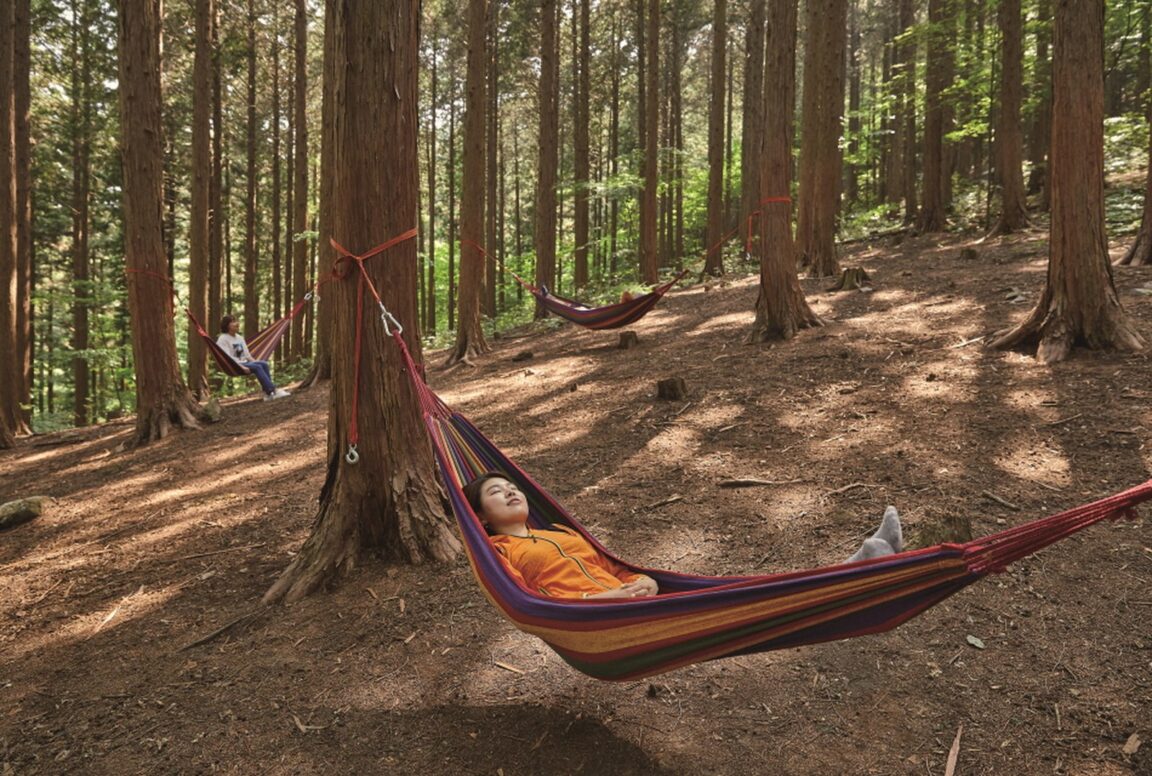
Featured image: Visitors resting in hammocks strung between the tall cypress trunks of the Jangseong healing forest in South Korea, dappled light on the forest floor. Photo from Visit Korea, the Korea Tourism Organization official site (visitkorea.or.kr), used with credit.