 River Callahan
Choose the ferry by the end of the island you want to sleep in, not by the shortest crossing: the Michigan boats, the Ranger III from Houghton in 6 hours and the Isle Royale Queen IV from Copper Harbor in 3.5 hours, both land at Rock Harbor on the northeast end, with the lodge, the main visitor centre and the densest trail network, while the Minnesota boats from Grand Portage, the Voyageur II in 2 hours and the Sea Hunter III in 1.5 hours, land at Windigo on the southwest end, quieter, smaller and closer to the Feldtmann Lake country. For a three night first stay, Rock Harbor is the safer base and Windigo is the connoisseur’s base, and the island’s moose and wolf country shapes both: moose are a realistic hope anywhere near water, wolves are a presence to understand rather than a sighting to expect.
Quick Facts
- Park: Isle Royale National Park, Michigan, a roadless island archipelago in northwestern Lake Superior, reached only by ferry, seaplane or private boat
- Season: Closed to all visitors from November 1 to April 15; ferries and seaplane run from mid May to September, per the National Park Service
- Entrance fee: $7 per person per day for visitors aged 16 and up, visitors 15 and under free, Isle Royale season pass $60, per the National Park Service, checked November 21, 2026
- Michigan ferries: Ranger III, Houghton to Rock Harbor, 6 hours, departs 9 a.m. eastern, arrives 3 p.m.; Isle Royale Queen IV, Copper Harbor to Rock Harbor, 3.5 hours, departs 8 a.m., arrives 11:30 a.m.
- Minnesota ferries: Voyageur II, Grand Portage to Windigo, 2 hours; Sea Hunter III, Grand Portage to Windigo, 1.5 hours; Voyageur II continues Windigo to Rock Harbor in about 5 hours
- Seaplane: Isle Royale Seaplanes from Hubbell, Michigan, about 40 minutes to Rock Harbor
- Backcountry: 36 campgrounds and about 165 miles of trails; overnight permits issued at the Rock Harbor and Windigo visitor centres, groups of 7 or more need a group permit and advance reservations
- Prices and times checked: November 21, 2026, against National Park Service pages
Michigan or Minnesota: which ferry actually fits a three night stay?
The Michigan side, for most first stays, and the reason is what waits at the dock. The National Park Service Isle Royale directions page sets out the full grid. From Houghton, the park’s own ferry Ranger III sails to Rock Harbor in 6 hours, departing at 9 a.m. eastern time and arriving at 3 p.m., and the same ship also serves Windigo from Houghton on its schedule. From Copper Harbor, 52 miles north of Houghton at the tip of the Keweenaw Peninsula, the Isle Royale Queen IV reaches Rock Harbor in 3.5 hours, departing at 8 a.m. and arriving at 11:30 a.m. eastern, which is the kindest Michigan crossing: a morning arrival that leaves the whole first afternoon usable. From Grand Portage, Minnesota, the Voyageur II reaches Windigo in 2 hours and the Sea Hunter III in 1.5 hours, and the Voyageur II then continues around the island, taking about 5 hours from Windigo to Rock Harbor, which is what makes point to point traverses possible.
Read those times as a base decision. Rock Harbor holds the island’s only full service lodging, Rock Harbor Lodge, its visitor centre, store, marina and the trailheads for the Tobin Harbor and Rock Harbor trails, so a three night stay based there can mix lodge or campground nights with serious day hiking and never move camp. Windigo holds a visitor centre, a small store, camper cabins and a campground at the head of Washington Harbor, and its day country, the Huginnin Cove loop, Grace Creek and the Feldtmann Lake trail, is softer, emptier and more intimate. Travellers weighing the beds themselves should read our where to stay for Isle Royale guide alongside this ferry decision, and first timers who want the full orientation should start with our Isle Royale first timer guide, which covers permits and the no roads rule in depth.
How does a three night Rock Harbor stay actually run?
Day one belongs to arrival and orientation. A Queen IV sailing puts you on the Rock Harbor dock at 11:30 a.m., early enough for the visitor centre permit talk if you are camping, lunch, and the Stoll Memorial Trail to Scoville Point, the classic first walk: an easy shoreline out and back through spruce and fir to a rocky point over Lake Superior. Day two is the big hiking day, and the honest choices are the climb to the Mount Franklin overlook on the Greenstone Ridge, the Tobin Harbor Trail’s quiet inland sea, or a boat assisted day using the local sightseeing and water taxi options from Rock Harbor toward Hidden Lake and Lookout Louise, where moose are often reported around the lake. Day three should be kept deliberately short, a Daisy Farm or Three Mile campground out and back for campers moving camp, or a slow Tobin Harbor morning for lodge guests, because the return ferry fixes the end of the day and Isle Royale weather can move departure plans.
For campers, the three night version with one move is the sweet spot: night one at Rock Harbor Campground, night two at Three Mile, night three back at Rock Harbor or Daisy Farm, distances that keep packs honest and leave afternoons for shoreline rather than trail grinding. Every overnight stay needs a permit, issued at the visitor centres on arrival for small parties; the park directs groups of 7 or more to a group camping permit with advance reservations, and boaters to permit in advance through the Houghton Visitor Center. Potable water is available at Rock Harbor and Windigo, and all lake and stream water must be treated, a rule that shapes how much water capacity a day hike needs.
What does moose and wolf country really mean for a visitor?
It means Isle Royale is a working predator and prey system that visitors walk through quietly, not a wildlife park with viewing platforms. Moose reached the island in the early 1900s, wolves crossed an ice bridge in the late 1940s, and the study of their relationship, running since 1958, is the longest continuous predator prey research of its kind in the world. The practical translation for a three night stay is this: moose are genuinely likely, especially near inland lakes, beaver ponds, campground edges and the shorelines at dawn and dusk, and a bull near a campground is a photograph from distance, never an approach. Wolves are almost never seen by short stay visitors. They are heard about in ranger talks, tracked in the research, and present in the scat, tracks and occasional howl that remind hikers the island’s ecology is intact. Plan for moose, respect the wolves’ privacy, store food in campground lockers or approved animal resistant containers as the park now directs, and give every animal the distance the park requires.
The crowd free claim in this article’s premise is not marketing. Isle Royale is perennially among the least visited national parks in the system, and its visitors stay for days rather than hours, which spreads them across 36 campgrounds and about 165 miles of trail. A hiker who walks one hour from either dock in any direction is, on most days, functionally alone. That solitude is protected by logistics: the park is closed from November 1 to April 15, the boats run only from mid May to September, and every seat on every ferry is finite. Book the crossing before the bed, and book both before anything else.
When should Windigo win instead?
When the trip starts in Minnesota or Ontario, when quiet matters more than services, or when the Feldtmann Lake loop is the point. The Grand Portage crossings are the shortest on the lake, the drive up the North Shore from Duluth, about 150 miles to Grand Portage per the park’s directions, is a trip in itself, and Windigo’s Washington Harbor is the island’s sunset side. A three night Windigo stay runs differently: night one at Washington Creek Campground beside the harbour, day two on the Feldtmann Lake Trail or the Huginnin Cove loop, day three on the Minong Ridge overlooks or a paddle in the harbour before the afternoon boat. The trade is real: fewer services, no lodge dining room, and a longer onward hop if Rock Harbor calls, about 5 hours aboard the Voyageur II around the island. Choose Windigo knowingly and it is the better trip; choose it by accident, because a search engine sold the shortest crossing, and it can feel like arriving at the island’s quiet door when you wanted its front hall.
Frequently Asked Questions
How much does Isle Royale cost to enter?
The entrance fee is $7 per person per day for every visitor aged 16 and up, with visitors aged 15 and under free. The Isle Royale season pass costs $60, and interagency passes waive the fee for the pass holder and up to three additional adults travelling with the party. Fees were checked against the National Park Service on November 21, 2026. Ferry fares are separate and set by each operator.
Which Isle Royale ferry is fastest?
The Sea Hunter III from Grand Portage, Minnesota, at about 1.5 hours to Windigo, followed by the Voyageur II from Grand Portage at 2 hours to Windigo. From Michigan, the Isle Royale Queen IV from Copper Harbor is fastest at 3.5 hours to Rock Harbor. The seaplane from Hubbell beats all of them at about 40 minutes to Rock Harbor, at a very different price point.
Can Isle Royale be done as a day trip?
Technically, on the Minnesota boats, and it is usually a mistake. The crossings, the permit and orientation process and the island’s scale mean a day visitor sees one dock area and a short trail. The park’s own pattern is multi day: three nights is the shortest stay that does Rock Harbor or Windigo justice.
Will I see a wolf on Isle Royale?
Probably not, and the trip should not be sold on it. Wolves are wide ranging, few in number and wary, and most visitors never see one in a short stay. Moose are a realistic hope near water at dawn and dusk. What every visitor gets is the country the wolf and moose system created: quiet forest, empty trails and an ecosystem with its predator intact.
When is Isle Royale open?
The park is open to visitors from April 16 to October 31 and closed to all visitors from November 1 to April 15. Ferries and the seaplane provide public transport from mid May to September, per the National Park Service, so the practical visiting season is those ferry months.
Do I need a permit to camp on Isle Royale?
Yes. All overnight backcountry stays need a camping permit, issued at the Rock Harbor and Windigo visitor centres for small parties on arrival. Groups of 7 or more need a group camping permit and advance reservations, and boaters are asked to permit in advance through the Houghton Visitor Center.
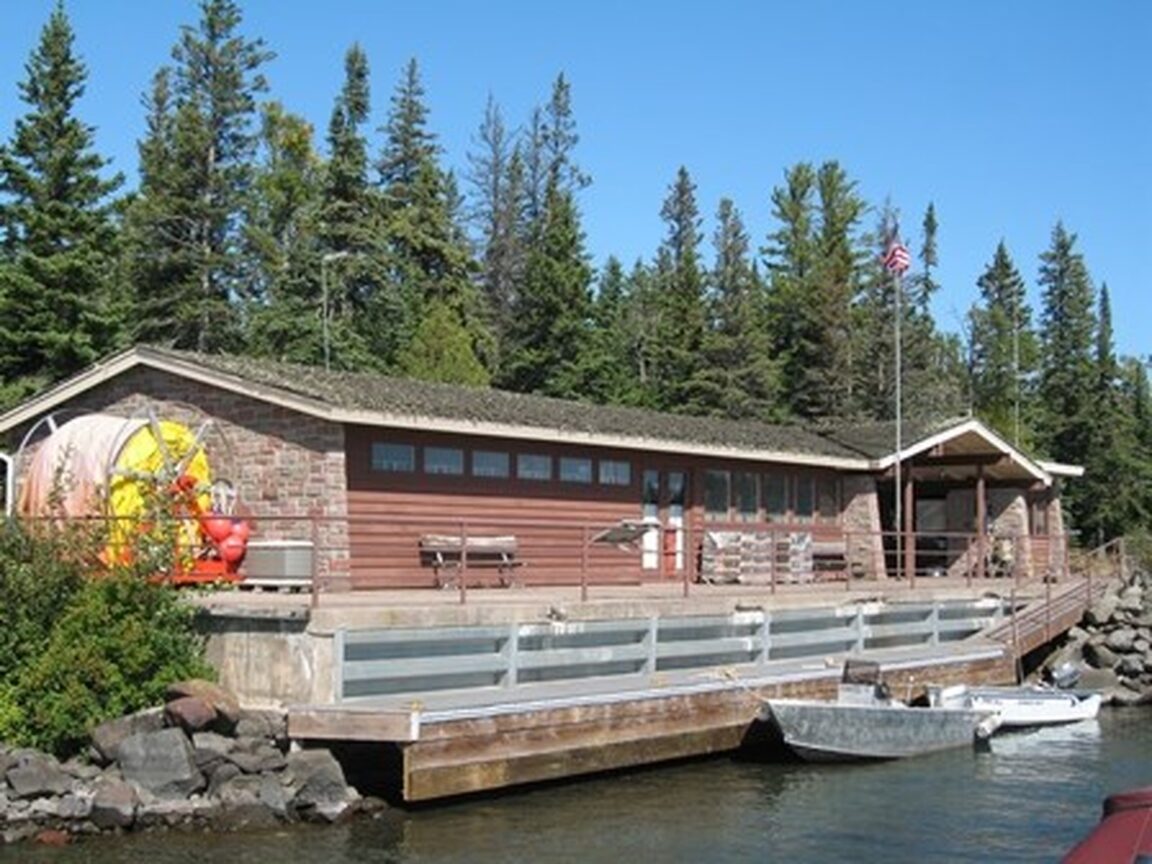
Featured image: The harbour building and dock at Rock Harbor, Isle Royale National Park, with boats moored alongside and boreal forest behind, Lake Superior in the foreground. Photo from the National Park Service official site (nps.gov), US Government work, used with credit.