 Hana Kim
Jeonju Hanok Village is two different places in one day, and the clock decides which one you get. Before about 9 in the morning the lanes belong to residents, delivery bicycles and the first smoke from breakfast kitchens, and the tiled roofs photograph clean because the day-trip crowds are still on trains from Seoul. By midday the same streets carry the full weight of one of Korea’s most visited quarters. After dark the village changes again, when the day visitors leave and the makgeolli houses fill their kettles. The village itself never closes and costs nothing to walk, so the whole game is timing: dawn for the streets, opening time for Gyeonggijeon and the Royal Portrait Museum, and the evening for the kettle bars and the Nambu Market side of town.
Quick Facts
The village: Around 735 traditional hanok houses in the Pungnam-dong and Gyo-dong quarters of Jeonju, the largest urban hanok cluster in Korea. The lanes are free and open at all hours, all year.
The one ticket that matters: Gyeonggijeon Shrine, which includes the Royal Portrait Museum, costs 3,000 won for adults, 2,000 won for youths and 1,000 won for children, and is free on the last Wednesday of the month.
Gyeonggijeon hours: 09:00 to 18:00 from November to February, to 19:00 in March to May and September to October, and to 20:00 from June to August, with last entry an hour before closing.
The cathedral: Jeondong Cathedral, the brick church facing Gyeonggijeon across the road, is free to enter, generally 09:00 to 17:00 outside Mass times.
Getting there: KTX trains from Seoul’s Yongsan Station take about 1 hour 40 minutes to Jeonju Station, then roughly 25 minutes by city bus to the Jeondong Cathedral (Hanok Village) stop.
The night market: Nambu Market’s night market runs on Friday and Saturday evenings, a short walk west of the village past Pungnammun gate.
Facts checked: 24 November 2026, against the Jeonju Hanok Village official portal and Jeonju City sources.
Why does the early morning change everything here?
Jeonju draws visitors in the millions each year, and most of them arrive in the same four-hour window in the middle of the day. The village, though, is a living neighbourhood before it is an attraction. Hanok guesthouses empty their guests into lanes that are still quiet, shopkeepers sweep the stone thresholds, and the light comes in low over the roof ridges from the east. A traveller who stays one night inside the village, rather than day-tripping, owns this hour outright. Our earlier guide to Jeonju as the slow alternative to Seoul makes the case for the overnight stay, and the morning is the strongest part of that argument.
The practical order is simple. Walk Taejo-ro, the main street, while it is still a street and not a queue. Climb to Omokdae, the hilltop pavilion on the village’s eastern edge, for the view back across the sea of grey tiled roofs before the tour groups reach it. Then be at Gyeonggijeon’s gate a few minutes before it opens, because the shrine grounds are at their best in the first hour, when the courtyard is empty and the bamboo grove behind the museum is silent.
What should you see inside Gyeonggijeon?
Gyeonggijeon was built in 1410 to house the portrait of King Taejo, founder of the Joseon dynasty, whose family came from Jeonju. The original buildings burned during the invasions of 1597 and were rebuilt in 1614. The portrait enshrined in the main hall today is a copy. The original, designated National Treasure No. 317, is kept in the Royal Portrait Museum inside the grounds and is shown to the public only in a limited November window, which is worth knowing before you promise yourself a sight of it.
The museum is included in the shrine ticket, so there is no reason to rush past it. It explains how royal portraits were painted, carried in procession and repaired, and it holds portraits of other Joseon kings alongside Taejo’s. Give the combined visit an hour. Free guided tours of the grounds run in English at set times, listed at the gate, and the site is free for everyone on the last Wednesday of each month, the national Culture Day pattern that applies at many Korean heritage sites.
How does the cathedral and portrait museum order work?
The two anchor sights face each other, which makes the order easy to get wrong in one specific way: visitors queue for Gyeonggijeon at midday, when it is busiest, and then cross to Jeondong Cathedral just as it closes for Mass or for the day. Do it the other way round. If you arrive in the village in the late morning, visit the cathedral first while it is open, then take Gyeonggijeon in the later afternoon when the day crowds thin and the light warms the courtyard walls.
Jeondong Cathedral was built between 1907 and 1914 on ground where Korean Catholics were martyred in the eighteenth and nineteenth centuries, and its foundations were laid with stones from the demolished city wall. It is a working church, so visits pause during Mass and visitors are asked to treat services as services, not as photo opportunities. Pungnammun, the only surviving gate of the old city wall, stands a few minutes west and costs nothing at any hour. Jeonju Hyanggyo, the old Confucian academy at the village’s east side, keeps shorter hours, generally 10:00 to 18:00, and rewards the walk with the quietest courtyard in the quarter.
What happens in the makgeolli alleys after dark?
Jeonju’s evening institution is the makgeolli house, and it works by a rule that surprises first-timers. You do not order dishes. You order a kettle of makgeolli, the milky rice wine, and a table of side dishes arrives with it. Order a second kettle and a further round of dishes appears, heartier than the first. The alleys of kettle bars, in the Samcheon-dong area a short taxi ride from the village and in lanes closer in, run on this escalating table system, and a group that understands it eats very well for the price of the wine.
The cheaper local habit is gamaek, a word built from the Korean for a corner shop and for beer. You buy beer and dried snacks at a small supermarket, then drink at the tables the shop sets outside, with dried pollack or squid grilled to order. It is the least formal drinking format in the city and one of the oldest. On Friday and Saturday evenings, add the Nambu Market night market, where stalls fill the market’s second floor and lanes with skewers, fried chicken, noodles and sweets until late. Travellers combining Jeonju with the coast can continue with our 3 days in Busan itinerary, which uses the same stay-overnight logic.
How do you build one full day on this clock?
Start at first light with the lanes and Omokdae. Take breakfast the Jeonju way, with kongnamul gukbap, the bean sprout soup with rice that the city claims as its own morning dish, served in the market area from early. Be at Gyeonggijeon for opening and give the shrine and the Royal Portrait Museum their hour. Cross to Jeondong Cathedral before lunch. Eat bibimbap at lunch, because Jeonju is the dish’s hometown and the midday restaurants are set up for it, then spend the hot or crowded middle of the day in the village’s craft workshops, tea houses and the Hanok Village’s side lanes rather than on Taejo-ro itself.
Late afternoon belongs to Jeonju Hyanggyo and a second, slower pass through the village as the day visitors drain away. Evening is for the kettle bars or gamaek, and on a Friday or Saturday for the Nambu night market as well. If you are travelling onward to the tomb city, our Gyeongju travel guide pairs naturally with Jeonju in one Korea week.
Frequently asked questions
Is Jeonju Hanok Village free to enter? Yes. The village streets are public lanes in a living neighbourhood and are open at all hours. The charge is for Gyeonggijeon Shrine, 3,000 won for adults including the Royal Portrait Museum, with free entry on the last Wednesday of the month.
What time should I arrive to beat the crowds? Before 9 in the morning. Staying overnight inside the village is the easiest way to do it, since day visitors from Seoul rarely reach the lanes before mid morning.
Can I see the original portrait of King Taejo? Usually not. The portrait in Gyeonggijeon’s main hall is a copy. The original, National Treasure No. 317, is held by the Royal Portrait Museum in the grounds and is displayed only in a limited November window.
How does a makgeolli house work? You order kettles of rice wine, and sets of side dishes arrive with each kettle, growing more substantial as you order. You do not order the dishes individually.
Is one day enough for Jeonju? One long day covers the sights, but it costs you both of the village’s best hours, the early morning and the evening. One night is the right unit.
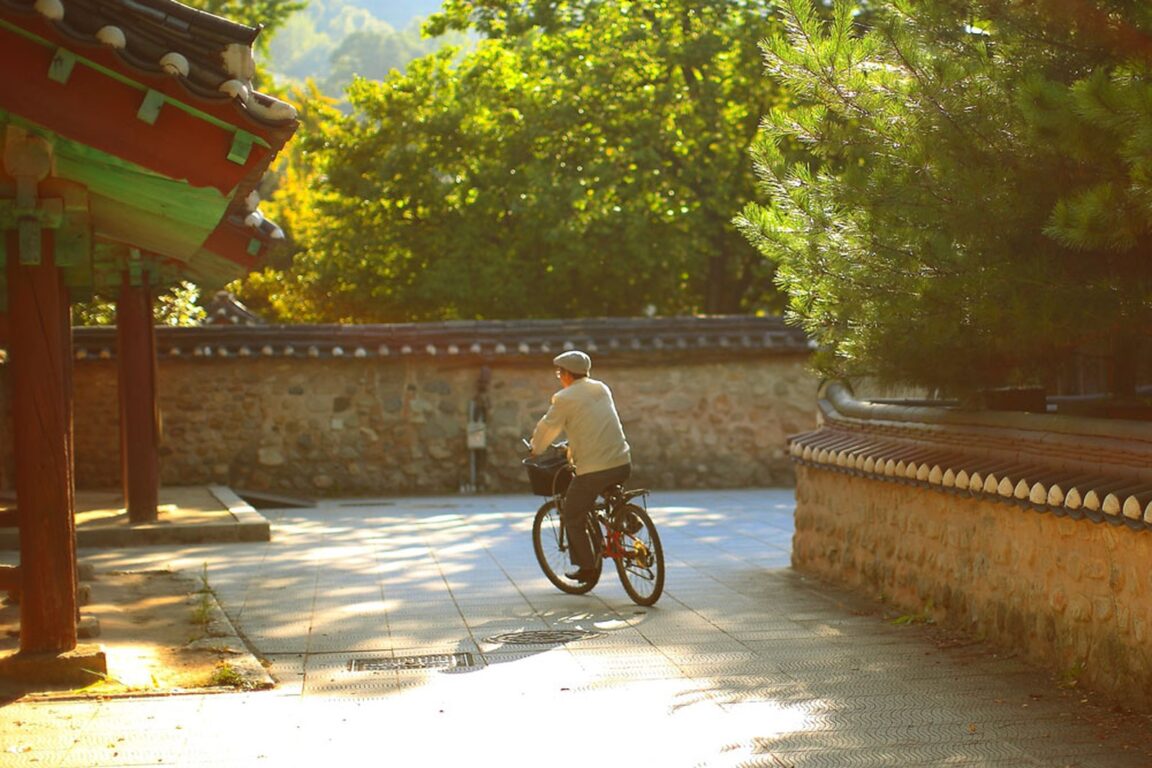
Featured image: A resident cycles through a sunlit lane in Jeonju Hanok Village in the early morning, beside the painted eaves of a traditional building. Photo: Jeonju Hanok Village official portal, via hanok.jeonju.go.kr, used with credit.