 Omar Haddad
Two days is the right amount of time for Petra, and the order matters more than the list. On day one, enter through the main gate at opening, walk the Siq to the Treasury in the early light, continue down the main trail past the theatre and the Royal Tombs to Qasr al Bint, and keep the afternoon for the Royal Tombs or the museum. On day two, come in the back door: start from Little Petra, take the Back Door trail to the Monastery, Ad Deir, and walk down through the whole city and out through the Siq, seeing everything in reverse and downhill. Buy the two day ticket, 55 Jordanian dinars against 50 for one day, before you enter on day one. That sequence, against the heat and against the crowds, is the whole plan.
Quick Facts
Tickets: For visitors staying at least one night in Jordan, one day costs 50 JOD, two consecutive days 55 JOD and three consecutive days 60 JOD. A day visit without an overnight stay in Jordan costs 90 JOD. Children under 12 enter free in the daytime.
The smart buy: The two day ticket costs only 5 JOD more than the one day ticket. Multi day tickets must be used on consecutive days, and you must present a valid passport at the ticket office.
Jordan Pass: The pass bundles the visa fee with Petra entry for one, two or three days at 70, 75 or 80 JOD. Jordan Pass holders using the Back Trail must present the pass at the ticket office for verification first.
The main trail: The Visitor Centre to Qasr al Bint route is 3.9 kilometres one way and graded easy by the Petra authority, passing the Djinn Blocks, the Siq, the Treasury, the Street of Facades, the theatre and the Colonnaded Street.
The Siq: The gorge runs just over 1.2 kilometres, narrowing in places to about 3 metres wide, and opens directly onto the Treasury.
Back Door logistics: One way 4×4 transfers run daily toward the Monastery trail between 7:30 a.m. and 3:00 p.m. at 5 JOD per person, per the official fees page. Golf carts run from the Visitor Centre from 7:00 a.m.
Petra by Night: A separate ticket, not included in daytime admission or the Jordan Pass, and a valid daytime ticket is required to attend.
Which ticket should you buy, and when?
Buy it at the Petra Visitor Centre in Wadi Musa on the morning of day one, or online through the official Petra Pass portal in advance, and buy the two day version straight away. The maths is not close: the second day costs 5 JOD on top of the 50 JOD one day ticket, and this itinerary uses both days fully. Two rules catch people out. Multi day tickets run on consecutive days, so a rest day in between wastes the second day entirely; and the cheap rates depend on staying at least one night in Jordan, with a passport shown at the ticket office. A visitor arriving and leaving the same day without a night in Jordan pays 90 JOD for one day, which is one more reason Petra rewards staying in Wadi Musa rather than busing in and out.
If you are touring Jordan more widely, price the Jordan Pass before you buy anything. Its tiers, 70, 75 and 80 JOD, bundle one, two or three days at Petra with entry to dozens of other sites and the visa fee, subject to the pass conditions on minimum stay. For this two day plan the middle tier matches. One Back Door specific rule applies to pass holders: present the Jordan Pass at the ticket office for verification before using the Back Trail, which in practice means a quick stop at the Visitor Centre before you head out to Little Petra on day two. Payments at the Visitor Centre are taken in Jordanian dinars in cash or by Visa card. For the packing side of the same trip, our guide to what to pack for Jordan in winter covers desert layers for Petra, Wadi Rum and Amman.
How should day one run, from the Siq to Qasr al Bint?
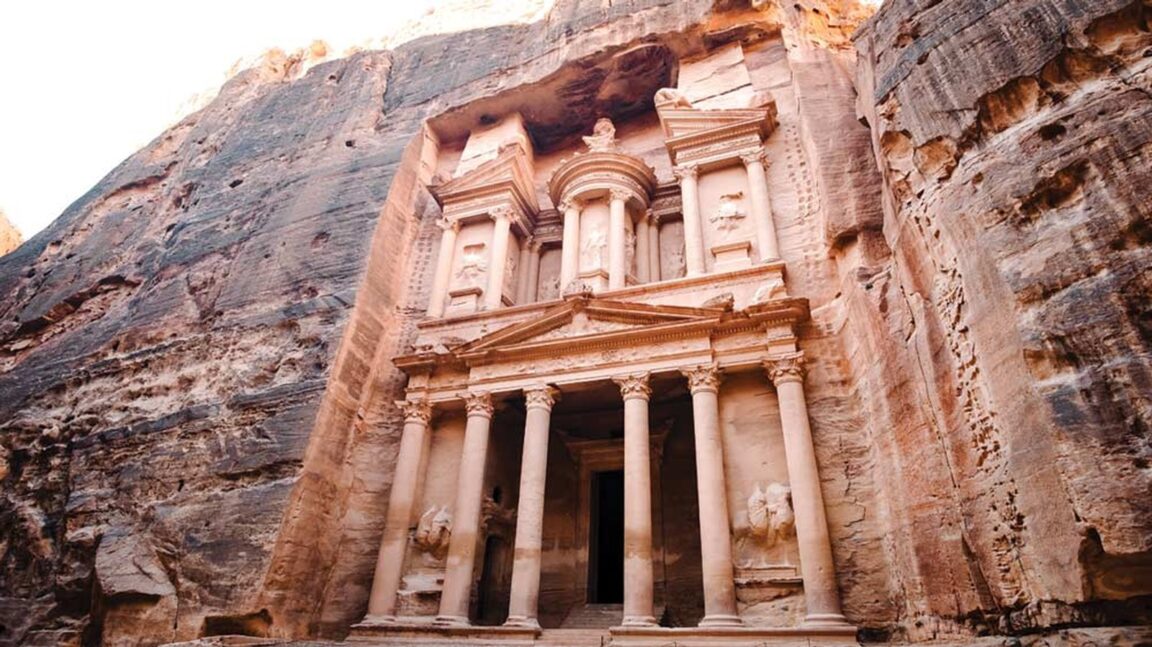
Be at the gate at opening. The walk from the Visitor Centre passes the Djinn Block tombs and the Obelisk Tomb along Bab as Siq, then enters the Siq itself, the natural sandstone gorge that winds for just over 1.2 kilometres toward the city. Early, the Siq is shaded, cool and nearly empty, the dam and the Nabataean water channels along its walls are easy to stop for, and the final narrow stretch frames the Treasury exactly as every photograph promises, except that at this hour there may be almost nobody in it. The Treasury, Al Khazna, is a facade, not a building you enter; give it its ten minutes, take the photographs, and move on while the light is still working for you further down the trail.
From the Treasury the main trail opens into the Outer Siq and the Street of Facades, passes the great theatre, cut into the rock and later expanded in the Roman period, and runs below the Royal Tombs in the cliff to the east, the Urn, Silk, Corinthian and Palace tombs. The Colonnaded Street and the Temenos Gate lead to Qasr al Bint, the great free standing temple at the end of the trail, with the Petra Museum and the basin restaurants nearby for lunch. The authority grades the whole 3.9 kilometre main trail easy and allows roughly an hour and a half of non stop walking; with stops, day one to Qasr al Bint and back is a full, unhurried five to six hours. Spend the late afternoon, when the tour groups have gone, climbing the short path to the Royal Tombs you walked beneath in the morning, and leave the Monastery entirely for tomorrow. It is the classic beginner’s error to attempt it at 3 p.m. on day one.
How does the Back Door day work?
Day two reverses the geography. Take a taxi or local transfer from Wadi Musa to Little Petra, Siq al Barid, the smaller gorge and caravan suburb a short drive north of the Visitor Centre, and walk its painted dining halls first while it is quiet. From there the Back Door trail, the Monastery Trail approached from the back, climbs through open, sculpted country behind the main site and delivers you, after roughly two hours of walking on uneven ground with some steep sections, to the Monastery from above and behind. Ad Deir is the largest facade in Petra, wider than the Treasury, set on a plateau with views west toward Wadi Araba, and arriving at it fresh, in the morning, from the back, is the single best sequencing decision a two day visit allows.
The practicalities are official and simple. A valid Petra ticket is required on the Back Trail, Jordan Pass holders must have the pass verified at the ticket office first, and one way 4×4 transfers toward the Monastery trail run daily from 7:30 a.m. to 3:00 p.m. at 5 JOD per person if you want to shorten the approach. From the Monastery, the day runs downhill: down the long rock stairway of about 800 steps past the Lion Triclinium to Qasr al Bint, then back along the main trail, through the city you saw yesterday at the hour when it is emptying, and out through the Siq in the late afternoon light. You finish having walked the site end to end in both directions, with the two hardest efforts, the early Siq and the back trail, both done in the cool of the morning. If Petra by Night runs on one of your evenings, it needs its own separate ticket bought on the day, plus your valid daytime ticket; treat it as an optional extra, not a reason to shorten either day. Our earlier guide to visiting Petra, the Siq and the Treasury gives the single day version of the same ground for travellers who truly have only one day.
How do you handle heat, water and the midday hours?
By treating midday as a resource to spend in shade rather than on stairs. Petra’s site has almost no natural shade outside the Siq and the tombs, Wadi Musa sits at altitude but the basin below traps heat, and the two climbs, to the Monastery and to the High Place of Sacrifice or the Royal Tombs viewpoint, are all exposed. Carry more water than feels reasonable; a hat and sunscreen are on the authority’s own essentials list, and sturdy shoes matter more than fitness, because the Siq floor, the sand and the worn rock steps punish sandals. Plan lunch at the basin near Qasr al Bint or from supplies carried in, sit down in the shade for the worst hour, and do the exposed viewpoints before 11 a.m. or after 3 p.m. In the winter months the same plan works with the signs reversed: shorter daylight, cold wind on the plateau, and an earlier close, so the early start matters even more. Ticket sales end before closing and the site is cleared from sunset, so keep the walk out in hand rather than assuming the gate stays open until dark.
Frequently Asked Questions
How much does Petra cost for two days?
A two day ticket costs 55 JOD for a visitor staying at least one night in Jordan, against 50 JOD for one day and 60 JOD for three days, with the days used consecutively. Children under 12 enter free in the daytime, and a valid passport is required at the ticket office.
Is the Jordan Pass worth it for two days at Petra?
Usually, if you are also visiting other Jordanian sites. The pass tiers at 70, 75 and 80 JOD bundle one, two or three days at Petra with the visa fee and entry to many other sites, subject to its minimum stay conditions. For Petra alone with no other sites, the plain 55 JOD two day ticket is cheaper.
What is the Back Door trail at Petra?
It is the Monastery Trail approached from Little Petra, entering the site from behind and above so that Ad Deir, the Monastery, is your first major monument of the day rather than the end of a long climb. It takes roughly two hours on uneven ground, needs a valid Petra ticket, and Jordan Pass holders must have the pass verified at the ticket office first.
How long is the walk through the Siq to the Treasury?
The Siq is just over 1.2 kilometres long and narrows to about 3 metres in places. From the Visitor Centre, through Bab as Siq and the Siq to the Treasury, allow about 30 to 45 minutes at a stopping pace, less on the way back out.
How many steps are there to the Monastery?
About 800 rock cut steps climb from the basin near Qasr al Bint to Ad Deir on the main Monastery Trail. This itinerary avoids climbing them loaded with a full day’s fatigue by approaching the Monastery on the Back Door trail on day two and walking down the steps instead.
Is Petra by Night included in the ticket?
No. Petra by Night requires a separate ticket, bought on the day, and a valid daytime admission ticket or Jordan Pass is required to attend. Daytime tickets never include it.
Featured image: Al Khazna, the Treasury at Petra, its columned facade carved into the rose sandstone cliff, seen from below. Photo by Andrea Leopardi via Unsplash (photo k8-5bWDAklo, hosted copy via Holidays With Kids), Unsplash License, used with credit.