 Kwame Mensah
A week on Tanzania’s Northern Circuit carries roughly 700 to 1,100 US dollars per person in government fees alone, before a single bed, meal or mile is paid for, and the fee stack is where safari budgets are won and lost. The Serengeti charges 82.60 dollars per adult for every 24 hours, sleeping inside any park adds a nightly concession fee on top of your room, and one descent into the Ngorongoro Crater costs 295 dollars per vehicle, the most misquoted number in East African travel. This guide itemises the whole stack from the official TANAPA and NCAA tariffs, then shows what the three camp price bands do to a seven-day total, and how guide tipping, the line nobody puts in the brochure, actually works.
Quick Facts
Serengeti entry: US$82.60 per non-resident adult per 24 hours in peak season, US$70.80 in the low season from 15 March to 15 May. Children aged 5 to 15 pay US$23.60, and under-fives are free. All figures include 18 percent VAT, which the published TANAPA tariff excludes.
Ngorongoro entry: US$70.80 per adult per 24 hours, charged by the NCAA, the separate authority that runs the conservation area. Ngorongoro is not a national park and is not on the TANAPA tariff.
The crater descent: US$295 per vehicle for each descent to the crater floor, on top of entry and concession fees. Per vehicle, not per person: a couple pays 147.50 dollars each for it, a full vehicle of six pays about 49 dollars each.
Sleeping inside: A concession fee is charged per person per night on top of accommodation: in the Serengeti, US$70.80 from July to September and US$59 the rest of the year at a lodge or permanent camp, US$35.40 at a public campsite. Ngorongoro’s lodge concession is US$59.
The other northern parks: Tarangire, Lake Manyara and Arusha National Park charge US$59 per adult per day in peak season, US$53.10 in the low season, with a US$47.20 nightly concession.
Tipping norms: Safari guides are customarily tipped around US$10 to 20 per guest per day, paid at the end of the safari, with camp staff tipped separately through the communal staff box at roughly US$5 to 10 per guest per day. Confirm your operator’s guidance, as policies vary.
Facts checked: 24 November 2026, against the published TANAPA and NCAA tariff schedules, with VAT added where the tariff excludes it.
Why do the fees surprise everyone?
Because they are charged per person, per 24 hours, per park, and a Northern Circuit week crosses three fee jurisdictions. TANAPA, the Tanzania National Parks Authority, runs the Serengeti, Tarangire, Lake Manyara and Arusha parks on one tariff. The NCAA runs Ngorongoro alone, on its own tariff, with its own permits. A typical six or seven day circuit, two days in Tarangire or Manyara, three in the Serengeti, one or two at Ngorongoro, stacks entry fees of roughly 59 dollars a day, then 82.60 a day, then 70.80 a day, and then adds a concession fee for every night slept inside a park boundary, which on a well-designed circuit is most of them.
There is also a presentational trap. TANAPA publishes its tariff before tax, so the Serengeti’s headline 70 dollars becomes 82.60 when the 18 percent VAT is added at payment. Quotes that use the pre-tax figures understate the fee stack by nearly a fifth. Every number in this guide is the amount actually payable. Travellers comparing a Tanzania week with a lodge splurge can read our Singita Sabora guide for what the top of the market buys in the western Serengeti.
How does the crater charge really work?
The Ngorongoro Crater service fee is the line to interrogate in any quote. It is 295 dollars per vehicle, per descent, charged by the NCAA in addition to the per-person entry fee for the conservation area and the per-night concession fee if you sleep inside the area. It is not per person, not per day, and not optional if you want the crater floor, which is the entire point of going. Quotes go wrong in both directions: some omit it and surprise you later, and some quietly multiply it by the number of passengers.
The vehicle basis of the fee is also the strongest argument in safari economics for filling the vehicle. A private safari for two carries the same 295 dollars as a group of six sharing one Land Cruiser, so the per-person cost of the crater day falls from about 218 dollars each for a couple, entry plus descent share, to about 120 dollars each in a full vehicle. The same logic applies to the vehicle and guide costs, which are hired by the vehicle and divided by its occupants. Our Ngorongoro Crater Lodge guide covers the rim-top sleeping option, whose concession maths sits inside this same fee stack.
What do the camp bands do to a seven-day total?
Accommodation is the variable that dwarfs everything else, and it falls into three broad bands. Budget and mid-range tented camps and lodges outside or inside the parks run roughly 200 to 450 dollars per person per night sharing, including meals and game drives. Upper-mid-range camps in prime positions run roughly 500 to 900 dollars. The luxury tier, small camps in private concessions or the best migration positions, runs from about 1,000 dollars per person per night well into four figures, with the very top camps several times that in peak migration weeks.
Build the week honestly and the shape emerges. Fees and the crater charge contribute roughly 700 to 1,100 dollars per person. A private vehicle and guide for the week, divided by two, commonly adds 1,500 to 2,500 dollars per person, and far less per head in a group. Six nights of mid-range camps add roughly 1,500 to 2,700 dollars. The realistic all-in range for a private seven-day Northern Circuit at mid-range level is therefore roughly 4,000 to 6,500 dollars per person sharing, before international flights, with group departures and low-season travel pulling below it and the luxury tier running to two or three times it. Any quote far outside the band for its tier deserves a line-by-line audit against the tariffs above.
How does tipping actually work?
Tipping is a real budget line, not small change, and it runs on custom rather than tariff. The working norms on the Northern Circuit are around 10 to 20 dollars per guest per day for your guide, handed over at the end of the safari and scaled to how good the guiding was, and around 5 to 10 dollars per guest per day into the communal staff box at each camp, which divides among the cooks, housekeepers and night staff you never see. On a seven-day trip for two, that is roughly 200 to 400 dollars in total, in cash, ideally in dollars or shillings in good condition.
Two cautions. Some operators include a service charge or publish their own tipping guidance, so ask before you travel and follow the house system where one exists. And never let tipping be itemised into a quote as a fee: it is a gratuity, paid by you, in person, at the end. For the packing side of the same trip, our Tanzania safari packing guide covers the soft-bag rule that the small internal flights enforce.
What else lands on the bill?
Three smaller lines complete the picture. The Tanzania visa costs most visitors 50 dollars, with some nationalities, including United States citizens, paying 100 dollars for a multiple-entry visa. Internal flights, if the itinerary flies into the Serengeti rather than driving, are priced per seat per leg and can add several hundred dollars while saving a day of road. And park fees are charged on a 24-hour clock from gate entry, so an itinerary that enters a park at midday and leaves at midday two days later pays two days, while a careless schedule that strays an hour over pays a third. Good operators plan gate times as carefully as game drives, and it is worth asking yours to show you the fee calculation, park by park, before you pay a deposit.
Frequently asked questions
How much are Tanzania park fees per day? For non-resident adults, with VAT included: Serengeti US$82.60 per 24 hours in peak season, Ngorongoro US$70.80, and Tarangire, Lake Manyara and Arusha US$59. Sleeping inside a park adds a nightly concession fee of US$47.20 to US$70.80 per person.
Is the Ngorongoro crater fee per person? No. The crater service fee is US$295 per vehicle for each descent, on top of the per-person conservation area entry fee. It is the most commonly misquoted charge on the circuit.
Why is my quote’s Serengeti fee lower than 82.60 dollars? It may be quoting the TANAPA tariff before the 18 percent VAT that is added at payment, or pricing the low season, 15 March to 15 May, when entry is US$70.80. Ask which basis the quote uses.
What does a mid-range safari week cost all in? Roughly US$4,000 to 6,500 per person sharing for a private seven-day Northern Circuit, including fees, vehicle and guide, and mid-range camps, before international flights. Group travel and low season reduce it; luxury camps multiply it.
How much should I tip on safari? Around US$10 to 20 per guest per day for the guide, paid at the end, and US$5 to 10 per guest per day into each camp’s communal staff box, unless your operator runs its own service charge system.
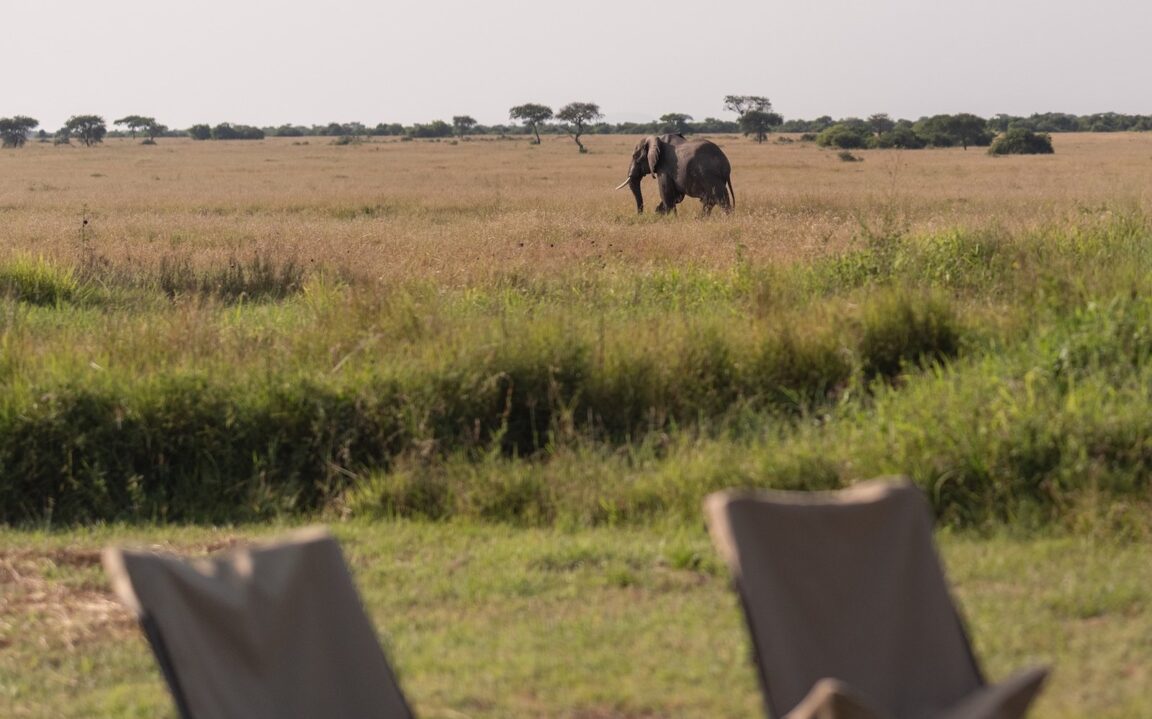
Featured image: An elephant crossing the Serengeti plains in the Grumeti, Tanzania, seen from the camp chairs at Singita Explore. Photo: Ross Couper for Singita, via singita.com, the operator’s official website, used with credit.