 Aiko Tanaka
Beyond Visby’s ring wall, Gotland orders itself by coast and by ferry. The island’s signature sights are the raukar, limestone sea stacks carved from ancient reef rock, standing in fields along the shores of the main island and of Faro, the smaller island off its northern tip, reached by a free road ferry from Farosund. Add the Lummelunda Cave, a guided only limestone system about 14 km north of Visby, and the nearly one hundred medieval farm churches scattered through the farmland, and the logic of a Gotland trip becomes clear: pick a coast per day, cross to Faro on its own day, and let the churches fill the drives between.
Quick Facts
- Where: Gotland, Sweden’s largest island, in the Baltic Sea, reached by ferry from Nynashamn and Oskarshamn and by air to Visby.
- The raukar: limestone sea stacks formed from reef rock around 400 million years old, found in fields at places such as Langhammars and Digerhuvud on Faro and Folhammar on the east coast.
- Langhammars: a nature reserve protected since 1931, about 479 hectares with roughly fifty stacks, some over eight metres high; its raukar appear on Sweden’s 200 krona banknote.
- Lummelunda Cave: about 14 km north of Visby on road 149; around four kilometres of the system explored; entry by guided tour only. Current season listings price the standard tour at 195 SEK for adults and 110 SEK for children aged 4 to 12, with under 3s free; check lummelundagrottan.se for dates and booking.
- The Faro crossing: the Farosund ferry is a free, first come road ferry that runs through the day; queues build in high summer.
- The churches: Gotland holds around a hundred medieval churches, most of them still in parish use, built in the island’s prosperous twelfth and thirteenth centuries.
What exactly is a rauk, and where are the best fields?
A rauk begins as a reef. In the Silurian period, some 400 million years ago, Gotland lay under a tropical sea, and the limestone that forms the island is reef and lagoon sediment. Where harder reef rock met softer surrounding stone, the Baltic wore the soft material away and left the hard cores standing as pillars, arches and oddly human shapes. The fields are not single monuments but whole shorelines of them, and the pleasure is walking among them at beach level, where every angle changes the silhouettes.
Langhammars, on Faro’s north coast, is the field to prioritise: a protected reserve since 1931 with around fifty stacks on a pebble beach at Klajvika, the tallest over eight metres, and one formation, Langhammarsgubben, named like a local resident. Digerhuvud, along the same northwest coast, spreads its raukar along a longer, wilder shoreline, and Gamla Hamn adds a medieval harbour site and the stack nicknamed the Dog. On the main island, Folhammar near Ljugarn gives east coast travellers a rauk field without the ferry, and the southern headlands around Hoburgen hold more, including the Hoburgsgubben, the Old Man of Hoburg.
How does a Faro day fit together?
Faro is a day, not a detour. Drive north from Visby to Farosund, take the free ferry across the sound, and then accept the island’s pace: single roads, sheep on the verges, and sights spaced by farmland. The rauk fields of the northwest coast are the spine of the day, with the fishing hamlet at Helgumannen and the wide sand beach at Sudersand as the counterpoints. Ingmar Bergman lived on Faro and set films in this landscape, and the Bergman Center in the island’s old school explains that layer for those who want it. In July the ferry queue is the day’s one real risk; cross early, or cross late and take the fields in evening light, which is when the limestone does its best work anyway.
Coast days built around geology and patience have cousins elsewhere in our coverage: the cannery port of Astoria, Oregon reads its river mouth the same slow way, and Cape Cod National Seashore rewards travellers who leave the famous beach for swamp boardwalks and wireless cliffs.
What happens underground at Lummelunda?
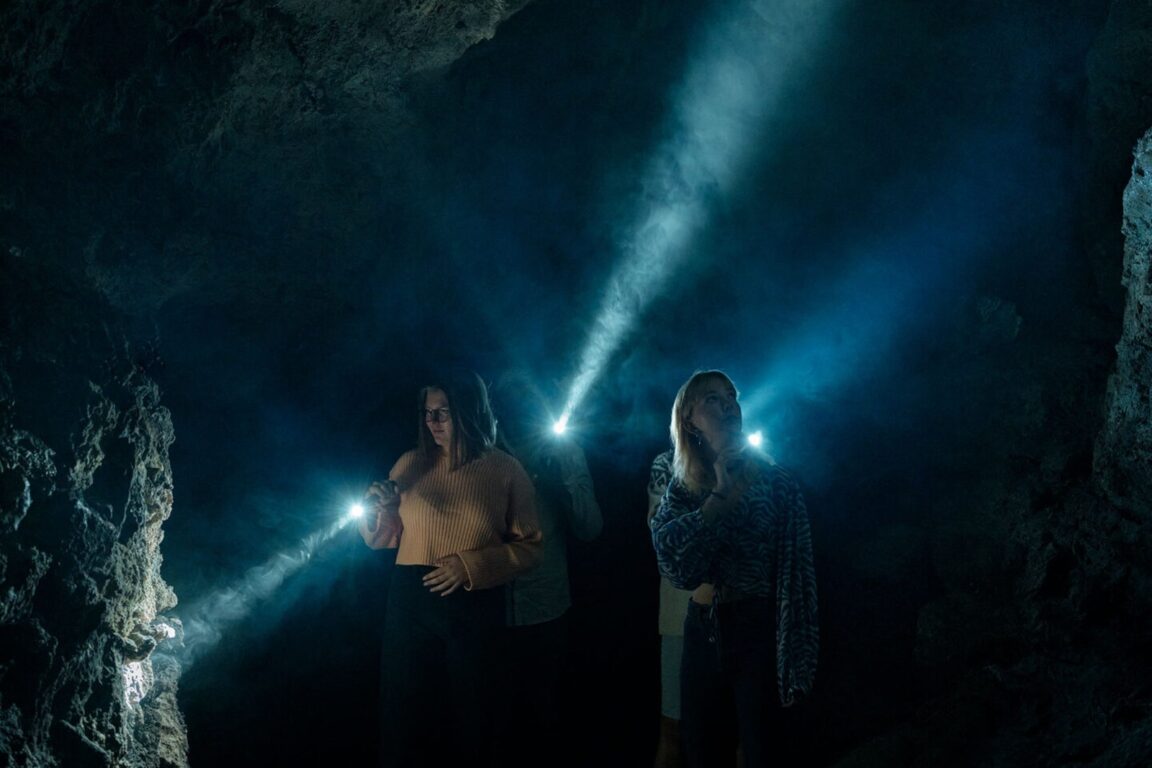
Lummelundagrottan is Sweden’s best known show cave, and it keeps a strict rule: nobody enters without a guide. Around four kilometres of passages have been explored, opened up after three local teenagers pushed into the system in the late 1940s and 1950s, and the standard guided tour covers the developed section of halls and formations in well under an hour, with a small exhibition and short film included in current listings. Longer adventure tours go deeper with specialist equipment, helmets and lamps, into passages the standard route only gestures toward.
The practicalities are seasonal. The cave opens in the warmer half of the year, daily in high summer and on a reduced pattern in the shoulder months, and it closes in winter and spring when water floods the system. The operator’s own directions are simple: road 149 north from Visby for about 14 km, bus 61 stops about 300 m from the entrance, and parking is charged by the hour in high season. Book the tour online ahead in July and August; a cool cave at a steady underground temperature is also the island’s best hot day or wet day insurance.
Why are there so many medieval churches?
Gotland grew rich on Baltic trade in the twelfth and thirteenth centuries, and the farming parishes spent the surplus on stone churches of a size that still startles: towers visible across flat fields, carved portals, and interiors with medieval wall paintings and fonts exported across the Baltic world. Around a hundred survive, nearly all in use, which makes them working buildings rather than ruins; many stand open in summer with a simple honesty box and a guest book. You do not need a list of twenty. Pick the ones on your coast road: Larbro and its painted interiors in the north, the churches along the east coast drives, and the tall spires that punctuate the run south to Burgsvik. They are the connective tissue of a Gotland itinerary, ten minute stops that explain who paid for everything else.
How many days does beyond Visby take?
Three full days is the honest minimum once Visby has had its day: one for Faro, one for the north including Lummelunda and Larbro, and one for the east or south coast, its rauk field, beaches and churches. A car makes this easy; cyclists do the same structure more slowly on the island’s marked routes, and summer buses cover the main corridors for travellers based in Visby. What not to do is treat the island as Visby plus a single excursion: the town wall is the introduction, and the island beyond it is the book.
Frequently Asked Questions
Is the ferry to Faro free?
Yes. The Farosund to Faro crossing is a Swedish road ferry, free for vehicles and passengers, running on a first come basis through the day. In high summer, queues form on the mainland side in the morning and on Faro in the late afternoon, so cross early or late.
How much does Lummelunda Cave cost?
Current season listings price the standard guided tour at 195 SEK for adults and 110 SEK for children aged 4 to 12, with children under 3 free, including the exhibition and film. The cave is guided only and seasonal, so confirm dates and book through lummelundagrottan.se.
Which rauk field should I choose if I only see one?
Langhammars on Faro, for the density of its stacks, its protected reserve setting and its place on the 200 krona banknote. If you are not crossing to Faro, Folhammar on the east coast is the main island alternative.
Can I visit the medieval churches freely?
Most Gotland churches are working parish churches and many stand open during the day in summer, with seasonal opening patterns varying by parish. Treat them as places of worship first: dress and behave accordingly, and check locally for service times.
Image: Visitors with lamps inside Lummelunda Cave on Gotland, during a guided tour. Photo via Lummelundagrottan, the cave’s official website (lummelundagrottan.se), used with credit.