 Wei Chen
Three days in Chengdu works best when you treat the pandas as a single early morning, not the whole trip. The city’s real curriculum is slower: a bamboo chair in a People’s Park teahouse while an ear cleaner works the tables, an evening Sichuan opera show where the face-changing performer swaps masks faster than the eye can follow, and a hotpot dinner you queued for with a numbered ticket and free snacks. This itinerary sequences those pieces the way Chengdu itself does, unhurried mornings, long afternoons, and dinners worth planning around, with the Panda Base slotted at opening time on day two, when the bears are actually awake.
Quick Facts
Panda Base tickets: Adult 55 yuan (ages 18 to 59), student 27 yuan, free for visitors 60 and over and children 6 and under or under 1.3 m; real-name online booking up to 14 days ahead, passport required for foreign visitors.
Panda Base hours: March to October, entry 7:30 to 12:00 and 12:00 to 17:00, site clears at 18:00; November to February, entry 8:00 to 12:00 and 12:00 to 16:30, clears 17:30.
Panda Base address: 1375 Panda Avenue, north of the city; go for the morning feeding activity, and note Giant Panda Villa No. 6 is closed on Mondays except holidays.
Teahouse anchor: People’s Park, where the century-old teahouse culture runs all day beside the lake.
Opera anchor: An evening Sichuan opera show built around bian lian, the face-changing art.
Food status: Chengdu is a UNESCO City of Gastronomy, the hotpot capital in a province that treats eating as the main event.
Day One: Teahouse Parks and Old Streets
Start where Chengdu starts its own days, in the parks. People’s Park, in the city centre, is the living museum of Chengdu leisure: a lake with rowing boats, bonsai gardens, a monument to the railway protection movement, and above all the teahouses, where the correct order is a covered bowl of jasmine or green tea and absolutely no plan for the next two hours. The gaiwan, the lidded bowl on a saucer, is the technology of the place: the lid strains the leaves, the bowl refills with hot water as many times as you can sit still, and the sitting still is the activity. Around you the park runs its full programme, mahjong games, tai chi, dancing groups, matchmaking notices posted by parents, and the famous ear cleaners, whose tuning-fork-and-feather routine is a Chengdu institution to watch even if you decline the service.
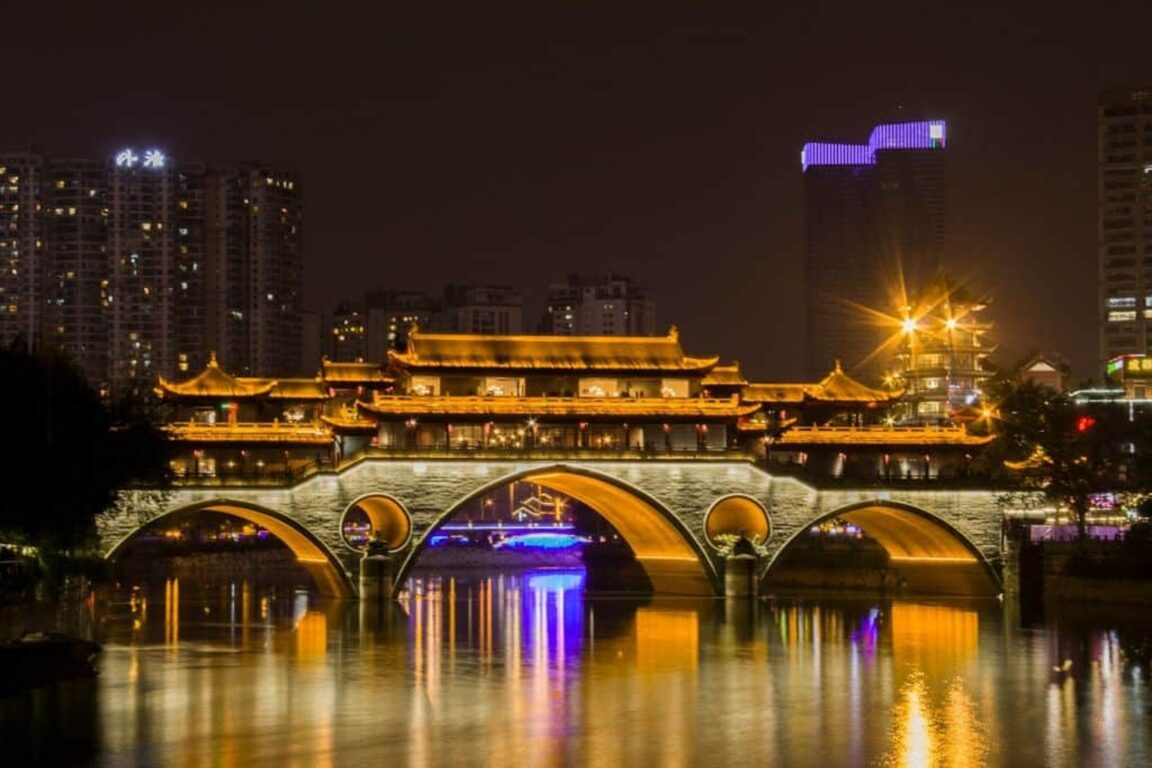
Spend the afternoon in the lanes. Kuanzhai Alley, the Wide and Narrow Alleys, preserves Qing dynasty courtyard streets in restored form, good for an hour of grazing and people-watching even if the commerce is polished. Then walk to Wuhou Shrine and Jinli Street if Three Kingdoms history interests you, or double down on the food city and graze toward dinner: dan dan noodles, wontons in chilli oil, and the skewer stalls that bridge the gap to hotpot hour. Finish the evening on the Jinjiang riverfront, where the Anshun Bridge, shown in this article’s featured image, lights up over the water and the riverside bars fill with the city’s night shift of diners.
Day Two: Pandas at Opening, Opera at Night
The Panda Base rewards exactly one strategy: be there when it opens. Book the real-name ticket online up to 14 days ahead, 55 yuan for adults, with your passport details if you are a foreign visitor, and arrive for the first entry window, 7:30 in the March to October season. The pandas eat breakfast, wrestle, climb and perform in the cool of the morning and retire to sleep through the middle of the day, so the first two hours are worth the next six combined. Work the enclosures in order, give the red pandas their due, and accept the crowds at the nursery as the price of the cutest room in China. By late morning, when the bears are asleep and the tour groups are at full volume, you are done; that is the system working as intended.
Take the afternoon off. Chengdu after a 6:00 alarm means a slow lunch, possibly a return to a teahouse chair, and no guilt about either. Then the evening belongs to Sichuan opera. The headline act is bian lian, face-changing: performers in silk costume and layered masks change their painted faces in a flick of a fan, a breath, a movement too fast to catch, a secret technique guarded within the art for generations. A full evening show wraps the face-changing in the form’s other set pieces, acrobatics, comedy, fire-spitting and the rolling lamp act, and runs in teahouse theatres across the city, with the Qintai Road cultural district the classic address. Book a seat with a tea service, arrive for the costume and make-up viewing if your venue offers it, and do not try to film the change in slow motion; everyone tries, the art survives.
Day Three: The Hotpot Queue System and the Food City
Chengdu is a UNESCO City of Gastronomy, and day three is for eating like it matters. The main event is hotpot, and the first thing to understand is the queue. The famous hotpot restaurants run a numbered ticket system: take a number at the door or through the restaurant’s app, note the estimated wait, which at peak dinner hour at a famous name can run past an hour, and use the waiting area the way the locals do. The big chains turned the queue into a hospitality genre of its own, with free snacks, drinks, manicures and shoe shines at the flagship operations, because a Chengdu diner kept happy for forty minutes is a diner who orders well.
Inside, the order is a system too. Choose the broth split, the classic yuanyang pot with a fiery tallow-based spicy side and a mild mushroom or tomato side, unless your table is fully committed to the heat. Order the Chengdu canon: thin-sliced beef and lamb for swishing, tripe and duck intestine for the seven-seconds-up, eight-seconds-down timing ritual, lotus root, potato slices and greens to finish in the enriched broth, and a sesame oil and garlic dipping dish, with coriander and oyster sauce to taste, to cool and coat each piece. The spice is cumulative and the correct pacing is slow; the tea and the mild side of the pot are load-bearing. Build the rest of day three around the meal: a morning at the Chengdu Museum or the Jinsha Site Museum for the ancient Shu civilisation, a final teahouse session, and the hotpot as the trip’s closing ceremony.
Practical Notes
Chengdu’s metro makes the itinerary easy: People’s Park and Kuanzhai Alley sit on central lines, and the Panda Base is reached by metro plus a short shuttle or taxi from the station. Foreign visitors should carry the passport used for the panda booking, as the ticket is real-name. Before the trip, confirm your entry route into China; our explainers on visa-free entry and the 240-hour transit policy cover the current rules, and Chengdu is one of the cities those policies are built around.
The Spice Scale, Briefly
Chengdu heat has two components and visitors routinely confuse them: la, the chilli burn, and ma, the numbing tingle of Sichuan pepper, which is not a heat at all but a citrusy electrical buzz that resets the palate between bites. A serious Chengdu meal orchestrates both, and the correct response to an overwhelming mouthful is rice, tea or the mild side of the pot, not water, which spreads the chilli oil. Order one dish beyond your comfort and no more; the city’s cooking rewards calibration, and tomorrow’s breakfast of dan dan noodles will test whatever calibration you chose.
Frequently Asked Questions
What time should I arrive at the Panda Base?
At opening: 7:30 in the March to October season, 8:00 from November to February. The pandas are fed and active in the morning and sleep through midday, so the first entry window is the whole game. Book the real-name ticket online up to 14 days ahead.
How much are Panda Base tickets?
55 yuan for adults aged 18 to 59, 27 yuan for students, and free for visitors aged 60 and over and children aged 6 and under or under 1.3 metres tall, per the base’s official ticket pages. Foreign visitors book with a passport; Giant Panda Villa No. 6 closes on Mondays except holidays.
What is face-changing, and where do I see it?
Bian lian is the Sichuan opera art of changing painted silk masks in an instant, a technique kept secret within the tradition. Evening Sichuan opera variety shows at teahouse theatres across Chengdu, classically around Qintai Road, build their programme around it, with fire-spitting and acrobatics alongside.
How does the hotpot queue work?
Take a numbered ticket at the restaurant or book a place in line through its app, then wait; famous restaurants at dinner peak can run past an hour. The big names entertain the queue with snacks and services. Arrive before 17:30 or after 20:30 to cut the wait sharply.
Is three days enough for Chengdu?
Yes, if the pandas get one morning rather than a whole day. Three days covers the teahouse parks, an opera night, a serious hotpot education and one major museum or shrine, with the city’s essential slowness intact.
Featured image: Anshun Bridge over the Jinjiang River in Chengdu at night. Photo by Zain Lee on Unsplash.