 Wei Chen
Dali is the Yunnan stop where the geography does the organising: a Bai old town pinned between the Cangshan mountain range on one side and Erhai Lake on the other, so every day naturally divides into a mountain half and a lake half. Base yourself in or near the old town, ride the cable cars up Cangshan in the morning when the ridge is clearest, spend the afternoon on the Erhai shore or in the Bai villages, and use the region’s rotating market days, each town holding its big market on its own weekday, to decide which village gets your spare morning. Two to three days covers the essentials; four lets the place slow you down, which is what Dali is for.
Quick Facts
Where: Western Yunnan, China, about two hours by high-speed train from Kunming.
Altitude: Just under 2,000 metres, high enough for strong sun and cool evenings.
The setting: Dali Old Town sits between the Cangshan range, whose highest peak rises above 4,100 metres, and Erhai Lake, an ear-shaped alpine lake roughly 250 square kilometres in area.
Signature sights: The Three Pagodas of Chongsheng Temple, the old town gates and lanes, Xizhou’s Bai mansions, and sunrise on Erhai’s eastern shore.
Market pattern: The Bai towns around the lake hold their main market on a fixed weekday each, so a market is happening somewhere within easy reach almost every day.
Best seasons: Spring (March to May) and autumn (September to November); summer is the monsoon, winter is dry, bright and quiet.
The Old Town Between Mountain and Lake
Dali Old Town is a grid of stone lanes inside Ming-era walls, entered through gates that still anchor the town’s mental map, the South Gate above all. Inside, the architecture is Bai: whitewashed walls, tiled screens at the ends of lanes painted with the town’s four emblematic scenes of wind, flowers, snow and moon, and courtyards behind wooden doors. Foreigner Street, Huguo Road, carries the cafe and bar end of the evening economy, while the lanes a few blocks away stay residential, with vegetable stalls, barbers and schoolchildren following the rhythms of a working town that happens to be beautiful.
The old town rewards early mornings. Before the day-trip buses arrive, the lanes belong to residents, the light comes over Erhai and strikes the Cangshan frontage, and the town’s scale, small enough to walk end to end in half an hour, feels exactly right. Stay inside the walls if you want atmosphere on your doorstep; stay on the lake side of town if you want the sunrise without the walk.
The Three Pagodas and Chongsheng Temple
A short distance northwest of the old town stand the Three Pagodas of Chongsheng Temple, Dali’s emblem for over a thousand years. The central Qianxun Pagoda, built in the Tang dynasty era, rises in sixteen tiers, flanked by two smaller Song dynasty pagodas arranged in a triangle, and the whole group is backed by the Cangshan range and reflected, on calm mornings, in the pond in front of it. Behind the pagodas the rebuilt Chongsheng Temple complex climbs the slope in a long sequence of halls; the walk to the top is a genuine climb and the view back over the pagodas to Erhai is the payoff. Entry to the combined site was around 75 yuan at last check; verify the current price before you go, as Yunnan scenic area pricing changes.
Up Cangshan: The Cable Cars
Cangshan is not a backdrop, it is half the destination: nineteen peaks in a long wall west of the town, threaded with streams, pine forest and a contour path, the Jade Belt Road, that lets walkers traverse the mountain’s mid-slopes for hours with the lake below. Cable cars climb the range at several points, from the gentler lower lines serving temples and the contour path to the long high line that rises toward the ridge and the alpine zone below the highest summits. The practical rule is weather: the ridge clears early and clouds build by afternoon, so take the cable car on the first clear morning of your stay rather than saving it for last, and carry a layer, because the top stations are properly cold even when the town is in shirtsleeves.
On the mountain’s lower slopes, the temples and tea houses make an easier half day, and the contour path suits anyone who wants the Cangshan experience at walking pace. Either way, looking back from the mountain explains Dali’s design: the town, the pagodas, the villages and the lake laid out in one frame, mountain water running down to the plain.
Erhai Lake and the Bai Villages
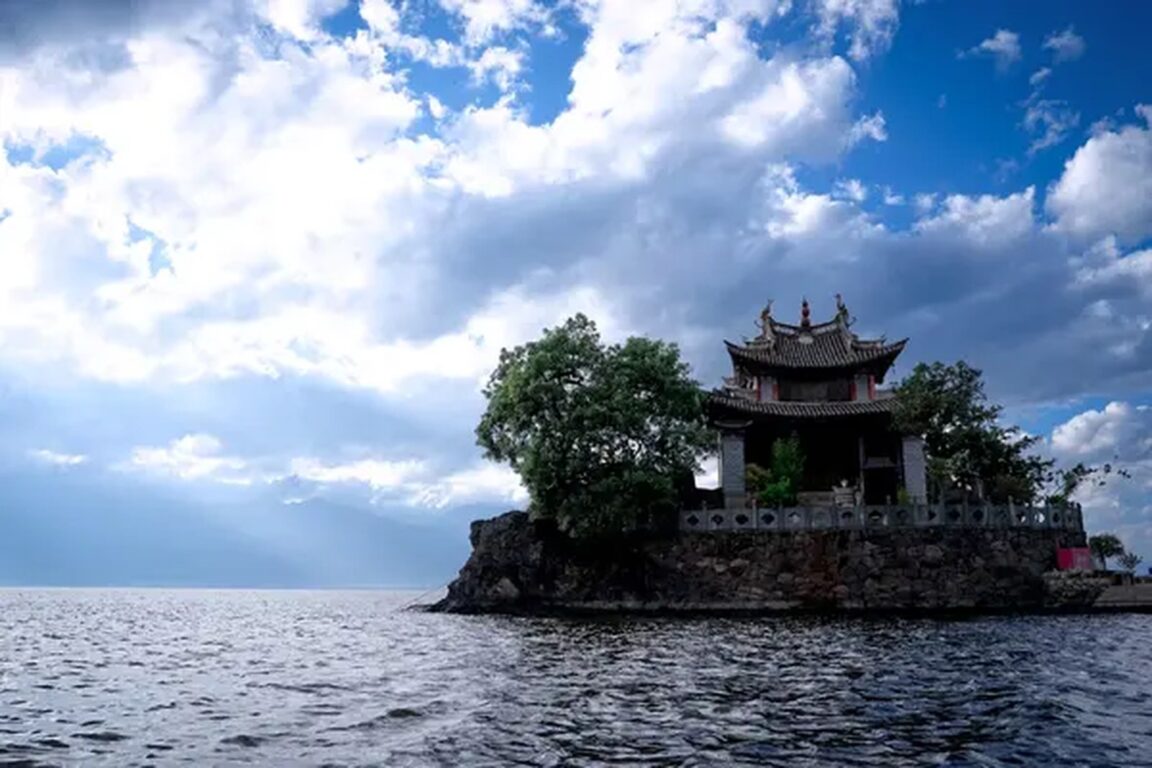
Erhai, the Ear Lake, named for its shape from above, is the second half of every Dali day. The western shore, between the old town and the villages, is the gentle side: an ecological corridor of paths and cycleway running along the water, best taken by bicycle in the morning. The eastern shore is the sunrise side, where villages like Shuanglang face west across the water to Cangshan and the evening light does the opposite trick. The featured image for this article shows a temple pavilion standing on a rocky point in the lake, the kind of small island shrine that punctuates the Erhai shore.
North of the old town, Xizhou is the village that justifies a dedicated trip: a prosperous Bai trading town of courtyard mansions with carved screens and painted gables, a morning market that still serves residents first, and the famous Xizhou baba, a baked flatbread, sweet or savoury, eaten hot from the oven. Xizhou is also the place to sit for the Bai Three-Course Tea, served in a fixed sequence of bitter, sweet and aftertaste cups that the Bai use to mark the stages of life; in a family courtyard, with the mansion’s woodwork around you, it is the single best hour of cultural Dali.
The Weekly Market Rotation
The practical secret of the Dali region is that the Bai towns take turns. Each town around the lake holds its main market on its own fixed weekday, a rotation inherited from the caravan era, so on almost any day of the week some town within an hour’s travel is at full market volume: produce from the Cangshan foothills, lake fish, flowers, textiles, livestock at the edges and street food at the centre. Ask at your guesthouse which town has market day tomorrow and build the morning around the answer; it will show you a working Bai town that no itinerary staple can match. The year’s great exception is the March Street Fair, the Sanyue Jie, held in the third lunar month at the fairground west of the old town, when the whole region converges for days of trading, horse racing and festival food, and Dali runs at full capacity.
Getting There and Onward
High-speed trains link Kunming to Dali in about two hours, and Dali’s station sits in the newer Xiaguan district, a bus or taxi ride from the old town. From Dali, the same rail line and the highway continue north to Lijiang, making Dali the natural first stop on the classic Yunnan route. Before travelling, check the current entry rules for your nationality; our explainer on China’s visa-free entry extension and the guide to the 240-hour transit visa-free policy cover the two routes most visitors use.
Staying Longer: The Slow Version
Dali is the rare destination that improves the longer you stay, because its pleasures are cyclical rather than collectible: the market rotation comes back around, the mountain clears on the third morning, the cafe owner learns your order. A week in Dali, the classic Yunnan slowdown, splits naturally into the old town days, the village days at Xizhou and the lakeside villages, a Cangshan walking day on the contour path, and whole afternoons given to nothing more than the shore path and a book. If your Yunnan route runs Kunming, Dali, Lijiang, the discipline is to resist compressing Dali to make room; travellers consistently report it as the stop they wish they had extended.
Frequently Asked Questions
How many days do you need in Dali?
Two full days cover the old town, the Three Pagodas, a Cangshan cable car and an Erhai shore ride. Three to four days add Xizhou properly, a market day in a Bai town and a sunrise on the eastern shore, and suit the pace Dali rewards.
Which side of Erhai is best for sunrise and sunset?
Sunrise belongs to the eastern shore, around Shuanglang, where the sun comes up over the lake with Cangshan behind you. Sunset is best from the western shore and the old town side, watching the light leave the Cangshan ridge.
When should I take the Cangshan cable car?
On the first clear morning of your stay. The ridge typically clouds over by afternoon, and high cable car lines can be suspended by wind, so a flexible plan that seizes the first good morning beats a fixed last-day booking.
What is the Bai Three-Course Tea?
A formal Bai tea service of three successive cups: bitter, then sweet, then a spiced cup with a lingering aftertaste, symbolising the stages of life. Xizhou’s courtyard houses are the classic place to experience it.
How does the market rotation work?
Each Bai town around Erhai holds its main market on a fixed weekday, so a significant market is running somewhere nearby almost every day. Your guesthouse can tell you which town is on tomorrow; go in the morning, when the market is at full strength.
Featured image: A temple pavilion on a rocky point in Erhai Lake, Dali. Photo by ün LIU on Unsplash.