 Priya Nair
The Forty Foot at Sandycove is where Dublin swims in the sea, all year, in all weather, and it has been doing so for roughly 250 years. The deal is simple: a rocky bathing place on the south shore of Dublin Bay, deep water straight off the rocks, no entry fee, no lifeguards, and a culture of regulars who treat a winter swim as a civic duty. Visitors are welcome if they follow the local rules: check the tide, never dive, swim within your ability in water that is cold by any standard, and understand that the Forty Foot belongs first to the people who swim there every day of the year.
Quick Facts
Where: Sandycove, on the south shore of Dublin Bay, about 14 km southeast of Dublin city centre.
Nearest station: Sandycove and Glasthule on the DART line, roughly a 1 km walk.
Cost: Free public access, open at all hours.
Depth: Around 20 feet (about 6 m) at high tide off the rocks; the name is one of the stories told about it.
Lifeguards: None. You swim entirely at your own risk, as the council signage states.
Famous neighbour: The James Joyce Tower, where Ulysses opens, a few minutes’ walk away.
Water temperature: Cold year-round by Mediterranean standards; the regulars swim without wetsuits, visitors often prefer one.
The Place and Its History
The Forty Foot sits at the tip of Sandycove Point, a cluster of granite rocks and concrete platforms arranged around a deep natural pool open to Dublin Bay. People have swum here for about 250 years, which makes it one of the oldest continuously used bathing places in Ireland. For most of that history it was a men-only preserve, defended with real stubbornness; women campaigners challenged the ban famously in 1974 by swimming there in protest, and the Sandycove Bathers Association only formally ended the exclusion of women members in 2014. Today the water is shared by everyone, and the mixed, all-ages, all-year crowd is the whole point of the place.
The name generates its own folklore. Explanations include the depth of the water, the 40th Regiment of Foot once stationed nearby, and the length of the original bathing platform. Nobody can prove their version, and the argument is part of the entertainment. What is certain is the literary address: the Martello tower above the cove is the James Joyce Tower, where the opening chapter of Ulysses is set, with Buck Mulligan shaving on the roof and the sea below described as the snotgreen mother of Ireland. Swimmers have been combining a dip with a look at the tower ever since.
The Rules, Written and Unwritten
Dún Laoghaire-Rathdown County Council, which manages the bathing areas along this coast, is blunt about the Forty Foot: there are no lifeguards, and bathing is at your own risk. The written safety logic follows from that. Never dive: the depth changes with the tide and the rocks are unforgiving. Enter by the steps and ladders, check where you will get out before you get in, and treat a rising swell as a reason to stay on the rocks with everyone else. Cold water shock is the other standing hazard; even in summer the Irish Sea is cold enough to take your breath, so enter gradually and keep the first swim short.
The unwritten rules matter as much. The regulars, many of them swimming daily for decades, have a rhythm: quick greetings, no hogging the ladders, no loud music, no inflatables, and a general understanding that the changing area is functional rather than private. Join the rhythm and you will be welcomed; the Forty Foot is famously friendly to newcomers who respect that it is a swimming place first and a photo opportunity second. The Christmas Day swim is the culture at full volume, when hundreds take the plunge and the rocks fill with spectators, but an ordinary grey Tuesday in February, with a dozen regulars doing their laps, shows you the real institution.
The Vico Baths and the Rest of the South Shore
The Forty Foot is the famous name, but Dublin Bay’s southern shore is a chain of bathing places, each with its own character. The Vico Baths at Dalkey, reached by steps down from Vico Road, is the connoisseur’s alternative: a small, sheltered bathing spot with views across Killiney Bay to the Sugar Loaf, quieter than Sandycove and beloved by the same all-year community. Hawk Cliff nearby offers rock swimming for the confident. Further along, Killiney Beach and Seapoint and the West Pier at Dún Laoghaire give gentler entries for swimmers who want sand or steps rather than deep rock water.
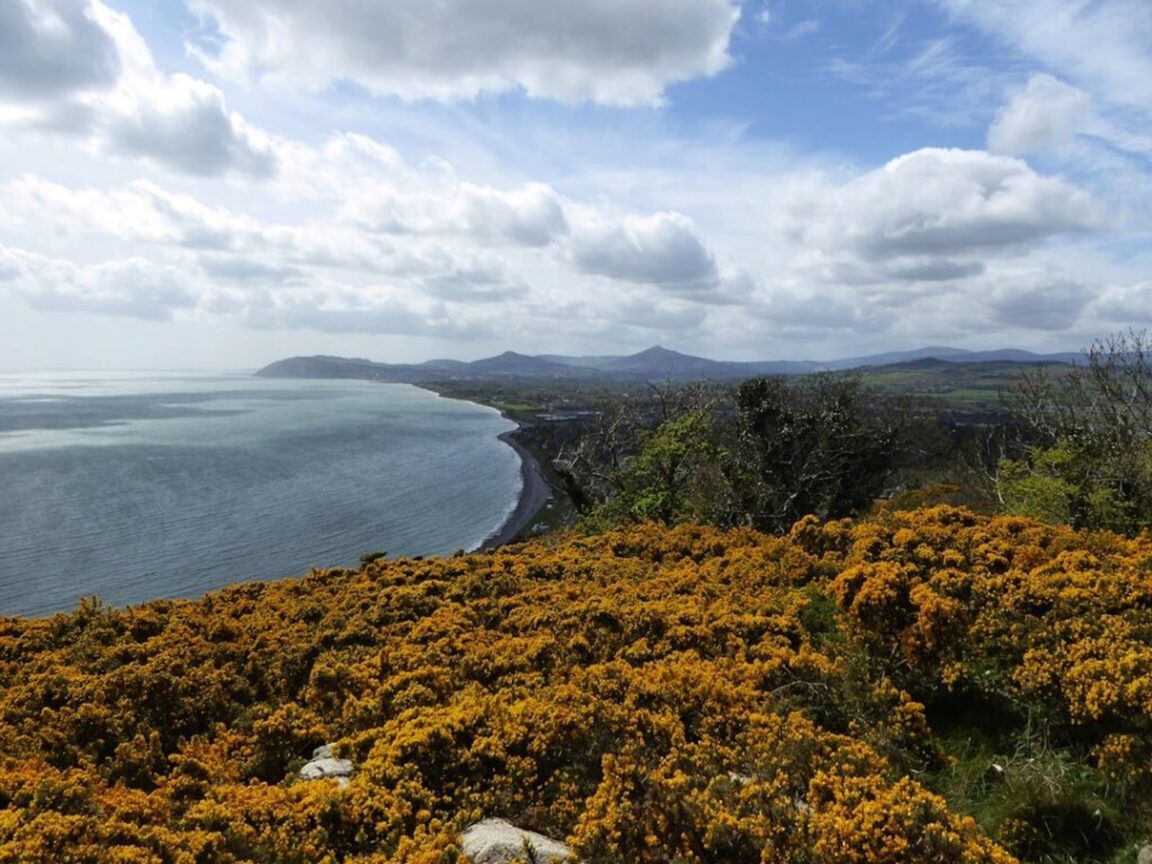
The featured image for this article shows that southern shore from the Killiney side: gorse-covered headland, the bay curving away, and the Wicklow hills in the distance. It is the same cold, green, granite-edged water all along the chain, and a swimmer based in Dublin for a week can work through the spots like a local, Forty Foot for the ritual, Vico for the view, Seapoint for an easy evening dip after the DART ride home.
Planning a Swim Visit
Take the DART to Sandycove and Glasthule and walk the kilometre to the point, or walk the coast path from Dún Laoghaire, which strings the piers, Seapoint and Sandycove into one good walk with the swim in the middle. Bring a towel, warm layers for afterwards and a flask if you are swimming in the colder half of the year; the regulars’ post-swim routine of tea and dry clothes is not vanity, it is how you warm up safely. Time a first visit for a calm day near high tide, when the water is deepest and the entry easiest, and go in the morning when the light on the bay is best and the rocks are at their most sociable.
If the sea swim becomes the centre of an Ireland trip rather than a morning excursion, plan the season with our guide to the best time to visit Ireland for a road trip, and note that the bay’s swimming culture runs through the same winter months covered in our Ireland winter packing guide, where the layers advice applies word for word to a February swim at the Forty Foot.
What to Bring and How to Behave
The kit list is short and specific. A swimsuit you can get into quickly on cold rocks, a towel, and a changing robe or a big coat for afterwards matter more than any wetsuit decision; many visitors swim in skins like the regulars for a short dip and save the wetsuit question for longer swims. Footwear you can scramble on wet granite in is genuinely useful, because the rocks are the changing room, the sun deck and the route to the water all at once. A flask of something hot is the regulars’ universal equipment from October to April.
Behaviour follows the place’s own logic. Keep the ladders and steps clear, because they are the motorway of the Forty Foot and people are entering cold water at the bottom of them. Keep noise down; the cove is sociable but it is not a beach club. Take photographs with restraint around the changing area, where people are in swimsuits and entitled to their privacy. And if a regular offers advice about the tide, the swell or where to get in, take it in the spirit given: the Forty Foot’s safety system, in the absence of lifeguards, is exactly this, a community that watches the water and each other, and lets newcomers borrow its judgement while they learn the place.
Frequently Asked Questions
Can anyone swim at the Forty Foot?
Yes. It is a free public bathing place with open access. There are no lifeguards and the council is explicit that bathing is at your own risk, so it suits confident swimmers who can handle deep, cold water and rock entries.
Why is it called the Forty Foot?
Nobody knows for certain. The depth of the water, about 20 feet at high tide in most tellings, the 40th Regiment of Foot and the length of an old platform all have their supporters. Treat the competing explanations as part of the local entertainment.
Do people really swim there in winter?
Yes, daily. The all-year swimming culture is the Forty Foot’s defining feature, peaking with the Christmas Day swim. Regulars mostly swim without wetsuits; visitors in winter should keep swims very short and warm up carefully afterwards.
Is the Forty Foot safe for children?
It is deep water off rocks with no lifeguards, so it suits older children who are strong swimmers under close supervision. Families wanting an easier entry usually choose Seapoint or Killiney Beach along the same shore.
What is the connection to James Joyce?
The James Joyce Tower stands above the cove, and the opening chapter of Ulysses is set in the tower with the Forty Foot’s sea below it. The tower now houses a small Joyce museum, making the swim and the literary pilgrimage a single trip.
Featured image: Dublin Bay’s southern shore on the Killiney side, the same chain of bathing places as the Forty Foot. Photo by Colin C Murphy on Unsplash.