 Sofia Rossi
The Prado in two hours is a Spanish masters visit with an ending: Velázquez first while your eyes are fresh, Goya second in two acts, court portraits and Bosch as the deliberate detours, and everything else consciously skipped. General admission is 15 euros, the museum opens Monday to Saturday from 10am to 8pm and Sundays to 7pm, and the last two hours of every day are free, which is exactly why a paid morning beats a free evening queue for a first visit. Two hours done this way is not a compromise. It is the museum at its strongest, taken in the order it deserves.
Quick Facts
Address: Paseo del Prado, 28014 Madrid, in the Paseo del Arte between the Reina Sofía and the Thyssen-Bornemisza.
Hours: Monday to Saturday 10am to 8pm, Sundays and public holidays 10am to 7pm. Closed 1 January, 1 May and 25 December, with reduced hours on 6 January, 24 and 31 December.
General admission: 15 euros, reduced 7.50 euros, per the museum’s published prices.
Free hours: The last two hours daily, Monday to Saturday 6pm to 8pm and Sundays and holidays 5pm to 7pm, for the permanent collection, subject to capacity and a free timed pass from the ticket office.
Last entry: 30 minutes before closing, and galleries are cleared shortly before closing time.
The two hour core: Las Meninas and the Velázquez rooms, Goya from the court portraits to the Black Paintings, with El Greco and Bosch as chosen detours.
Prices and hours checked: 24 November 2026, against the Museo del Prado’s published visitor information.
Why Velázquez first, and which rooms?
Because Las Meninas is the painting the whole museum turns around, and it rewards a fresh eye and a quieter room. Enter, take the museum’s plan, and go directly to the Velázquez rooms on the first floor. Las Meninas, the court scene that is also a puzzle about who is looking at whom, needs ten unhurried minutes: the Infanta Margarita, the painter himself at the canvas, the king and queen present only as a reflection. Around it sit the court portraits, the buffoons painted with unsettling dignity, and The Surrender of Breda, Velázquez at his most humane, victors and defeated given equal grace.
Resist the completist pull. The Prado holds thousands of works and displays around 1,800, and a first visit that tries to honour them all honours none. Velázquez first is not a preference, it is triage: if energy or time collapses later, the essential encounter has already happened. The Reina Sofía pairing works the same way in reverse, as the Guggenheim ramp guide argues for New York: one building, one clear order, no marathon.
How do you take Goya in two acts?
Act one is Goya the court painter, on the upper floors with Velázquez’s century echoing around him: The Family of Charles IV, arranged with a honesty about its sitters that still startles, and the two Majas, clothed and naked, hung as a pair and argued about for two centuries. This is Goya ascending, brilliant and employed, painting power as he found it.
Act two is downstairs, and it is a different artist. The Second and Third of May 1808 face the visitor with the uprising against Napoleon and its firing squads, the Third of May being one of the founding images of modern art: no heroics, a man in a white shirt with his arms thrown wide. Beyond them, the Black Paintings, the murals Goya painted on the walls of his own house in old age and deafness, Saturn among them, are the darkest great rooms in European art. End your Goya there. Nothing should follow Saturn except daylight, and the museum’s exit is well placed for exactly that.
What do you deliberately skip, and what earns a detour?
Skip, on a first two hour pass: the full Flemish and Italian circuits beyond a glance, the sculpture and decorative arts, and any temporary exhibition, however advertised, unless it is the reason you came to Madrid. Skipping is the skill this guide is teaching. The Prado will still be here, and a second visit built on Titian, Rubens and the Italian rooms is a better visit than a first one diluted by them.
Two detours earn their minutes. El Greco, whose Nobleman with his Hand on his Chest and elongated saints explain where Spanish painting’s strangeness begins, sits naturally on the Velázquez route. And Bosch’s Garden of Earthly Delights, on the ground floor, is the one non-Spanish painting that belongs in a Spanish masters visit, because the Spanish crown collected it and centuries of Spanish visitors have made it the museum’s other pilgrimage picture. Give it ten minutes, close up, panel by panel. Then stop. The discipline of the ending is what makes two hours feel complete rather than cut short.
How do the free hours and the Reina Sofía pairing really work?
The free slot, the last two hours daily, is real and popular: 6pm to 8pm Monday to Saturday, 5pm to 7pm on Sundays and holidays, covering the permanent collection, with a free timed pass issued at the ticket office subject to capacity. The queue forms well before the slot opens, longest on weekends and holidays, and last entry is 30 minutes before closing, so the realistic visit inside is ninety minutes at most. Use it as this guide’s route suggests, for a second visit, a single floor, or a return to one painting. For a first visit, pay the 15 euros, book a timed ticket on the museum’s own site, and walk in at 10am.
The Reina Sofía, ten minutes away at the other end of the Paseo del Arte, is the Prado’s modern counterpart and the home of Picasso’s Guernica. Pair them on different halves of a day, Prado in the morning, Reina Sofía after lunch and a rest, never back to back. Together they tell one continuous story of Spanish art from Velázquez to Picasso, and the walk between them, past the Thyssen, is the finest museum street in Europe. For more Madrid sequencing, the museum quarter logic in the Frick Collection guide applies the same one-great-museum-at-a-time discipline.
Frequently Asked Questions
How much does the Prado cost, and when is it free?
General admission is 15 euros, with a reduced rate of 7.50 euros. Entry to the permanent collection is free in the last two hours daily: 6pm to 8pm Monday to Saturday and 5pm to 7pm on Sundays and holidays, subject to capacity, with a free pass from the ticket office.
What are the Prado’s opening hours?
Monday to Saturday 10am to 8pm, and Sundays and public holidays 10am to 7pm. It closes on 1 January, 1 May and 25 December, and keeps reduced hours, to 2pm, on 6 January, 24 and 31 December. Last entry is 30 minutes before closing.
What should I see first at the Prado?
Las Meninas and the Velázquez rooms on the first floor. Go there directly on entry, before the rooms fill, then take Goya in two acts: the court paintings above and the May paintings and Black Paintings below.
Is two hours really enough for the Prado?
For the Spanish masters core, yes. Velázquez, Goya, El Greco and Bosch in a planned order make a complete first visit. The Italian, Flemish and temporary exhibition circuits deserve their own second visit rather than a rushed share of the first.
Can I take photographs inside the Prado?
Photography is not permitted inside the Prado’s galleries. Plan to look rather than record, and use the museum’s own digital collection online afterwards for the works you want to revisit.
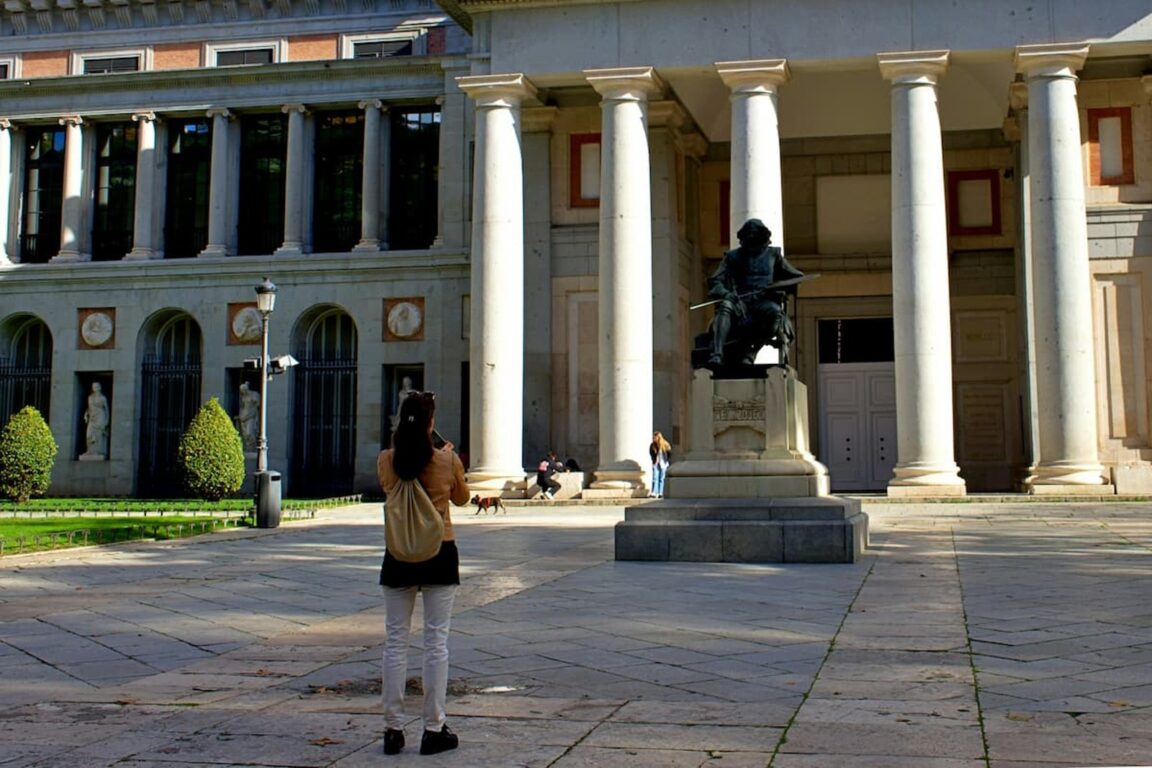
Image: The Velázquez Gate of the Museo del Prado, Madrid, with the statue of Velázquez before the portico. Photo: José Cuerva, via Unsplash (hosted copy via Gallerix), Unsplash License, used with credit.