 Priya Nair
Do not let the Zeitz MOCAA swallow the whole day. The V&A Waterfront’s museum quarter, in Cape Town’s working harbour, rewards sequencing: start with the Two Oceans Aquarium at opening, when its kelp forest and predator exhibits are quiet, cross to the Watershed’s maker halls for the middle of the day, take a harbour cruise between museum blocks, and finish at the Zeitz or the smaller specialist museums as the light turns. This order, checked against the aquarium’s and the Waterfront’s own published hours on 24 November 2026, turns a shopping district day into a museum day with the harbour doing the connecting work.
Quick Facts
Where: V&A Waterfront, Cape Town, around Dock Road and the Clock Tower precinct
Aquarium hours: Two Oceans Aquarium opens 9:30 am to 6 pm on weekdays and 9 am to 6 pm on weekends, on its official site
Aquarium scale: More than 3,000 living sea animals from the Indian and Atlantic oceans
Headline museum: Zeitz MOCAA, contemporary African art in the converted grain silo
Maker hall: The Watershed, the Waterfront’s craft and design market hall beside the aquarium
Facts checked: 24 November 2026, on aquarium.co.za and waterfront.co.za
Why should the aquarium come first?
Because it is the one venue in the quarter whose quality depends on the clock. The Two Oceans Aquarium, on Dock Road at the meeting point of the two oceans its name claims, builds its day around feeds, talks and the movement of school groups, and its signature space, the great kelp forest exhibit, is at its calmest in the first hour. Arriving at the 9:30 am weekday opening, or 9 am on a weekend, puts you in front of the big tanks before the midday crowds, when the forest sways in the surge and the fish hold their morning positions. The predator exhibit and the penguin colony reward the same early start, because the animals are active and the glass is clear of fingerprints and condensation.
The aquarium also teaches the harbour you are about to walk. Its exhibits are organised by the two currents that define Cape Town, the cold Benguela of the Atlantic side and the warm Agulhas of the Indian Ocean side, and an hour inside makes the working port outside legible: the fishing boats, the seal platforms and the dry dock all belong to the same cold, rich water. Children get the touch pools and the play spaces; adults should not skip the jellyfish and the microscopic life galleries, which are the aquarium’s quiet argument that the small ocean matters as much as the sharks.
What does the Watershed add that a museum cannot?
The makers themselves. The Watershed, the long craft and design hall a few steps from the aquarium, houses South African designers, jewellers, textile artists, ceramicists and leather workers in open studios and stalls, and on the right day the person who made the object is standing behind it. As a museum quarter stop it plays the role of the living collection: the beadwork, wire work, printed cloth and carved wood that the formal museums display behind glass are here being made, priced and argued over. Budget it a full hour, not a walk through, and treat it as the quarter’s gift buying solution as well as a cultural stop, because the quality control is high and the provenance is the stallholder.
Between the aquarium and the Watershed, note the quarter’s smaller specialist: the diamond story. The Cape Town Diamond Museum, in the Clock Tower precinct, tells the South African diamond story from the Kimberley discoveries onward, with replica stones and the cutting and polishing craft explained. It is a short, dense visit, best taken as the hinge between the aquarium morning and lunch, and it pairs naturally with a walk out to the Clock Tower itself and the swing bridge as the harbour traffic moves through.
When should Zeitz MOCAA enter the day?
After lunch, deliberately. The Zeitz Museum of Contemporary Art Africa, carved inside the Waterfront’s historic grain silo, is the quarter’s headline and its most demanding visit: a cathedral like atrium cut from the silo’s tubes, and galleries of contemporary art from Africa and its diaspora that deserve fresh eyes rather than the end of a long morning. Visitors who reverse the order, starting at Zeitz and drifting to the aquarium at midday, meet the worst of both: a rushed silo and a crowded kelp forest. The afternoon also suits the silo’s upper floors and the views back over the harbour and Table Mountain as the light warms.
Practical rhythm helps. The Waterfront’s food options cluster around the museum blocks, so lunch between the Watershed and Zeitz keeps the day in one walkable precinct, and the harbour cruises that leave from the quays beside the aquarium fit the late afternoon slot best, when the museum feet need rest and the seals, the dry dock and the port’s working theatre perform for free. A cruise is not a break from the museum quarter; it is its outdoor gallery, with the harbour itself as the exhibit and the museum buildings as the skyline. For the neighbourhood food culture a short walk away, pair this day with our guide to Bo-Kaap’s cooking walks and Cape Malay kitchens.
How do you pace the quarter with children or one short day?
Cut the list, not the order. Aquarium first, Watershed second, one harbour cruise, and Zeitz only if the party still has legs, beats all five venues at a shuffle. Families should know the aquarium is the quarter’s most forgiving venue for short attention spans, with the day structured by feeds and talks that reset a child’s focus hourly. Museum completists should give the quarter a full day and resist adding Table Mountain to the same date; the mountain has its own weather and its own queue, and Cape Town rewards travellers who let each of its theatres have a day. Readers who like a single building to organise a museum visit will recognise the same principle in our Guggenheim ramp guide: the route is the visit.
Frequently Asked Questions
What time does the Two Oceans Aquarium open?
At 9:30 am on weekdays and 9 am on weekends, closing at 6 pm, on the aquarium’s official site as checked on 24 November 2026. Arrive at opening for the quietest kelp forest hour.
How many animals does the Two Oceans Aquarium hold?
More than 3,000 living sea animals, drawn from the Indian and Atlantic oceans that meet at the Cape, including sharks, turtles, penguins and the great kelp forest community.
What is the Watershed at the V&A Waterfront?
A craft and design hall beside the aquarium where South African makers sell and often make ceramics, jewellery, textiles, leather goods and art in open studios and stalls. It is the museum quarter’s living collection and its best gift stop.
Should you visit Zeitz MOCAA before the aquarium?
No. Zeitz is best after lunch, when the aquarium has had its quiet morning and the silo’s galleries get fresh attention. Reversing the order crowds the kelp forest and rushes the art.
Is the V&A Waterfront a working harbour or a mall?
Both, and the museum quarter makes sense because of it. The fishing fleet, dry dock, seals and harbour cruises operate inside a retail and museum precinct, so the port is the outdoor exhibit between the indoor ones.
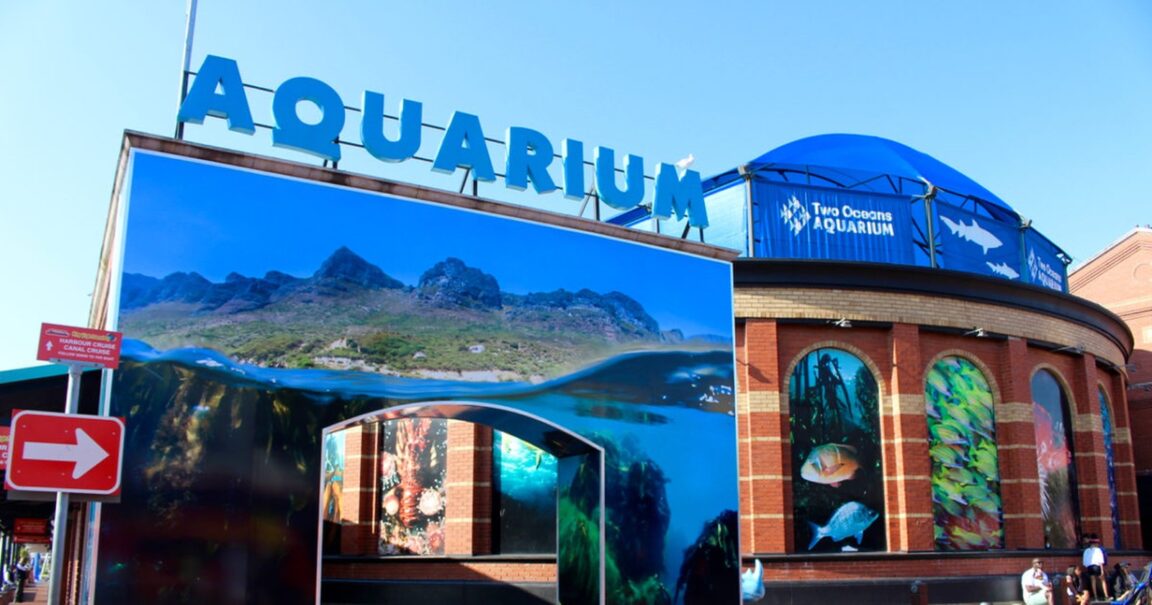
Photo: The entrance of the Two Oceans Aquarium at the V&A Waterfront, Cape Town, its signage and ocean murals facing Dock Road. Photo: Two Oceans Aquarium, via aquarium.co.za, the aquarium’s official website, used with credit.